Khan Tanzim, Shin Laura, Woelfel Stephanie, Rowe Vincent, Wilson Brittany L, Armstrong David G
The Southwestern Academic Limb Salvage Alliance (SALSA), Department of Surgery, Keck School of Medicine of University of Southern California (USC), Los Angeles, CA, USA.
Department of Orthopaedics, University of Pittsburgh Medical Center (UPMC), Pittsburgh, PA, USA.
Diabet Foot Ankle. 2018 Mar 22;9(1):1452513. doi: 10.1080/2000625X.2018.1452513. eCollection 2018.
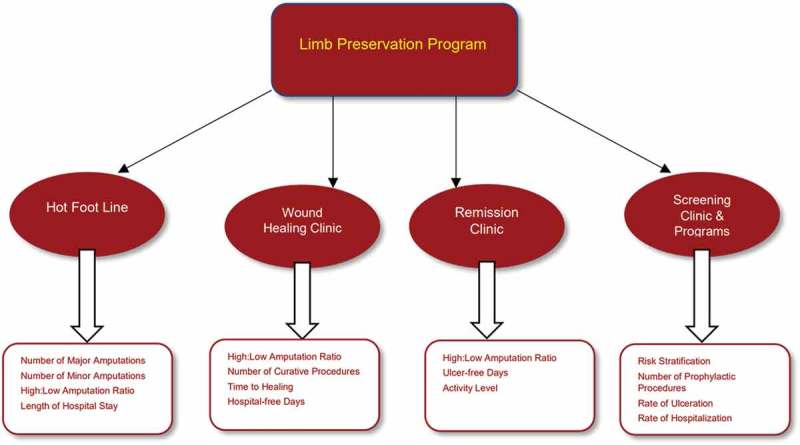
Over the past generation, limb preservation programs and diabetic foot services have begun to proliferate within academic health science centers as well as within health-care systems in general. We describe four key components for a successful program that, developed sequentially with temporal overlap, can allow the program to scale. The first component includes establishment of a 'hot foot line' for urgent emergency department/inpatient referral. The second includes development of a wound-healing clinic to address outpatient care through to remission. The third component focuses on the diabetic foot in remission to maximize ulcer-free days following healing. The fourth and final component focuses on implementation of local and widespread screening clinics to identify and triage patients into appropriate therapeutic and surveillance programs for healing, remission, and primary prevention. Along with developing each of these components, we describe discrete methods to quantify success.
在过去的一代人时间里,肢体保全项目和糖尿病足服务已开始在学术健康科学中心以及整个医疗保健系统中广泛开展。我们描述了一个成功项目的四个关键组成部分,这些部分依次发展且有时间上的重叠,能够使项目得以扩展。第一个组成部分包括设立一条“热足热线”,用于急诊科/住院部的紧急转诊。第二个组成部分是建立一个伤口愈合诊所,以处理门诊治疗直至病情缓解。第三个组成部分关注病情缓解期的糖尿病足,以在愈合后最大限度地增加无溃疡天数。第四个也是最后一个组成部分侧重于实施本地和广泛的筛查诊所,以识别患者并将其分诊到适当的治疗和监测项目中,以实现愈合、缓解和一级预防。在开发这些组成部分的同时,我们还描述了量化成功的具体方法。