Ward Rebecca, Sundaramurthi Husvinee, Di Giacomo Valeria, Kennedy Breandán N
UCD School of Biomolecular & Biomedical Science, UCD Conway Institute, University College Dublin, Dublin, Ireland.
UCD School of Medicine, University College Dublin, Dublin, Ireland.
Front Cell Dev Biol. 2018 Apr 11;6:37. doi: 10.3389/fcell.2018.00037. eCollection 2018.
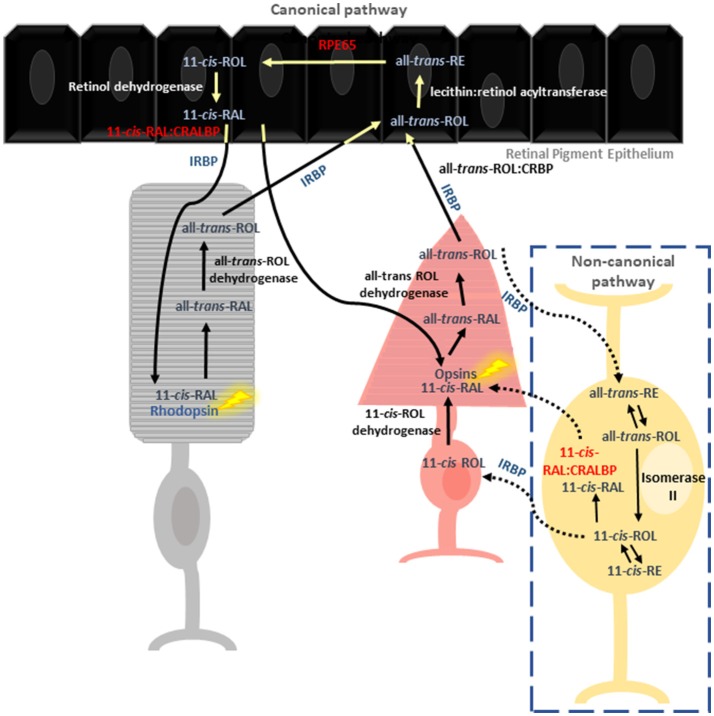
During the vertebrate visual cycle, all--retinal is exported from photoreceptors to the adjacent RPE or Müller glia wherein 11--retinal is regenerated. The 11- chromophore is returned to photoreceptors, forming light-sensitive visual pigments with opsin GPCRs. Dysfunction of this process perturbs phototransduction because functional visual pigment cannot be generated. Mutations in visual cycle genes can result in monogenic inherited forms of blindness. Though key enzymatic processes are well characterized, questions remain as to the physiological role of visual cycle proteins in different retinal cell types, functional domains of these proteins in retinoid biochemistry and pathogenesis of disease mutations. Significant progress is needed to develop effective and accessible treatments for inherited blindness arising from mutations in visual cycle genes. Here, we review opportunities to apply gene editing technology to two crucial visual cycle components, RPE65 and CRALBP. Expressed exclusively in the human RPE, RPE65 enzymatically converts retinyl esters into 11- retinal. CRALBP is an 11--retinal binding protein expressed in human RPE and Muller glia. Loss-of-function mutations in either protein results in autosomal recessive forms of blindness. Modeling these human conditions using RPE65 or CRALBP murine knockout models have enhanced our understanding of their biochemical function, associated disease pathogenesis and development of therapeutics. However, rod-dominated murine retinae provide a challenge to assess cone function. The cone-rich zebrafish model is amenable to cost-effective maintenance of a variety of strains. Interestingly, gene duplication in zebrafish resulted in three Rpe65 and two Cralbp isoforms with differential temporal and spatial expression patterns. Functional investigations of zebrafish Rpe65 and Cralbp were restricted to gene knockdown with morpholino oligonucleotides. However, transient silencing, off-target effects and discrepancies between knockdown and knockout models, highlight a need for more comprehensive alternatives for functional genomics. CRISPR/Cas9 in zebrafish has emerged as a formidable technology enabling targeted gene knockout, knock-in, activation, or silencing to single base-pair resolution. Effective, targeted gene editing by CRISPR/Cas9 in zebrafish enables unprecedented opportunities to create genetic research models. This review will discuss existing knowledge gaps regarding RPE65 and CRALBP. We explore the benefits of CRISPR/Cas9 to establish innovative zebrafish models to enhance knowledge of the visual cycle.
在脊椎动物视觉循环中,全反式视黄醛从光感受器输出到相邻的视网膜色素上皮(RPE)或穆勒胶质细胞,在那里11-顺式视黄醛得以再生。11-发色团再回到光感受器,与视蛋白G蛋白偶联受体(GPCR)形成光敏感视觉色素。这一过程的功能障碍会扰乱光转导,因为无法生成功能性视觉色素。视觉循环基因的突变可导致单基因遗传性失明。尽管关键的酶促过程已得到充分表征,但关于视觉循环蛋白在不同视网膜细胞类型中的生理作用、这些蛋白在类视黄醇生物化学中的功能结构域以及疾病突变的发病机制等问题仍然存在。要开发针对因视觉循环基因突变导致的遗传性失明的有效且可及的治疗方法,还需要取得重大进展。在此,我们综述了将基因编辑技术应用于两个关键视觉循环成分——RPE65和CRALBP的机会。RPE65仅在人类RPE中表达,它能将视黄酯酶促转化为11-顺式视黄醛。CRALBP是一种在人类RPE和穆勒胶质细胞中表达的11-顺式视黄醛结合蛋白。这两种蛋白中任何一种的功能丧失突变都会导致常染色体隐性失明。利用RPE65或CRALBP小鼠基因敲除模型模拟这些人类病症,增强了我们对其生化功能、相关疾病发病机制及治疗方法开发方面的理解。然而,以视杆细胞为主的小鼠视网膜对评估视锥细胞功能提出了挑战。富含视锥细胞的斑马鱼模型适合以经济有效的方式维持多种品系。有趣的是,斑马鱼中的基因复制产生了三种Rpe65和两种Cralbp异构体,它们具有不同的时空表达模式。对斑马鱼Rpe65和Cralbp的功能研究仅限于用吗啉代寡核苷酸进行基因敲低。然而,瞬时沉默、脱靶效应以及敲低模型和敲除模型之间的差异,凸显了对功能基因组学更全面替代方法的需求。斑马鱼中的CRISPR/Cas9已成为一项强大的技术,能够实现靶向基因敲除、敲入、激活或沉默,精确到单碱基对分辨率。通过CRISPR/Cas9在斑马鱼中进行有效的靶向基因编辑,为创建遗传研究模型带来了前所未有的机会。本综述将讨论关于RPE65和CRALBP的现有知识空白。我们探讨CRISPR/Cas9在建立创新斑马鱼模型以增进对视觉循环了解方面的益处。