Perrin Amélie, Tavassoli Neda, Mathieu Céline, Hermabessière Sophie, Houles Mathieu, McCambridge Cécile, Magre Elodie, Fernandez Sophie, Caquelard Anne, Charpentier Sandrine, Lauque Dominique, Azema Olivier, Bismuth Serge, Chicoulaa Bruno, Oustric Stéphane, Costa Nadège, Molinier Laurent, Vellas Bruno, Bérard Emilie, Rolland Yves
Gérontopôle, Centre Hospitalier Universitaire de Toulouse, Toulouse, France.
Équipe Régionale Vieillissement et Prévention de La Dépendance (ERVPD), Toulouse, France.
Contemp Clin Trials Commun. 2017 Jul 21;7:217-223. doi: 10.1016/j.conctc.2017.07.005. eCollection 2017 Sep.
Each year, around one out of two nursing home (NH) residents are hospitalized in France, and about half to the emergency department (ED). These transfers are frequently inappropriate. This paper describes the protocol of the FINE study. The first aim of this study is to identify the factors associated with inappropriate transfers to ED.
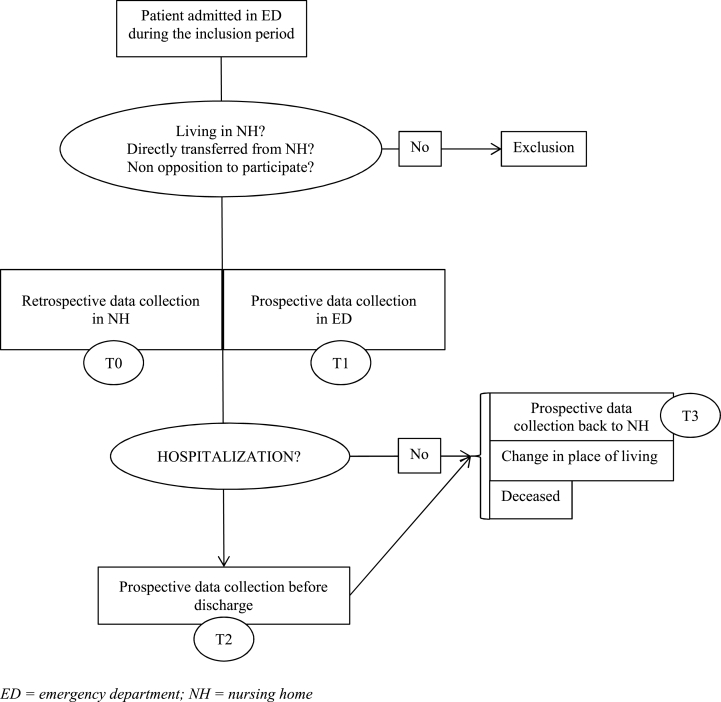
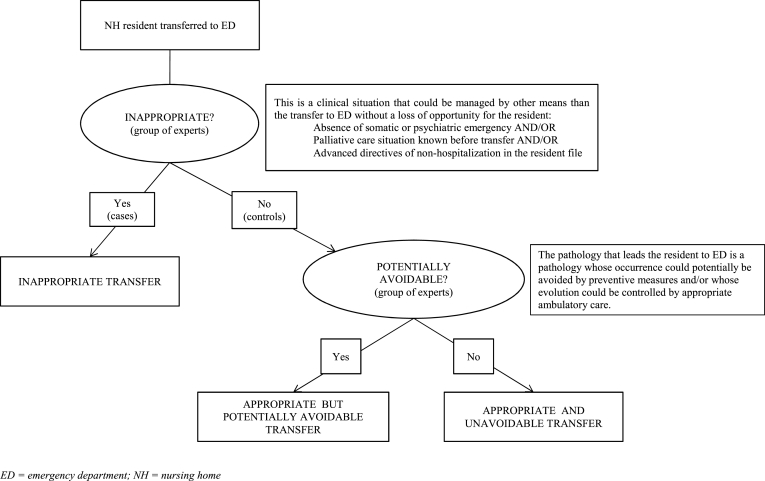
METHODS/DESIGN: FINE is a case-control observational study. Sixteen hospitals participate. Inclusion period lasts 7 days per season in each center for a total period of inclusion of one year. All the NH residents admitted in ED during these periods are included. Data are collected in 4 times: before transfer in the NH, at the ED, in hospital wards in case of patient's hospitalization and at the patient's return to NH. The appropriateness of ED transfers (i.e. case versus control NH residents) is determined by a multidisciplinary team of experts.
Our primary objective is to determine the factors predisposing NH residents to inappropriate transfer to ED. Our secondary objectives are to assess the cost of the transfers to ED; study the evolution of NH residents' functional status and the psychotropic and inappropriate drugs prescription between before and after the transfer; calculate the prevalence of potentially avoidable transfers to ED; and identify the factors predisposing NH residents to potentially avoidable transfer to ED.
A better understanding of the determinant factors of inappropriate transfers to ED of NH residents may lead to proposals of recommendations of better practice in NH and would allow implementing quality improvement programs in the health organization.
在法国,每年约有二分之一的养老院居民会住院,其中约一半会前往急诊科。这些转诊往往并不恰当。本文介绍了FINE研究的方案。本研究的首要目的是确定与不恰当转诊至急诊科相关的因素。
方法/设计:FINE是一项病例对照观察性研究。16家医院参与其中。每个中心每个季节的纳入期为7天,总纳入期为一年。纳入在此期间入住急诊科的所有养老院居民。数据分4次收集:在养老院转诊前、在急诊科、若患者住院则在医院病房以及患者返回养老院时。急诊科转诊的适宜性(即病例组与对照组养老院居民)由一个多学科专家团队确定。
我们的主要目标是确定使养老院居民易发生不恰当转诊至急诊科的因素。我们的次要目标是评估转诊至急诊科的费用;研究养老院居民功能状态的变化以及转诊前后精神药物和不恰当药物的处方情况;计算潜在可避免转诊至急诊科的发生率;并确定使养老院居民易发生潜在可避免转诊至急诊科的因素。
更好地了解养老院居民不恰当转诊至急诊科的决定因素,可能会提出关于养老院更好实践的建议,并有助于在卫生组织中实施质量改进计划。