Emergency Department, Antwerp University Hospital, Wilrijkstraat 10, 2650, Edegem, Belgium.
Faculty of Medicine and Health Sciences, University of Antwerp, Universiteitsplein 1, 2610, Wilrijk, Belgium.
BMC Geriatr. 2019 Jan 21;19(1):17. doi: 10.1186/s12877-019-1028-z.
Elderly living in a Nursing Home (NH) are frequently transferred to an Emergency Department when they need acute medical care. A proportion of these transfers may be considered inappropriate and may be avoidable.
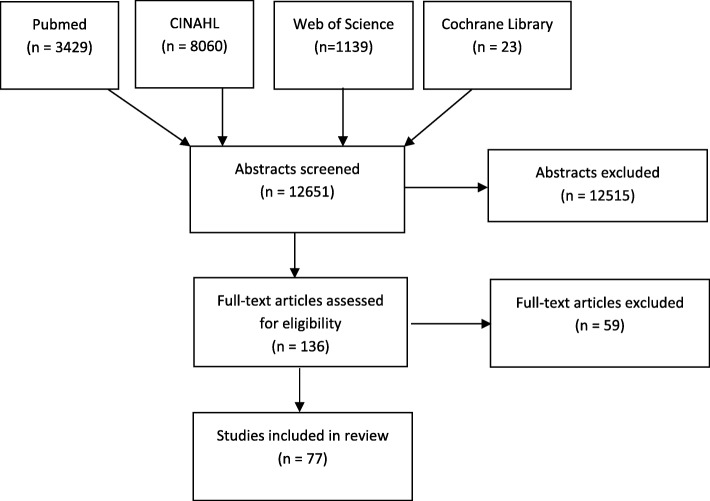
Systematic review. Literature search performed in September 2018 using PubMed, Web of Science, the Cochrane Library and the Cumulative Index to Nursing and Allied Health Literature database. Titles and abstracts were screened against inclusion and exclusion criteria. Full-texts of the selected abstracts were read and checked for relevance. All years and all languages were included provided there was an English, French, Dutch or German abstract.
Seventy-seven articles were included in the systematic review: 1 randomised control trial (RCT), 6 narrative reviews, 9 systematic reviews, 7 experimental studies, 10 qualitative studies and 44 observational studies. Of all acute transfers of NH residents to an ED, 4 to 55% were classified as inappropriate. The most common reasons for transfer were trauma after falling, altered mental status and infection. Transfers were associated with a high risk of complications and mortality, especially during out-of-hours. Advance directives (ADs) were usually not available and relatives often urge NH staff to transfer patients to an ED. The lack of availability of GPs was a barrier to organise acute care in the NH in order to prevent admission to the hospital.
The definition of appropriateness is not uniform across studies and needs further investigation. To avoid inappropriate transfer to EDs, we recommend to respect the patient's autonomy, to provide sufficient nursing staff and to invest in their education, to increase the role of GPs in the care of NH residents both in standard and in acute situations, and to promote interprofessional communication and collaboration between GPs, NH staff and EDs.
老年人在养老院(NH)居住时,若需要急性医疗护理,经常会被转往急诊科。这些转院中,有一部分可能被认为是不恰当的,而且是可以避免的。
系统评价。2018 年 9 月,使用 PubMed、Web of Science、Cochrane 图书馆和 Cumulative Index to Nursing and Allied Health Literature 数据库进行了系统检索。根据纳入和排除标准筛选标题和摘要。阅读并检查所选摘要的全文以确定相关性。只要有英文、法文、荷兰文或德文摘要,就包括所有年份和所有语言。
系统评价共纳入 77 篇文章:1 项随机对照试验(RCT)、6 篇叙述性综述、9 篇系统综述、7 项实验研究、10 项定性研究和 44 项观察性研究。在所有 NH 居民转往 ED 的急性转院中,有 4%至 55%被归类为不恰当。最常见的转院原因是跌倒后创伤、精神状态改变和感染。转院与并发症和死亡率高相关,尤其是在非工作时间。预先指示(AD)通常不可用,家属通常敦促 NH 工作人员将患者转往 ED。GP 缺乏可用性是在 NH 组织急性护理以防止住院的障碍。
各研究中对适当性的定义并不统一,需要进一步研究。为避免不恰当地转往 ED,我们建议尊重患者的自主权,提供充足的护理人员,并对其进行教育,增加 GP 在 NH 居民护理中的作用,包括在标准和急性情况下,以及促进 GP、NH 工作人员和 ED 之间的跨专业沟通与协作。