Hossain Tanzib, Ghazipura Marya, Reddy Vineet, Rivera Pedro J, Mukherjee Vikramjit
Division of Pulmonary, Critical Care, and Sleep Medicine, New York University School of Medicine, 462 First Avenue, NBV 7N24, New York, NY, 10016, USA.
Department of Population Health, New York University School of Medicine, New York, NY, USA.
Drug Saf Case Rep. 2018 Apr 25;5(1):19. doi: 10.1007/s40800-018-0084-1.
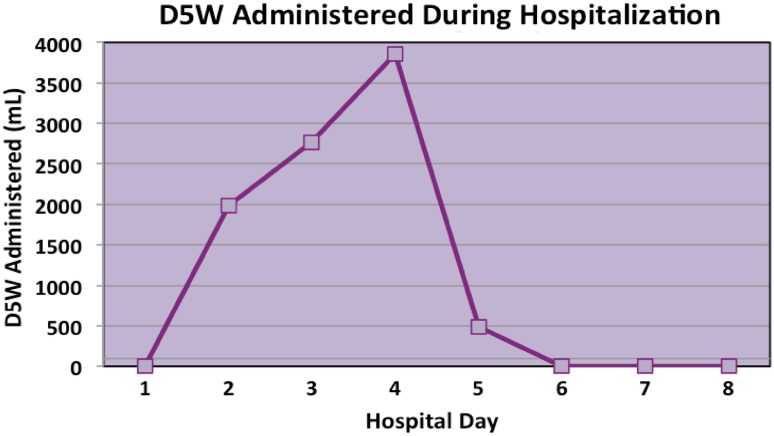
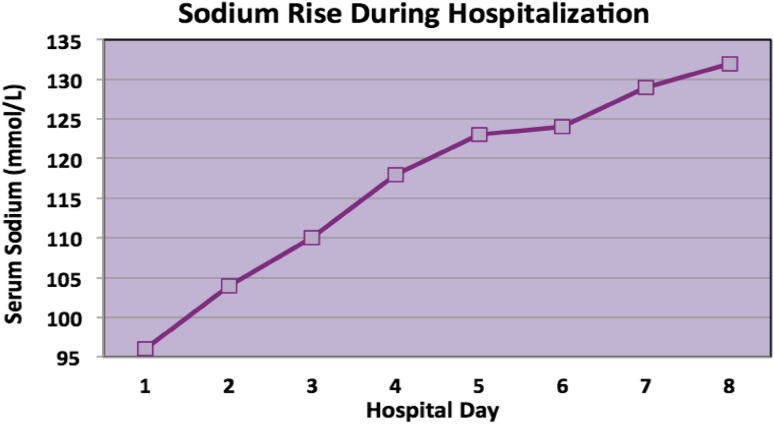
Desmopressin, a synthetic vasopressin analog, is used to treat central diabetes insipidus, hemostatic disorders such as von Willebrand's disease, and nocturnal enuresis. We present the case of a 69-year-old man who developed severe hyponatremia during treatment with intranasal desmopressin at 10 µg twice daily for chronic polyuria and nocturia thought to be due to central diabetes insipidus. After 5 months of therapy, the patient noticed progressive fatigue, anorexia, dizziness, weakness, light-headedness, decreased concentration, and new-onset falls. At 6 months of therapy, the patient was brought to the emergency department for altered mental status and was found to be severely hyponatremic with a serum sodium level of 96 mmol/L, down from a value of 134 mmol/L at the initiation of therapy. The intranasal desmopressin was discontinued and the patient was admitted to the intensive care unit where the hyponatremia was slowly corrected over the next week to 132 mmol/L, never increasing by more than 8 mmol/L a day, with careful fluid management. This included infusion of over 11 L of 5% dextrose to account for a high urine output, which peaked at 7.4 L in 1 day. However, while the recommended rate for sodium correction was followed, the patient's magnetic resonance imaging of the brain obtained after discharge displayed evidence of central pontine myelinolysis. Despite this finding, the patient eventually returned to his baseline mental status with no permanent neurologic deficits.
去氨加压素是一种合成的血管加压素类似物,用于治疗中枢性尿崩症、诸如血管性血友病等止血障碍以及夜间遗尿症。我们报告一例69岁男性病例,该患者因慢性多尿和夜尿被认为是由中枢性尿崩症所致,接受每日两次10微克鼻内去氨加压素治疗期间发生了严重低钠血症。治疗5个月后,患者出现进行性疲劳、厌食、头晕、虚弱、头晕目眩、注意力下降以及新发跌倒。治疗6个月时,患者因精神状态改变被送至急诊科,发现严重低钠血症,血清钠水平为96毫摩尔/升,较治疗开始时的134毫摩尔/升有所下降。停用鼻内去氨加压素,患者被收入重症监护病房,在接下来的一周内通过谨慎的液体管理,低钠血症缓慢纠正至132毫摩尔/升,每天升高不超过8毫摩尔/升。这包括输注超过11升5%葡萄糖以应对高尿量,高尿量在1天内达到峰值7.4升。然而,尽管遵循了推荐的钠纠正速率,但患者出院后进行的脑部磁共振成像显示有脑桥中央髓鞘溶解的证据。尽管有这一发现,但患者最终恢复至基线精神状态,无永久性神经功能缺损。