Aging and Metabolism Research Program, Oklahoma Medical Research Foundation, Oklahoma City, Oklahoma.
Department of Physiology, University of Oklahoma Health Sciences Center, Oklahoma City, Oklahoma.
Aging Cell. 2018 Aug;17(4):e12769. doi: 10.1111/acel.12769. Epub 2018 Apr 25.
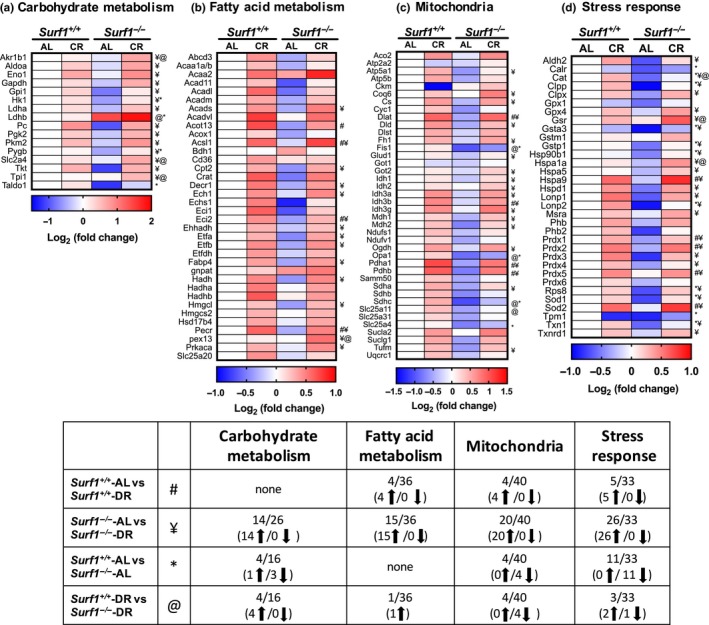
Loss of SURF1, a Complex IV assembly protein, was reported to increase lifespan in mice despite dramatically lower cytochrome oxidase (COX) activity. Consistent with this, our previous studies found advantageous changes in metabolism (reduced adiposity, increased insulin sensitivity, and mitochondrial biogenesis) in Surf1 mice. The lack of deleterious phenotypes in Surf1 mice is contrary to the hypothesis that mitochondrial dysfunction contributes to aging. We found only a modest (nonsignificant) extension of lifespan (7% median, 16% maximum) and no change in healthspan indices in Surf1 vs. Surf1 mice despite substantial decreases in COX activity (22%-87% across tissues). Dietary restriction (DR) increased median lifespan in both Surf1 and Surf1 mice (36% and 19%, respectively). We measured gene expression, metabolites, and targeted expression of key metabolic proteins in adipose tissue, liver, and brain in Surf1 and Surf1 mice. Gene expression was differentially regulated in a tissue-specific manner. Many proteins and metabolites are downregulated in Surf1 adipose tissue and reversed by DR, while in brain, most metabolites that changed were elevated in Surf1 mice. Finally, mitochondrial unfolded protein response (UPR )-associated proteins were not uniformly altered by age or genotype, suggesting the UPR is not a key player in aging or in response to reduced COX activity. While the changes in gene expression and metabolism may represent compensatory responses to mitochondrial stress, the important outcome of this study is that lifespan and healthspan are not compromised in Surf1 mice, suggesting that not all mitochondrial deficiencies are a critical determinant of lifespan.
SURF1 是一种复合体 IV 组装蛋白,其缺失会导致小鼠寿命延长,尽管细胞色素氧化酶(COX)活性显著降低。与这一结果一致,我们之前的研究发现 Surf1 小鼠的代谢发生了有益的变化(脂肪减少、胰岛素敏感性增加和线粒体生物发生增加)。Surf1 小鼠没有表现出有害表型,这与线粒体功能障碍导致衰老的假说相悖。我们发现,尽管 COX 活性显著降低(各组织中降低 22%-87%),但 Surf1 与 Surf1 小鼠的寿命仅适度(无统计学意义)延长(中位数延长 7%,最大延长 16%),健康寿命指数没有变化。饮食限制(DR)增加了 Surf1 和 Surf1 小鼠的中位寿命(分别增加 36%和 19%)。我们测量了 Surf1 和 Surf1 小鼠脂肪组织、肝脏和大脑中的基因表达、代谢物和关键代谢蛋白的靶向表达。基因表达以组织特异性方式差异调节。许多蛋白质和代谢物在 Surf1 脂肪组织中下调,并被 DR 逆转,而在大脑中,大多数变化的代谢物在 Surf1 小鼠中升高。最后,未折叠蛋白反应(UPR)相关蛋白的年龄或基因型变化并不一致,表明 UPR 不是衰老或对 COX 活性降低的关键因素。虽然基因表达和代谢的变化可能代表对线粒体应激的代偿反应,但本研究的重要结果是 Surf1 小鼠的寿命和健康寿命没有受到影响,这表明并非所有的线粒体缺陷都是寿命的关键决定因素。