Alhanafy Alshimaa Mahmoud, Zanaty Fouad, Ibrahem Reda, Omar Suzan
Department of Clinical Oncology and Nuclear Medicine,Faculty of Medicine, Menoufia University, Egypt. Email:
Asian Pac J Cancer Prev. 2018 Apr 27;19(4):1113-1118. doi: 10.22034/APJCP.2018.19.4.1113.
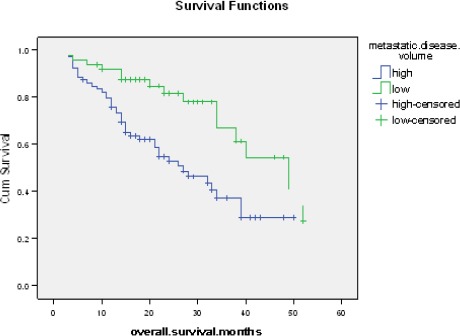
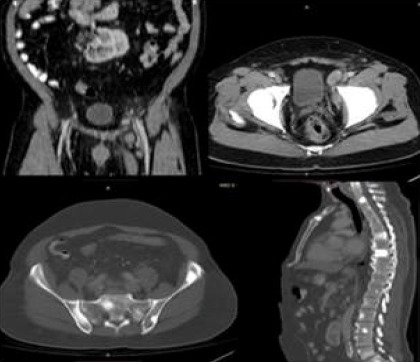
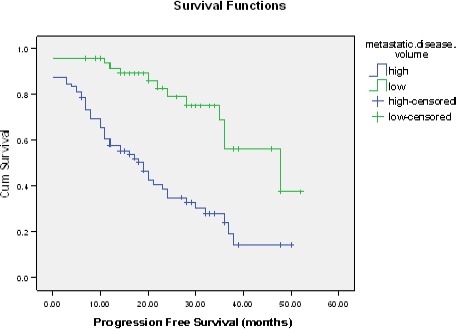
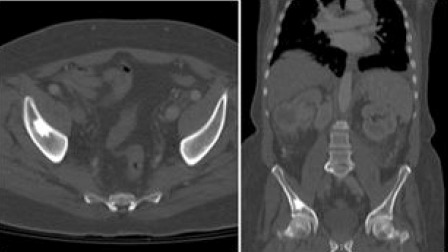
Background and Aim: The optimal management of metastatic hormone-sensitive prostate cancer has been controversial in recent years with introduction of upfront chemohormonal treatment based on results of several Western studies. This changing landscape has renewed interest in the concept “disease volume”, the focus of the present study is the Egyptian patients. Methods: Patients with hormone sensitive metastatic prostate cancer presenting at Menoufia University Hospital, Egypt, during the period from June 2013 to May 2016, were enrolled. All received hormonal treatment. Radiologic images were evaluated and patients were stratified according to their disease volume into high or low, other clinical and pathological data that could affect survival also being collected and analyzed. Results: A total of 128 patients were included, with a median age of 70 years (53.9% ≥70). About 46% had co-morbidities, 62% having high volume disease. During the median follow up period of 28 months about half of the patients progressed and one third received chemotherapy. On univariate analysis, disease volume, performance status (PS), prostate specific antigen level (PSA) and presence of pain at presentation were identified as factors influencing overall survival. Multivariate analysis revealed the independent predictor factors for survival to be PS, PSA and disease volume. The median overall survival with 27 months was high volume versus 49 with low volume disease (hazard ratio 2.1; 95% CI 1.2 - 4.4; P=0.02). Median progression free survival was 19 months in the high volume, as compared with 48 months in the low volume disease patients (hazard ratio, 2.44; 95% CI, 1.42 – 7.4; P=0.009). Conclusions: Disease volume is a reliable predictor of survival which should be incorporated with other important factors as; patient performance status and comorbidities in treatment decision-making.
近年来,基于多项西方研究结果引入了 upfront 化学激素治疗,转移性激素敏感性前列腺癌的最佳管理一直存在争议。这种不断变化的局面重新引发了人们对“疾病体积”这一概念的兴趣,本研究的重点是埃及患者。方法:纳入 2013 年 6 月至 2016 年 5 月期间在埃及梅努菲亚大学医院就诊的激素敏感性转移性前列腺癌患者。所有患者均接受了激素治疗。对放射影像进行评估,并根据疾病体积将患者分为高或低两组,同时收集并分析其他可能影响生存的临床和病理数据。结果:共纳入 128 例患者,中位年龄为 70 岁(53.9%≥70 岁)。约 46%的患者有合并症,62%的患者疾病体积大。在中位随访期 28 个月内,约一半的患者病情进展,三分之一的患者接受了化疗。单因素分析显示,疾病体积、体能状态(PS)、前列腺特异性抗原水平(PSA)和就诊时是否存在疼痛是影响总生存的因素。多因素分析显示,生存的独立预测因素为 PS、PSA 和疾病体积。疾病体积大的患者中位总生存为 27 个月,而疾病体积小的患者为 49 个月(风险比 2.1;95%CI 1.2 - 4.4;P = 0.02)。疾病体积大的患者中位无进展生存期为 19 个月,而疾病体积小的患者为 48 个月(风险比,2.44;95%CI,1.42 – 7.4;P = 0.009)。结论:疾病体积是生存的可靠预测指标,在治疗决策中应将其与其他重要因素如患者体能状态和合并症相结合。