Department of Chemistry and Biomedical Sciences, Linnæus University, Norra vägen 49, Kalmar, SE-391 82, Sweden.
Linnæus University Centre for Biomaterials Chemistry, Linnæus University, Norra vägen 49, Kalmar, SE-391 82, Sweden.
BMC Bioinformatics. 2018 Apr 24;19(1):155. doi: 10.1186/s12859-018-2145-y.
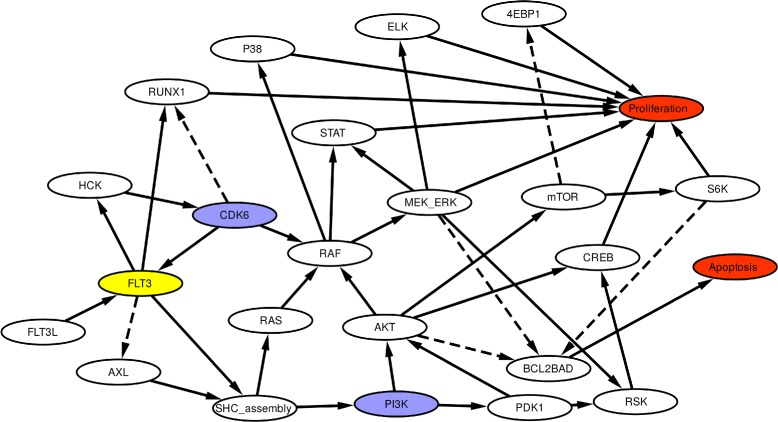
Mutations in the FMS-like tyrosine kinase 3 (FLT3) are associated with uncontrolled cellular functions that contribute to the development of acute myeloid leukaemia (AML). We performed computer simulations of the FLT3-dependent signalling network in order to study the pathways that are involved in AML development and resistance to targeted therapies.
Analysis of the simulations revealed the presence of alternative pathways through phosphoinositide 3 kinase (PI3K) and SH2-containing sequence proteins (SHC), that could overcome inhibition of FLT3. Inhibition of cyclin dependent kinase 6 (CDK6), a related molecular target, was also tested in the simulation but was not found to yield sufficient benefits alone.
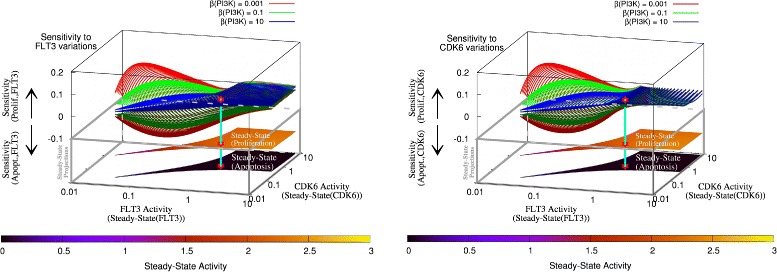
The PI3K pathway provided a basis for resistance to treatments. Alternative signalling pathways could not, however, restore cancer growth signals (proliferation and loss of apoptosis) to the same levels as prior to treatment, which may explain why FLT3 resistance mutations are the most common resistance mechanism. Finally, sensitivity analysis suggested the existence of optimal doses of FLT3 and CDK6 inhibitors in terms of efficacy and toxicity.
FMS 样酪氨酸激酶 3(FLT3)的突变与不受控制的细胞功能有关,这些功能有助于急性髓系白血病(AML)的发展。我们对 FLT3 依赖性信号网络进行了计算机模拟,以研究参与 AML 发展和对靶向治疗耐药的途径。
对模拟结果的分析表明,存在通过磷酸肌醇 3 激酶(PI3K)和 SH2 含有序列蛋白(SHC)的替代途径,可以克服 FLT3 的抑制。在模拟中还测试了对细胞周期蛋白依赖性激酶 6(CDK6)的抑制,这是一种相关的分子靶标,但单独使用并未发现足够的益处。
PI3K 途径为治疗耐药提供了基础。然而,替代信号通路不能将癌症生长信号(增殖和凋亡丧失)恢复到治疗前的相同水平,这可能解释了为什么 FLT3 耐药突变是最常见的耐药机制。最后,敏感性分析表明,在疗效和毒性方面,FLT3 和 CDK6 抑制剂存在最佳剂量。