Tropical Infectious Diseases Research and Education Centre (TIDREC), University of Malaya, 50603, Kuala Lumpur, Malaysia.
Department of Medical Microbiology, Faculty of Medicine, University of Malaya, 50603, Kuala Lumpur, Malaysia.
BMC Evol Biol. 2018 Apr 24;18(1):58. doi: 10.1186/s12862-018-1175-4.
Dengue virus type 3 genotype III (DENV3/III) is associated with increased number of severe infections when it emerged in the Americas and Asia. We had previously demonstrated that the DENV3/III was introduced into Malaysia in the late 2000s. We investigated the genetic diversity of DENV3/III strains recovered from Malaysia and examined their phylogenetic relationships against other DENV3/III strains isolated globally.
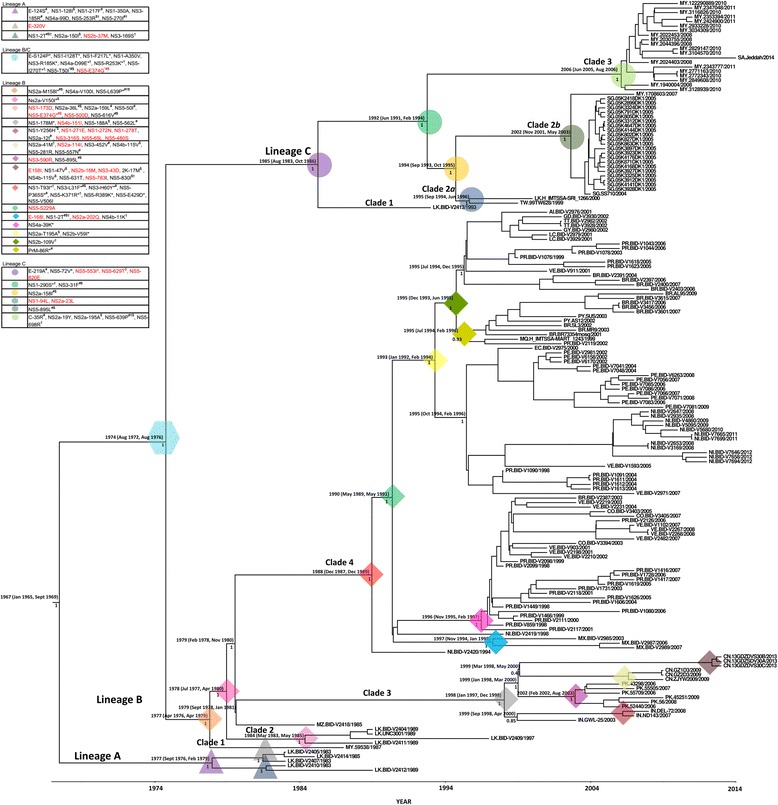
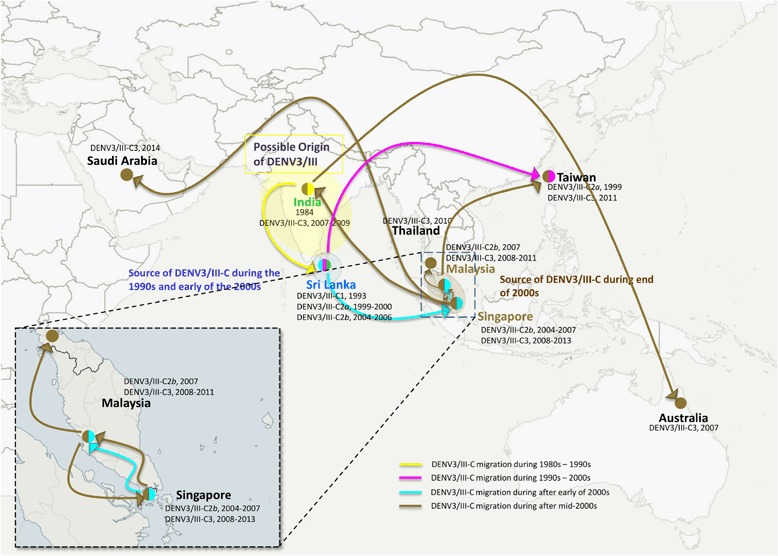
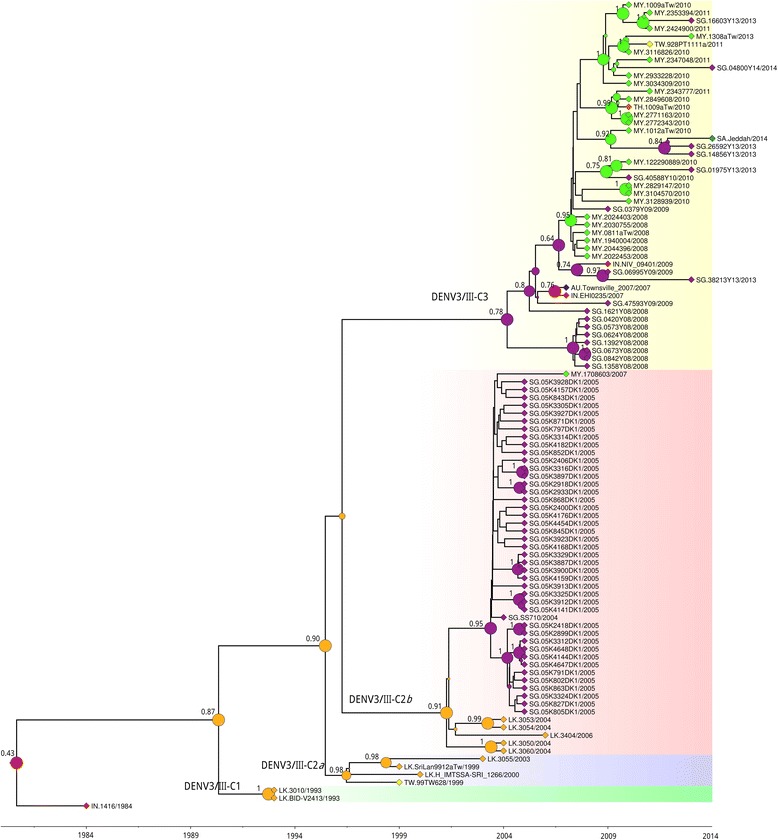
Phylogenetic analysis revealed at least four distinct DENV3/III lineages. Two of the lineages (DENV3/III-B and DENV3/III-C) are current actively circulating whereas the DENV3/III-A and DENV3/III-D were no longer recovered since the 1980s. Selection pressure analysis revealed strong evidence of positive selection on a number of amino acid sites in PrM, E, NS1, NS2a, NS2b, NS3, NS4a, and NS5. The Malaysian DENV3/III isolates recovered in the 1980s (MY.59538/1987) clustered into DENV3/III-B, which was the lineage with cosmopolitan distribution consisting of strains actively circulating in the Americas, Africa, and Asia. The Malaysian isolates recovered after the 2000s clustered within DENV3/III-C. This DENV3/III-C lineage displayed a more restricted geographical distribution and consisted of isolates recovered from Asia, denoted as the Asian lineage. Amino acid variation sites in NS5 (NS5-553I/M, NS5-629 T, and NS5-820E) differentiated the DENV3/III-C from other DENV3 viruses. The codon 629 of NS5 was identified as a positively selected site. While the NS5-698R was identified as unique to the genome of DENV3/III-C3. Phylogeographic results suggested that the recent Malaysian DENV3/III-C was likely to have been introduced from Singapore in 2008 and became endemic. From Malaysia, the virus subsequently spread into Taiwan and Thailand in the early part of the 2010s and later reintroduced into Singapore in 2013.
Distinct clustering of the Malaysian old and new DENV3/III isolates suggests that the currently circulating DENV3/III in Malaysia did not descend directly from the strains recovered during the 1980s. Phylogenetic analyses and common genetic traits in the genome of the strains and those from the neighboring countries suggest that the Malaysian DENV3/III is likely to have been introduced from the neighboring regions. Malaysia, however, serves as one of the sources of the recent regional spread of DENV3/III-C3 within the Asia region.
登革病毒 3 型基因型 III(DENV3/III)在美洲和亚洲出现时,与严重感染数量的增加有关。我们之前已经证明,DENV3/III 于 2000 年代后期引入马来西亚。我们调查了从马来西亚回收的 DENV3/III 菌株的遗传多样性,并对其与全球分离的其他 DENV3/III 菌株的系统发育关系进行了检查。
系统发育分析显示,至少存在四个不同的 DENV3/III 谱系。其中两个谱系(DENV3/III-B 和 DENV3/III-C)目前正在积极传播,而 DENV3/III-A 和 DENV3/III-D 自 20 世纪 80 年代以来已不再回收。选择压力分析显示,PrM、E、NS1、NS2a、NS2b、NS3、NS4a 和 NS5 中的多个氨基酸位点存在强烈的正选择证据。20 世纪 80 年代从马来西亚回收的马来西亚 DENV3/III 分离株(MY.59538/1987)聚集在 DENV3/III-B 中,该谱系分布广泛,由在美洲、非洲和亚洲积极传播的菌株组成。2000 年代后从马来西亚回收的分离株聚集在 DENV3/III-C 中。这个 DENV3/III-C 谱系显示出更有限的地理分布,由从亚洲回收的分离株组成,称为亚洲谱系。NS5 中的氨基酸变异位点(NS5-553I/M、NS5-629T 和 NS5-820E)将 DENV3/III-C 与其他 DENV3 病毒区分开来。NS5 的密码子 629 被确定为一个正选择位点。而 NS5-698R 被确定为 DENV3/III-C 基因组的独特特征。系统发育地理结果表明,最近马来西亚的 DENV3/III-C 很可能是在 2008 年从新加坡引入的,并成为地方性疾病。从马来西亚,病毒随后在 2010 年代初期传播到台湾和泰国,然后在 2013 年再次引入新加坡。
马来西亚新旧 DENV3/III 分离株的明显聚类表明,目前在马来西亚流行的 DENV3/III 并非直接来自 20 世纪 80 年代回收的菌株。系统发育分析和来自邻国的菌株与基因组中的常见遗传特征表明,马来西亚的 DENV3/III 可能是从邻国引入的。然而,马来西亚是 DENV3/III-C3 最近在亚洲地区区域传播的来源之一。