Center for Knowledge Management, Vanderbilt University Medical Center, 3401 West End, Suite 304, Nashville, TN, 37203, USA.
Connectus Health, Nashville, TN, USA.
BMC Public Health. 2018 Apr 24;18(1):550. doi: 10.1186/s12889-018-5453-2.
Addressing social and behavioral determinants of health (SBDs) may help improve health outcomes of community clinic patients. This cross-sectional study explored how assessing SBDs can be used to complement health data collection strategies and provide clinicians with a more in-depth understanding of their patients.
Adult patients, ages 18 and older, at an urban community health care clinic in Tennessee, U.S.A., were asked to complete a questionnaire regarding health status, health history and SBDs while waiting for their clinic appointment. The SBD component included items from the National Academy of Medicine, the Protocol for Responding to and Assessing Patient Assets, Risks, and Experiences instrument, and the Survey of Household Economics and Decisionmaking. Data collection and analysis occurred in 2017.
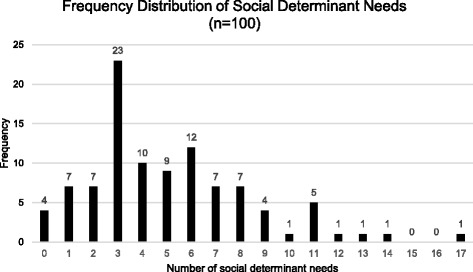
One hundred participants completed the study. The questionnaire took approximately 11 min to complete, and the response rate was 90% or higher for all items except annual household income (unanswered by 40 participants). The median number of negative SBDs was 4 (IQR 2.75-7.0), 96 participants had at least one unmet need, and the most common negative SBD was physical activity (75%; 75/100).
The hybrid questionnaire provided insight into a community clinic population's SBDs and allowed for a more complete understanding than a single questionnaire alone. The brief questionnaire administration time and low non-response rate support the questionnaire's feasibility in the community clinic setting, and results can be used by clinicians to further the personalization goals of precision medicine. Next steps include evaluating how to connect patients with appropriate resources for addressing their SBDs.
解决社会和行为决定因素(SBDs)可能有助于改善社区诊所患者的健康结果。本横断面研究探讨了如何评估 SBDs 可以补充健康数据收集策略,并为临床医生提供更深入了解患者的方法。
在美国田纳西州一家城市社区医疗诊所,等待就诊时,要求 18 岁及以上的成年患者完成一份关于健康状况、健康史和 SBD 的问卷。SBD 部分包括国家医学科学院、回应和评估患者资产、风险和经验工具协议以及家庭经济和决策调查中的项目。数据收集和分析于 2017 年进行。
100 名参与者完成了研究。完成问卷大约需要 11 分钟,除了年家庭收入(40 名参与者未回答)外,所有项目的回复率均为 90%或更高。负面 SBD 的中位数为 4(IQR 2.75-7.0),96 名参与者有至少一项未满足的需求,最常见的负面 SBD 是体力活动(75%;75/100)。
混合问卷深入了解了社区诊所人群的 SBDs,并比单独使用单一问卷提供了更全面的了解。简短的问卷管理时间和低不响应率支持了该问卷在社区诊所环境中的可行性,结果可由临床医生用于进一步实现精准医学的个性化目标。下一步包括评估如何为解决 SBD 患者联系适当的资源。