
耗竭型 NKG2A/CD56/CD16 自然杀伤细胞的早期扩增是单倍体造血干细胞移植治疗的靶点。
The early expansion of anergic NKG2A/CD56/CD16 natural killer represents a therapeutic target in haploidentical hematopoietic stem cell transplantation.
机构信息
Laboratory of Translational Immunology, Humanitas Clinical and Research Center, Rozzano, Milan, Italy.
Unit of Clinical and Experimental Immunology, Humanitas Clinical and Research Center, Rozzano, Milan, Italy.
出版信息
Haematologica. 2018 Aug;103(8):1390-1402. doi: 10.3324/haematol.2017.186619. Epub 2018 Apr 26.
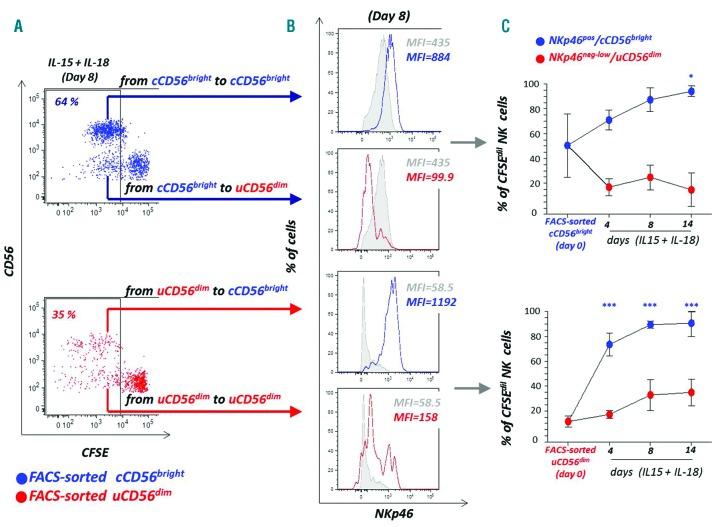
Natural killer cells are the first lymphocyte population to reconstitute early after non-myeloablative and T cell-replete haploidentical hematopoietic stem cell transplantation with post-transplant infusion of cyclophosphamide. The study herein characterizes the transient and predominant expansion starting from the second week following haploidentical hematopoietic stem cell transplantation of a donor-derived unconventional subset of NKp46/CD56/CD16 natural killer cells expressing remarkably high levels of CD94/NKG2A. Both transcription and phenotypic profiles indicated that unconventional NKp46/CD56/CD16 cells are a distinct natural killer cell subpopulation with features of late stage differentiation, yet retaining proliferative capability and functional plasticity to generate conventional NKp46/CD56/CD16 cells in response to interleukin-15 plus interleukin-18. While present at low frequency in healthy donors, unconventional NKp46/CD56/CD16 cells are greatly expanded in the seven weeks following haploidentical hematopoietic stem cell transplantation, and express high levels of the activating receptors NKG2D and NKp30 as well as of the lytic granules Granzyme-B and Perforin. Nonetheless, NKp46/CD56/CD16 cells displayed a markedly defective cytotoxicity that could be reversed by blocking the inhibitory receptor CD94/NKG2A. These data open new and important perspectives to better understand the ontogenesis/homeostasis of human natural killer cells and to develop a novel immune-therapeutic approach that targets the inhibitory NKG2A check-point, thus unleashing natural killer cell alloreactivity early after haploidentical hematopoietic stem cell transplantation.
自然杀伤细胞是在非清髓性和 T 细胞充足的单倍体造血干细胞移植后,输注环磷酰胺后,最早重建的淋巴细胞群体。本研究描述了从单倍体造血干细胞移植后第二周开始,供体衍生的非常规 NKp46/CD56/CD16 自然杀伤细胞亚群的短暂和主要扩增,这些细胞表达显著高水平的 CD94/NKG2A。转录和表型特征均表明,非常规 NKp46/CD56/CD16 细胞是一种独特的自然杀伤细胞亚群,具有晚期分化的特征,但仍保留增殖能力和功能可塑性,可在白细胞介素-15 和白细胞介素-18 的作用下产生常规 NKp46/CD56/CD16 细胞。虽然在健康供体中频率较低,但在单倍体造血干细胞移植后七周内,非常规 NKp46/CD56/CD16 细胞大量扩增,并表达高水平的激活受体 NKG2D 和 NKp30 以及溶细胞颗粒 Granzyme-B 和 Perforin。然而,NKp46/CD56/CD16 细胞表现出明显的细胞毒性缺陷,可通过阻断抑制性受体 CD94/NKG2A 来逆转。这些数据为更好地理解人类自然杀伤细胞的个体发生/稳态提供了新的重要视角,并为开发一种新型的免疫治疗方法提供了依据,该方法靶向抑制性 NKG2A 检查点,从而在单倍体造血干细胞移植后早期释放自然杀伤细胞的同种异体反应性。



 Zotero 插件