Department of Animal and Avian Sciences, University of Maryland, 2123 Animal Science Building, College Park, MD, 20742, USA.
Institute of Animal Science, Agricultural Research Organization (ARO), The Volcani Center, 15159, Rishon LeTsiyon, Israel.
BMC Genomics. 2018 Apr 27;19(1):304. doi: 10.1186/s12864-018-4705-y.
Crossover generated by meiotic recombination is a fundamental event that facilitates meiosis and sexual reproduction. Comparative studies have shown wide variation in recombination rate among species, but the characterization of recombination features between cattle breeds has not yet been performed. Cattle populations in North America count millions, and the dairy industry has genotyped millions of individuals with pedigree information that provide a unique opportunity to study breed-level variations in recombination.
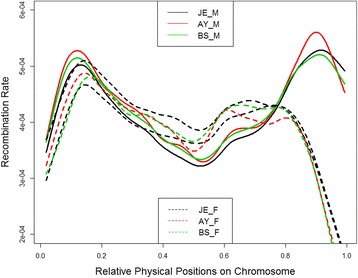
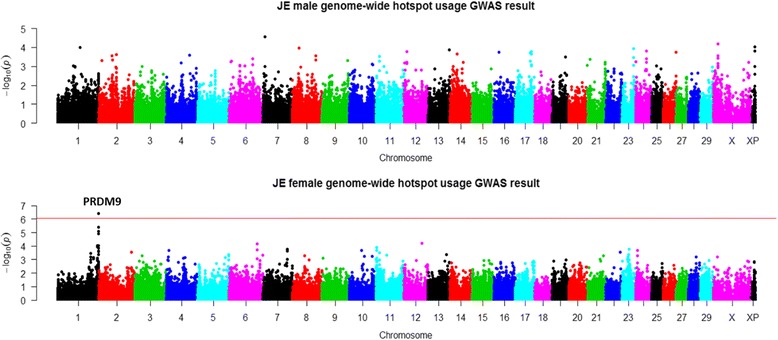
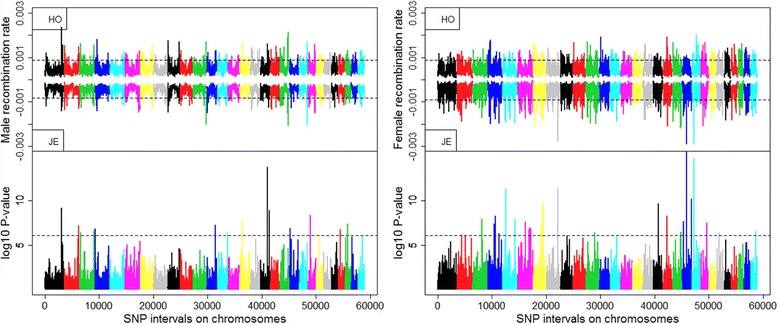
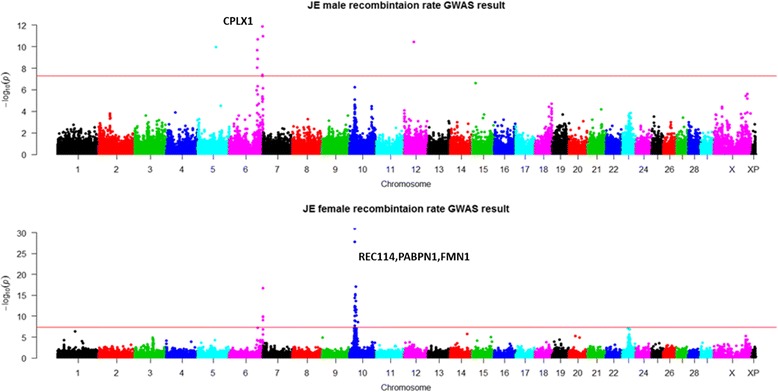
Based on large pedigrees of Jersey, Ayrshire and Brown Swiss cattle with genotype data, we identified over 3.4 million maternal and paternal crossover events from 161,309 three-generation families. We constructed six breed- and sex-specific genome-wide recombination maps using 58,982 autosomal SNPs for two sexes in the three dairy cattle breeds. A comparative analysis of the six recombination maps revealed similar global recombination patterns between cattle breeds but with significant differences between sexes. We confirmed that male recombination map is 10% longer than the female map in all three cattle breeds, consistent with previously reported results in Holstein cattle. When comparing recombination hotspot regions between cattle breeds, we found that 30% and 10% of the hotspots were shared between breeds in males and females, respectively, with each breed exhibiting some breed-specific hotspots. Finally, our multiple-breed GWAS found that SNPs in eight loci affected recombination rate and that the PRDM9 gene associated with hotspot usage in multiple cattle breeds, indicating a shared genetic basis for recombination across dairy cattle breeds.
Collectively, our results generated breed- and sex-specific recombination maps for multiple cattle breeds, provided a comprehensive characterization and comparison of recombination patterns between breeds, and expanded our understanding of the breed-level variations in recombination features within an important livestock species.
减数分裂重组产生的交叉是促进减数分裂和有性繁殖的基本事件。比较研究表明,不同物种之间的重组率存在广泛差异,但尚未对牛种之间的重组特征进行描述。北美的牛群数以百万计,乳业已经对具有系谱信息的数百万人进行了基因分型,这为研究牛种间重组特征的差异提供了独特的机会。
基于具有基因型数据的泽西、爱尔夏和瑞士褐牛的大型系谱,我们从 161309 个三代家系中鉴定出了超过 340 万个母本和父本交叉事件。我们使用三个奶牛品种的 58982 个常染色体 SNP 构建了六个种间和性别特异性的全基因组重组图谱。对六个重组图谱的比较分析表明,不同牛种之间存在相似的全球重组模式,但在性别之间存在显著差异。我们证实,在所有三个奶牛品种中,雄性重组图谱比雌性图谱长 10%,这与之前在荷斯坦奶牛中的报道结果一致。当比较牛种间的重组热点区域时,我们发现 30%和 10%的雄性和雌性热点区域分别在品种间共享,每个品种都有一些品种特异性的热点区域。最后,我们的多品种全基因组关联分析发现,8 个位点的 SNP 影响了重组率,PRDM9 基因与多个牛种的热点使用相关,这表明多个奶牛品种之间的重组具有共同的遗传基础。
总的来说,我们的研究结果为多个牛种生成了种间和性别特异性的重组图谱,全面描述和比较了品种间的重组模式,并扩展了我们对重要家畜物种内重组特征的品种间差异的理解。