Department of Microbiology, Boston University School of Medicine, Boston, MA 02118, USA.
Center for Genome Sciences, United States Army Research Institute of Infectious Diseases (USAMRIID), Frederick, MD 21702, USA.
Cell. 2018 May 17;173(5):1098-1110.e18. doi: 10.1016/j.cell.2018.03.070. Epub 2018 Apr 26.
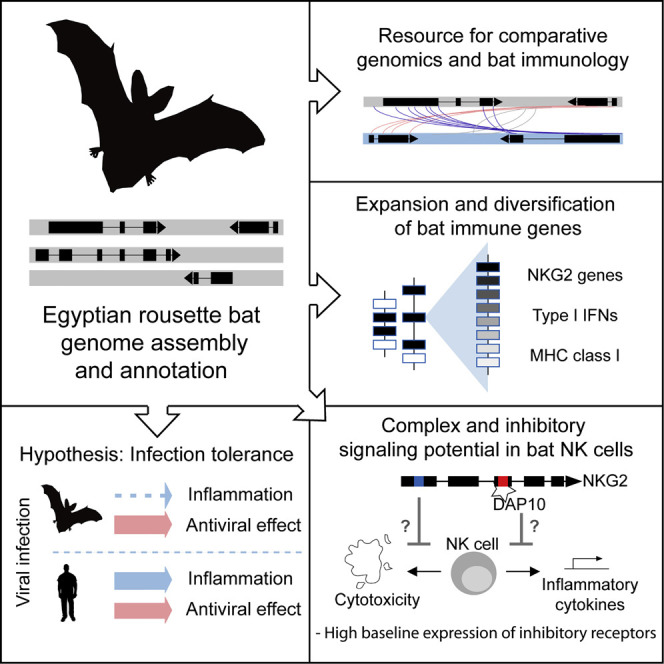
Bats harbor many viruses asymptomatically, including several notorious for causing extreme virulence in humans. To identify differences between antiviral mechanisms in humans and bats, we sequenced, assembled, and analyzed the genome of Rousettus aegyptiacus, a natural reservoir of Marburg virus and the only known reservoir for any filovirus. We found an expanded and diversified KLRC/KLRD family of natural killer cell receptors, MHC class I genes, and type I interferons, which dramatically differ from their functional counterparts in other mammals. Such concerted evolution of key components of bat immunity is strongly suggestive of novel modes of antiviral defense. An evaluation of the theoretical function of these genes suggests that an inhibitory immune state may exist in bats. Based on our findings, we hypothesize that tolerance of viral infection, rather than enhanced potency of antiviral defenses, may be a key mechanism by which bats asymptomatically host viruses that are pathogenic in humans.
蝙蝠无症状携带许多病毒,包括一些以在人类中引起极高致病性而闻名的病毒。为了鉴定人类和蝙蝠之间抗病毒机制的差异,我们对 Rousettus aegyptiacus 进行了测序、组装和分析,它是马尔堡病毒的天然宿主,也是唯一已知的任何丝状病毒的宿主。我们发现了一个扩展和多样化的自然杀伤细胞受体、MHC Ⅰ类基因和 I 型干扰素的 KLRC/KLRD 家族,这与其他哺乳动物中的功能对应物有很大的不同。蝙蝠免疫的这些关键成分的协同进化强烈提示存在新的抗病毒防御模式。对这些基因的理论功能的评估表明,在蝙蝠中可能存在抑制性免疫状态。基于我们的发现,我们假设,容忍病毒感染而不是增强抗病毒防御能力可能是蝙蝠无症状携带对人类具有致病性的病毒的关键机制。