Nie Danian, Huang Kezhi, Yin Songmei, Li Yiqing, Xie Shuangfeng, Ma Liping, Wang Xiuju, Wu Yudan, Xiao Jie, Wang Jieyu, Yang Wenjuan, Liu Hongyun
1Guangdong Provincial Key Laboratory of Malignant Tumor Epigenetics and Gene Regulation and Department of Hematology, Sun Yat-Sen Memorial Hospital, Sun Yat-Sen University, 510120 Guangzhou, China.
2Department of Hematology, Hemostasis, Oncology, and Stem Cell Transplantation, Hannover Medical School, Carl-Neuberg-Straße 1, 30625 Hannover, Germany.
Cell Death Discov. 2018 Apr 23;4:48. doi: 10.1038/s41420-018-0049-2. eCollection 2018.
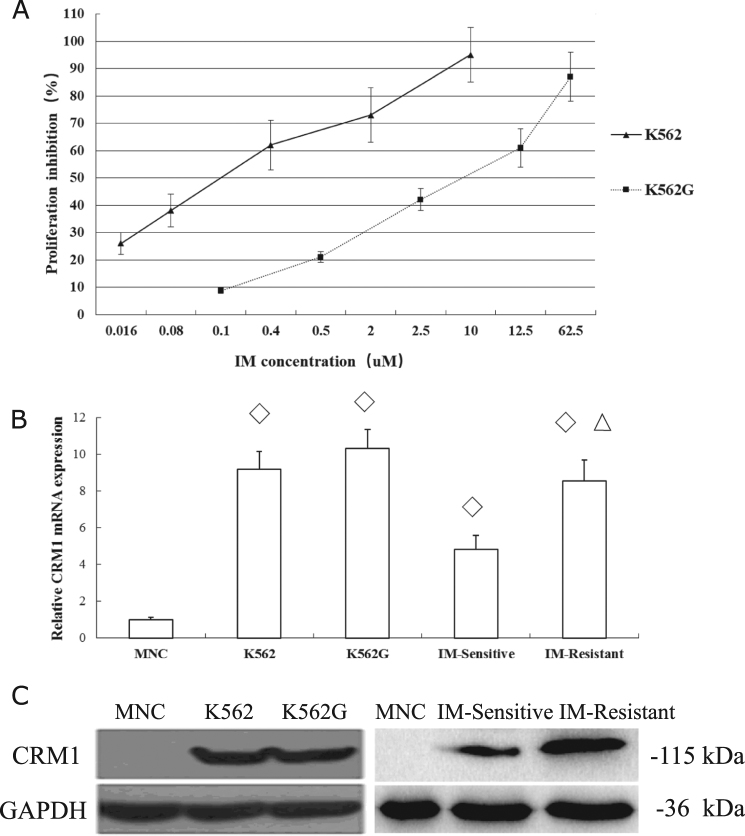
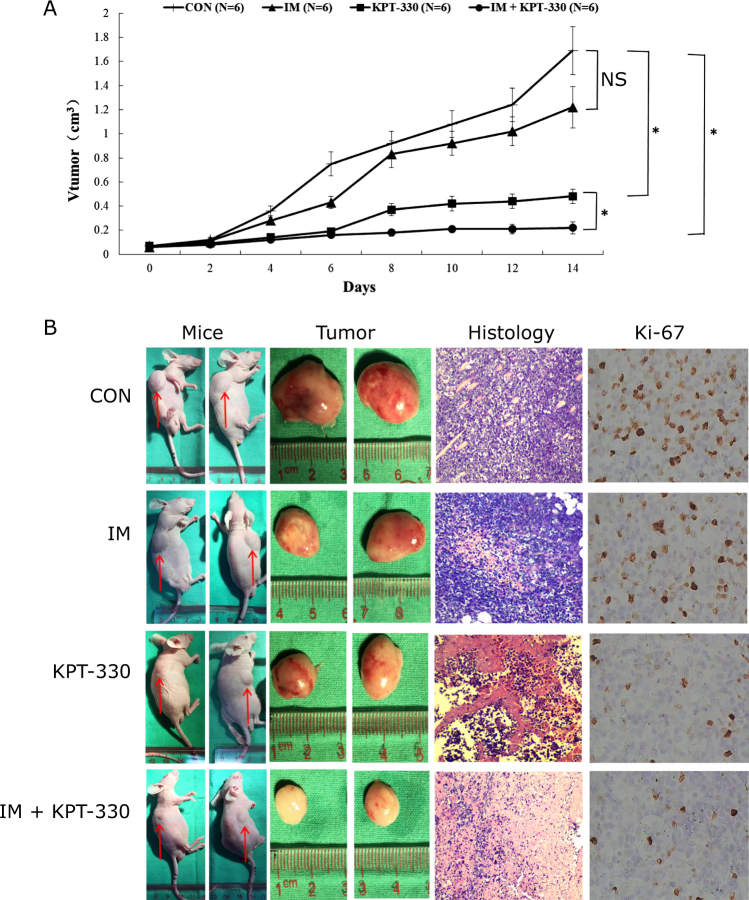
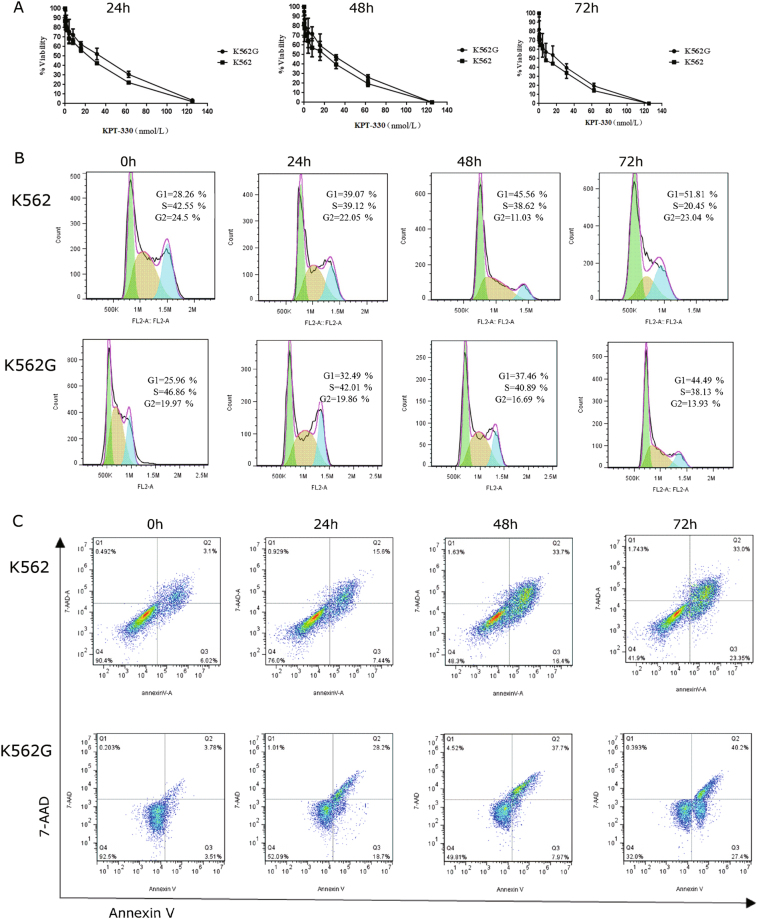
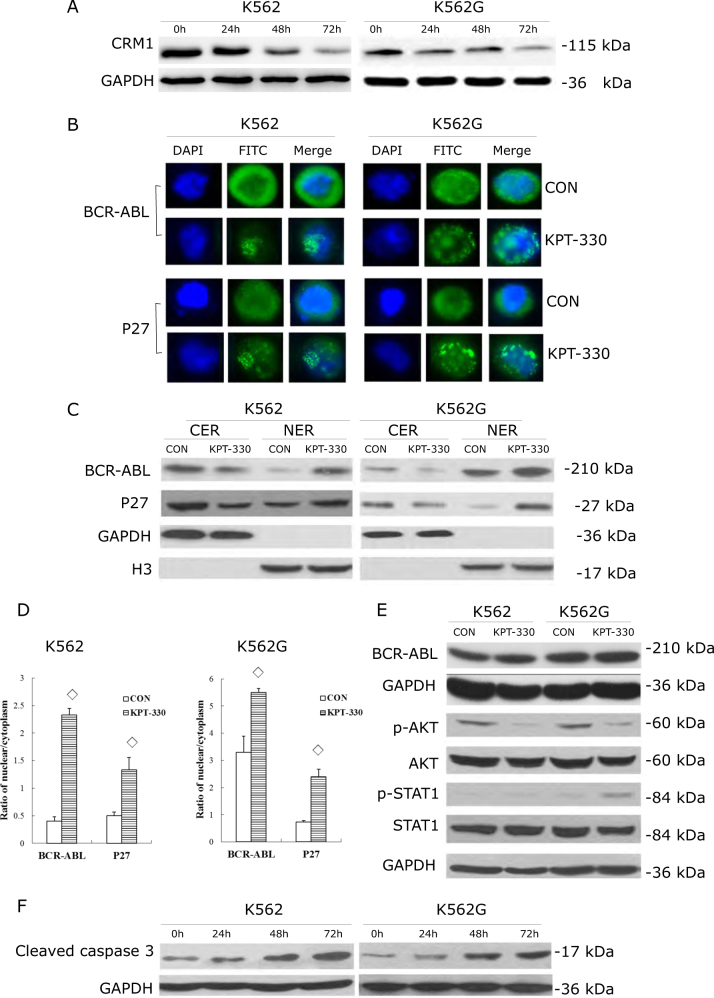
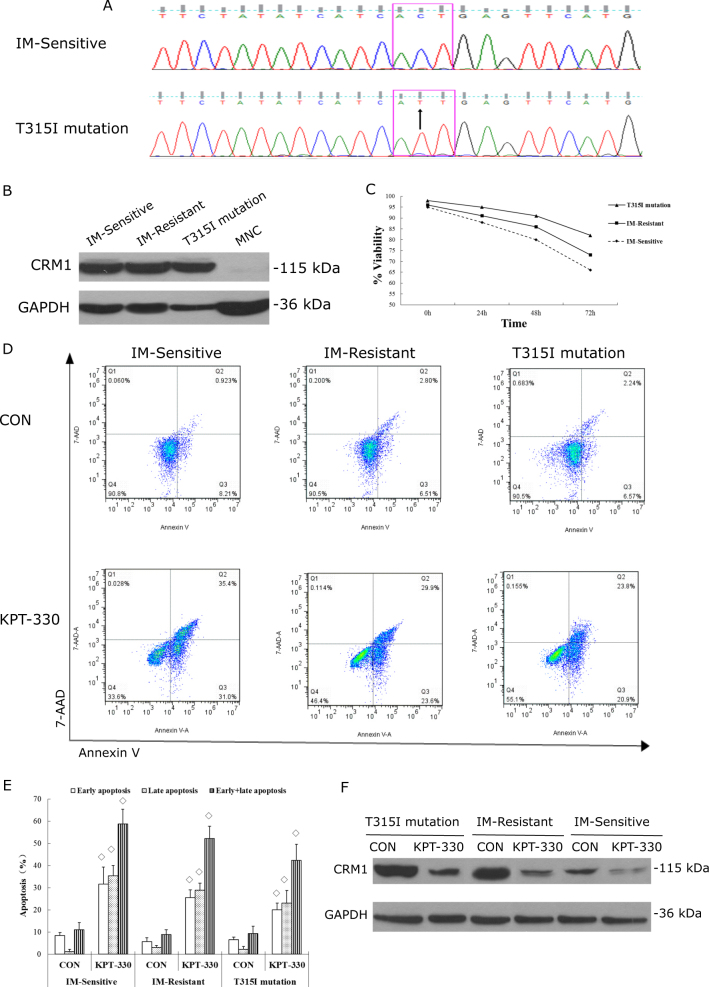
As tyrosine kinase inhibitors (e.g., Imatinib, IM) fail to induce long-term response in some chronic myeloid leukemia (CML), novel therapies targeting leukemia-dysregulated pathways are necessary. Nuclear-cytoplasmic trafficking of proteins play a key role in the development of leukemia and drug resistance. KPT-330 (Selinexor), an inhibitor of chromosome region maintenance 1 (CRM1, nuclear receptor exportin 1, XPO1), demonstrated activities against a few hematological malignancies. We examined the anti-leukemic efficacy of KPT-330 in IM-resistant CML. Cell viability was examined by MTS assay. Apoptosis and cell cycle were assessed by flow cytometry. CRM1 mRNA was detected by PCR. Expression of CRM1 protein and its cargo proteins were determined by western blot or immunofluorescent staining. Furthermore, we engrafted nude mice subcutaneously with IM-resistant CML K562G. Mice were treated with IM, KPT-330 alone or in combination. Expression of CRM1 in CML were markedly higher than control. KPT-330 inhibited proliferation, induced cell cycle arrest and apoptosis of K562 and K562G. IC50 of IM on K562G was reduced by KPT-330. Mechanistically, KPT-330 inhibited CRM1 and increased the nuclear/cytoplasm ratio of BCR-ABL and P27. p-AKT was downregulated while p-STAT1 and caspase-3 were upregulated. Furthermore, KPT-330 showed anti-leukemic effect in primary IM-resistant CML with T315I mutation in CRM1-dependent manner. In K562G xenograft mice model, KPT-330 inhibited tumor growth and sensitized K562G to IM in vivo. To conclude, KPT-330 showed anti-leukemic activity and sensitized CML to IM in CRM1-dependent manner in vitro and in vivo. KPT-330 represents an alternative therapy for IM-refractory CML, warranting further investigation of CRM1 as therapeutic target.
由于酪氨酸激酶抑制剂(如伊马替尼,IM)在某些慢性髓性白血病(CML)中无法诱导长期缓解,因此需要针对白血病失调通路的新型疗法。蛋白质的核质运输在白血病的发展和耐药性中起关键作用。KPT-330(塞利尼索)是染色体区域维持蛋白1(CRM1,核受体输出蛋白1,XPO1)的抑制剂,对一些血液系统恶性肿瘤具有活性。我们研究了KPT-330对IM耐药CML的抗白血病疗效。通过MTS法检测细胞活力。通过流式细胞术评估细胞凋亡和细胞周期。通过PCR检测CRM1 mRNA。通过蛋白质印迹或免疫荧光染色测定CRM1蛋白及其货物蛋白的表达。此外,我们将IM耐药的CML K562G皮下接种到裸鼠体内。小鼠分别接受IM、KPT-330单独治疗或联合治疗。CML中CRM1的表达明显高于对照组。KPT-330抑制K562和K562G细胞的增殖,诱导细胞周期停滞和凋亡。KPT-330降低了IM对K562G的IC50。机制上,KPT-330抑制CRM1并增加BCR-ABL和P27的核/质比。p-AKT下调,而p-STAT1和caspase-3上调。此外,KPT-330以CRM1依赖的方式对具有T315I突变的原发性IM耐药CML显示出抗白血病作用。在K562G异种移植小鼠模型中,KPT-330在体内抑制肿瘤生长并使K562G对IM敏感。总之,KPT-330在体外和体内均以CRM1依赖的方式显示出抗白血病活性并使CML对IM敏感。KPT-330代表了IM难治性CML的替代疗法,有必要进一步研究将CRM1作为治疗靶点。