Centre de Recherche en Organogenèse Expérimentale de l'Université Laval/LOEX, Centre Hospitalier Universitaire (CHU) de Québec-Université Laval, Hôpital Enfant-Jésus, Québec City, QC, Canada.
Department of Surgery, Faculty of Medicine, Université Laval, Québec City, QC, Canada.
Biomed Res Int. 2018 Mar 8;2018:5684679. doi: 10.1155/2018/5684679. eCollection 2018.
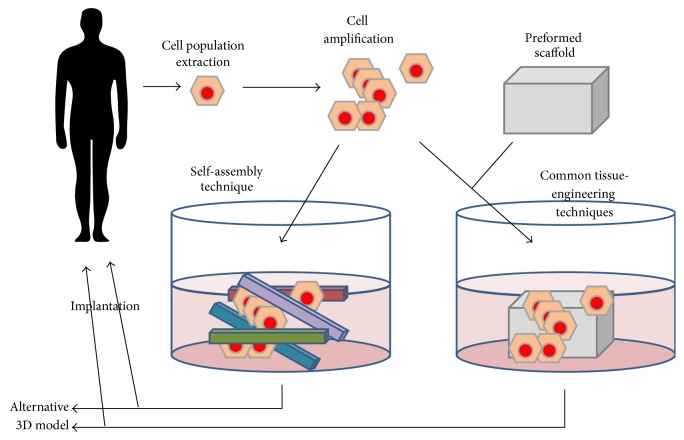
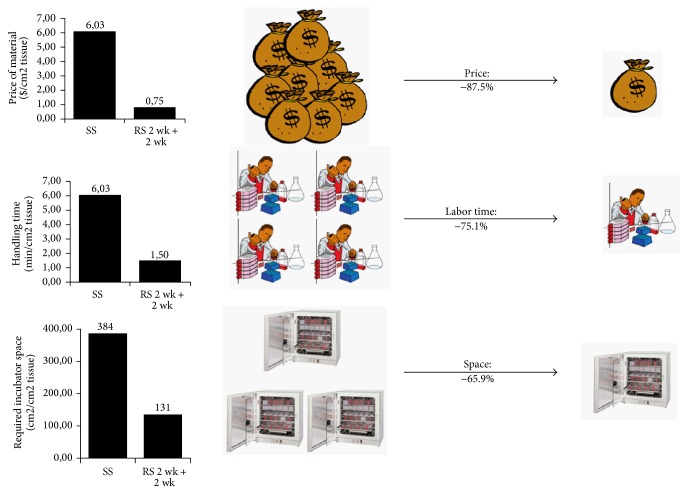
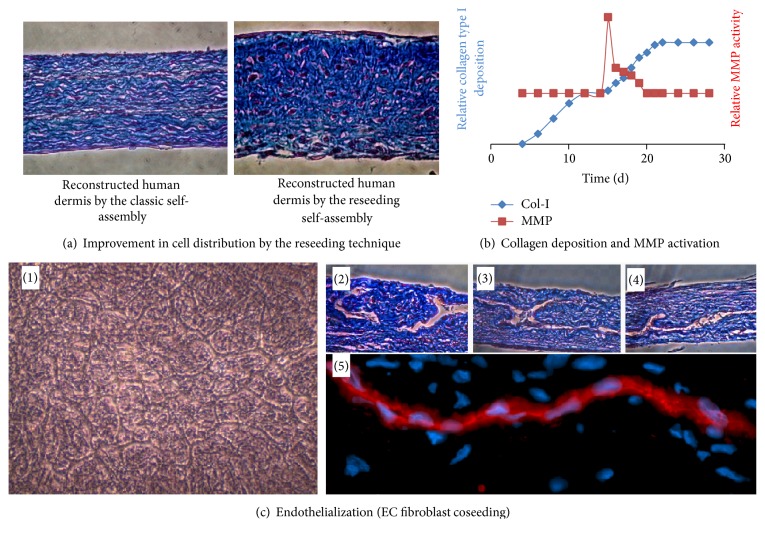
Twenty years ago, Dr. François A. Auger, the founder of the Laboratory of Experimental Organogenesis (LOEX), introduced the self-assembly technique. This innovative technique relies on the ability of dermal fibroblasts to produce and assemble their own extracellular matrix, differing from all other tissue-engineering techniques that use preformed synthetic scaffolds. Nevertheless, the use of the self-assembly technique was limited for a long time due to its main drawbacks: time and cost. Recent scientific breakthroughs have addressed these limitations. New protocol modifications that aim at increasing the rate of extracellular matrix formation have been proposed to reduce the production costs and laboratory handling time of engineered tissues. Moreover, the introduction of vascularization strategies permits the formation of capillary-like networks within reconstructed tissues. These optimization strategies enable the large-scale production of inexpensive native-like substitutes using the self-assembly technique. These substitutes can be used to reconstruct three-dimensional models free of exogenous materials for clinical and fundamental applications.
二十年前,实验器官发生学实验室(LOEX)的创始人弗朗索瓦·奥热(François A. Auger)博士引入了自组装技术。这项创新技术依赖于真皮成纤维细胞产生和组装自己的细胞外基质的能力,与使用预先成型的合成支架的所有其他组织工程技术不同。然而,由于其主要缺点:时间和成本,自组装技术在很长一段时间内受到限制。最近的科学突破解决了这些限制。已经提出了新的方案修改,旨在增加细胞外基质形成的速度,以降低工程组织的生产成本和实验室处理时间。此外,血管生成策略的引入允许在重建组织内形成类似毛细血管的网络。这些优化策略使使用自组装技术大规模生产廉价的类似天然的替代品成为可能。这些替代品可用于临床和基础应用中重建无外源性材料的三维模型。