Wadei Hani M, Lee David D, Croome Kristopher P, Mai Lorraine, Leonard Deanne, Mai Martin L, Taner C Burcin, Keaveny Andrew P
Mayo Clinic Collaborative in Transplant Research and Outcomes, Department of Transplant, Mayo Clinic Florida, Jacksonville, FL.
Transplant Direct. 2018 Mar 14;4(4):e352. doi: 10.1097/TXD.0000000000000771. eCollection 2018 Apr.
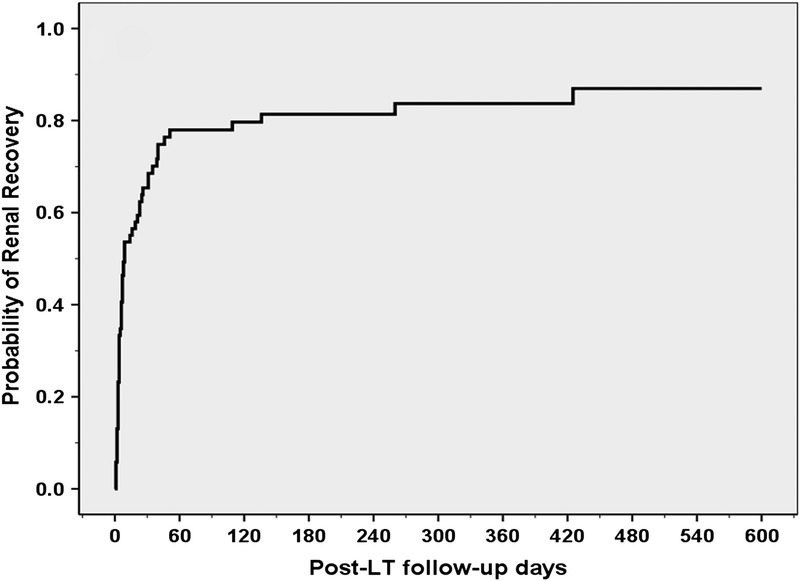
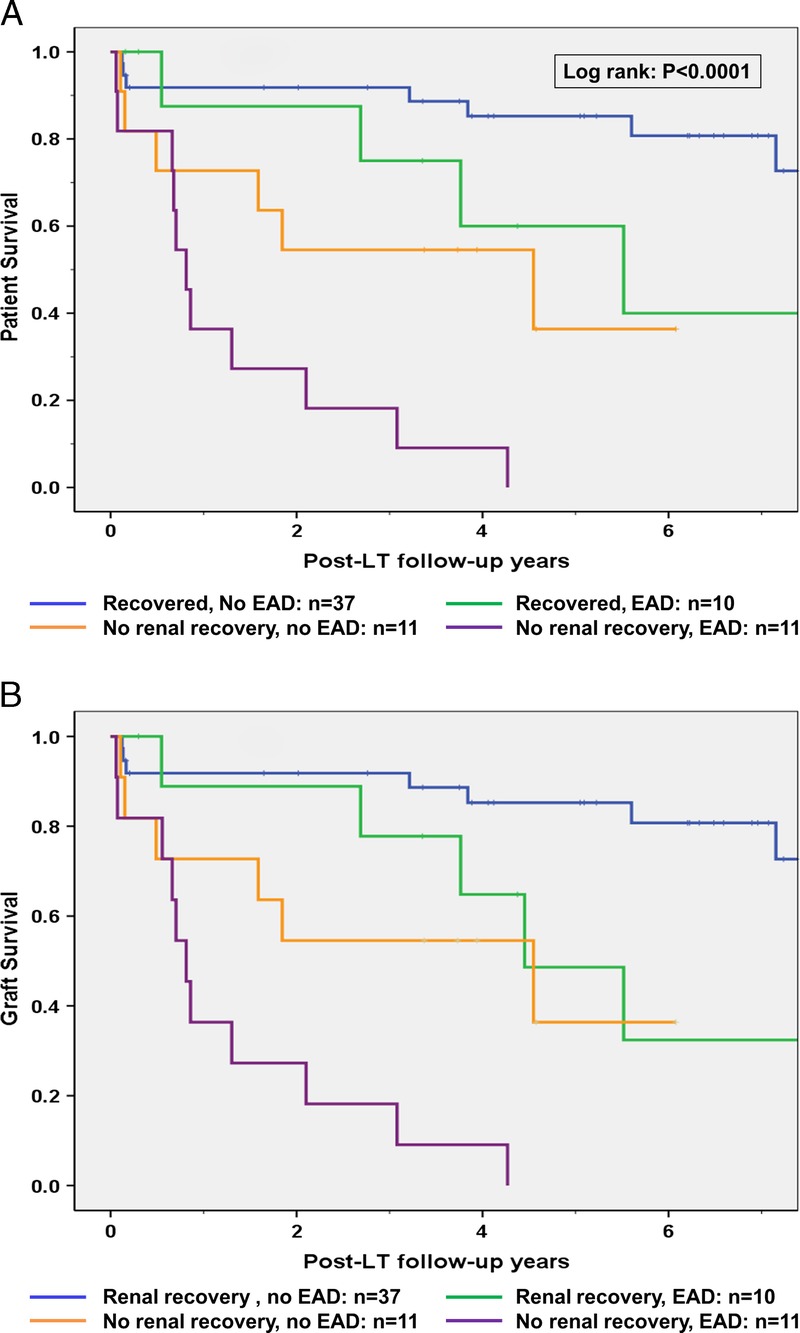
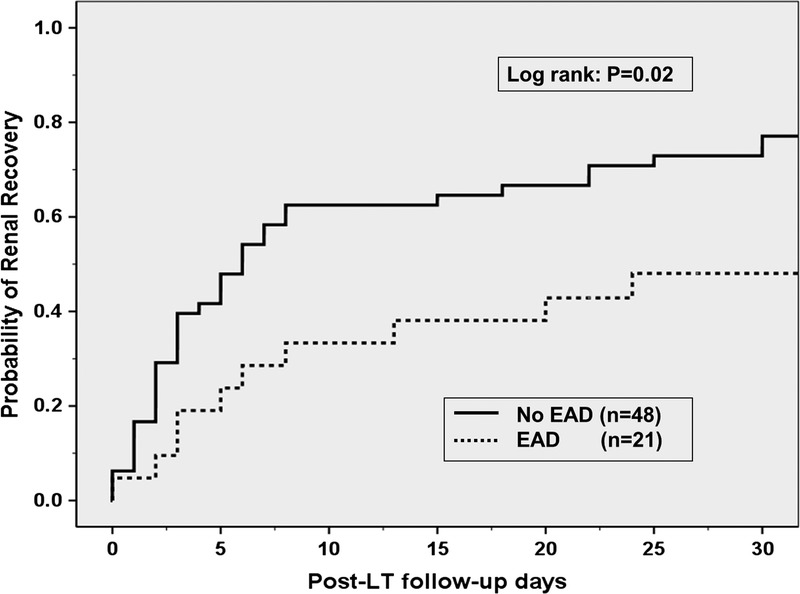
Early allograft dysfunction (EAD) identifies allografts with marginal function soon after liver transplantation (LT) and is associated with poor LT outcomes. The impact of EAD on post-LT renal recovery, however, has not been studied. Data on 69 primary LT recipients (41 with and 28 without history of renal dysfunction) who received renal replacement therapy (RRT) for a median (range) of 9 (13-41) days before LT were retrospectively analyzed. Primary outcome was renal nonrecovery defined as RRT requirement 30 days from LT. Early allograft dysfunction developed in 21 (30%) patients, and 22 (32%) patients did not recover renal function. Early allograft dysfunction was more common in the renal nonrecovery group (50% vs 21%, = 0.016). Multivariate logistic regression analysis demonstrated that EAD (odds ratio, 7.25; 95% confidence interval, 2.0-25.8; = 0.002) and baseline serum creatinine (odds ratio, 3.37; 95% confidence interval, 1.4-8.1; = 0.007) were independently associated with renal nonrecovery. History of renal dysfunction, duration of renal dysfunction, and duration of RRT were not related to renal recovery ( > 0.2 for all). Patients who had EAD and renal nonrecovery had the worst 1-, 3-, and 5-year patient survival, whereas those without EAD and recovered renal function had the best outcomes ( < 0.001). Post-LT EAD was independently associated with renal nonrecovery in LT recipients on RRT for a short duration before LT. Furthermore, EAD in the setting of renal nonrecovery resulted in the worst long-term survival. Measures to prevent EAD should be undertaken in LT recipients on RRT at time of LT.
早期移植肝功能障碍(EAD)可识别肝移植(LT)后短期内功能边缘的移植物,并与LT预后不良相关。然而,EAD对LT后肾功能恢复的影响尚未得到研究。对69例初次LT受者(41例有肾功能不全病史,28例无肾功能不全病史)的数据进行回顾性分析,这些受者在LT前接受了中位(范围)9(13 - 41)天的肾脏替代治疗(RRT)。主要结局是肾未恢复,定义为LT后30天仍需要RRT。21例(30%)患者发生了早期移植肝功能障碍,22例(32%)患者肾功能未恢复。早期移植肝功能障碍在肾未恢复组中更常见(50%对21%,P = 0.016)。多因素逻辑回归分析表明,EAD(比值比,7.25;95%置信区间,2.0 - 25.8;P = 0.002)和基线血清肌酐(比值比,3.37;95%置信区间,1.4 - 8.1;P = 0.007)与肾未恢复独立相关。肾功能不全病史、肾功能不全持续时间和RRT持续时间与肾功能恢复无关(所有P>0.2)。发生EAD且肾未恢复的患者1年、3年和5年的患者生存率最差,而未发生EAD且肾功能恢复的患者预后最好(P<0.001)。LT前短期接受RRT的LT受者中,LT后EAD与肾未恢复独立相关。此外,肾未恢复情况下的EAD导致最差的长期生存。LT时接受RRT的LT受者应采取预防EAD的措施。