Wicks June K, Smith Raymond F, Fratanduono Dayne E, Coppari Federica, Kraus Richard G, Newman Matthew G, Rygg J Ryan, Eggert Jon H, Duffy Thomas S
Department of Geosciences, Princeton University, Princeton, NJ 08544, USA.
Department of Earth and Planetary Sciences, Johns Hopkins University, Baltimore, MD 21218, USA.
Sci Adv. 2018 Apr 25;4(4):eaao5864. doi: 10.1126/sciadv.aao5864. eCollection 2018 Apr.
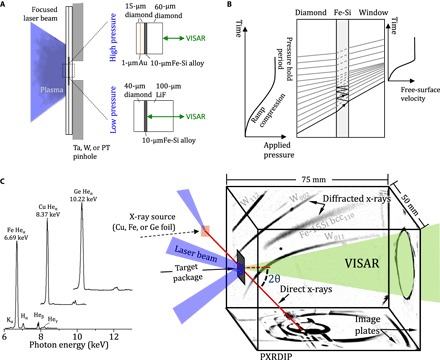
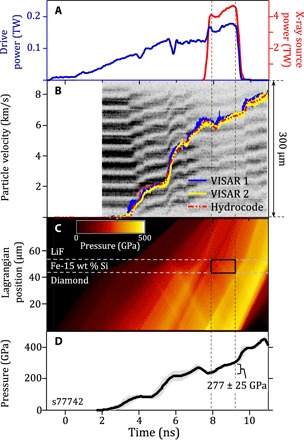
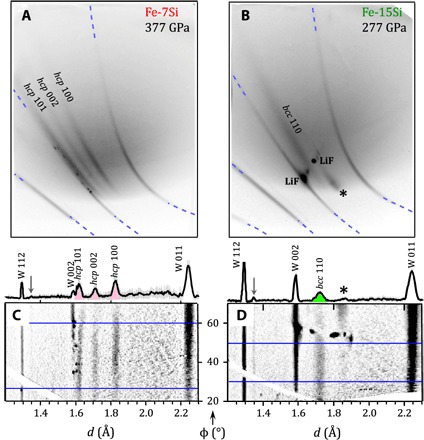
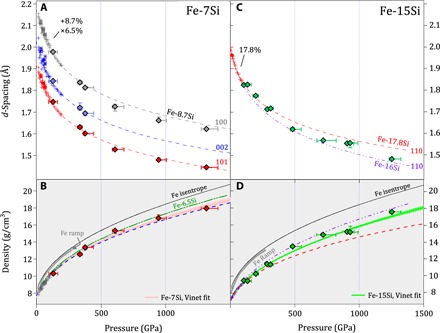
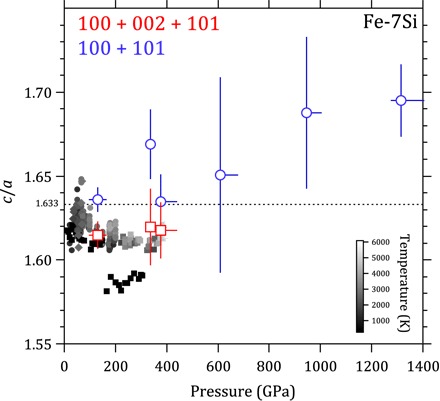
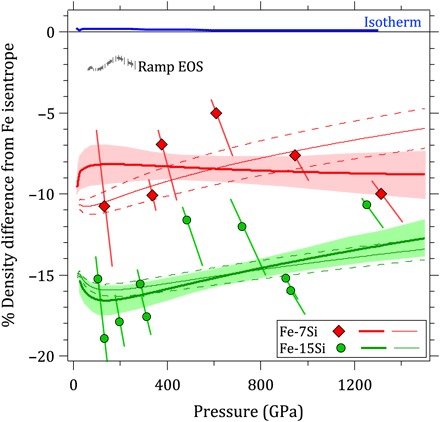
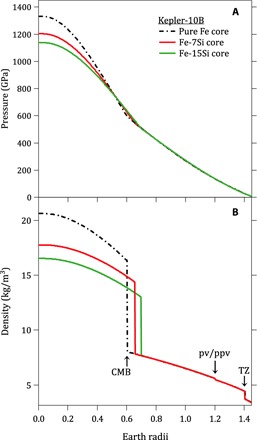
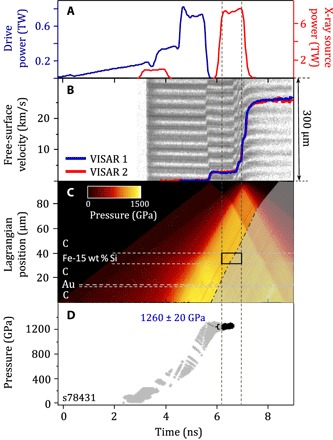
The high-pressure behavior of Fe alloys governs the interior structure and dynamics of super-Earths, rocky extrasolar planets that could be as much as 10 times more massive than Earth. In experiments reaching up to 1300 GPa, we combine laser-driven dynamic ramp compression with in situ x-ray diffraction to study the effect of composition on the crystal structure and density of Fe-Si alloys, a potential constituent of super-Earth cores. We find that Fe-Si alloy with 7 weight % (wt %) Si adopts the hexagonal close-packed structure over the measured pressure range, whereas Fe-15wt%Si is observed in a body-centered cubic structure. This study represents the first experimental determination of the density and crystal structure of Fe-Si alloys at pressures corresponding to the center of a ~3-Earth mass terrestrial planet. Our results allow for direct determination of the effects of light elements on core radius, density, and pressures for these planets.
铁合金的高压行为决定了超级地球(质量可能比地球大10倍的岩质系外行星)的内部结构和动力学。在高达1300吉帕斯卡的实验中,我们将激光驱动的动态斜坡压缩与原位X射线衍射相结合,以研究成分对铁硅合金晶体结构和密度的影响,铁硅合金是超级地球核心的潜在组成部分。我们发现,含7重量%(wt%)硅的铁硅合金在测量的压力范围内采用六方密堆积结构,而含15wt%硅的铁硅合金则呈现体心立方结构。这项研究首次通过实验确定了铁硅合金在相当于约3个地球质量的类地行星中心压力下的密度和晶体结构。我们的结果可以直接确定轻元素对这些行星的核心半径、密度和压力的影响。