Cohen B, Liu J, Larson E
Columbia University School of Nursing, New York, NY, USA.
Department of Epidemiology, Mailman School of Public Health, New York, NY, USA.
J Prev Med Hyg. 2017 Dec 30;58(4):E294-E301. doi: 10.15167/2421-4248/jpmh2017.58.4.774. eCollection 2017 Dec.
National efforts to curtail healthcare-associated infections (HAI) proliferated recently, though data detailing progress over time are limited. This retrospective cohort study aims to describe changes in incidence and antimicrobial susceptibility of HAI in four New York City hospitals over seven years.
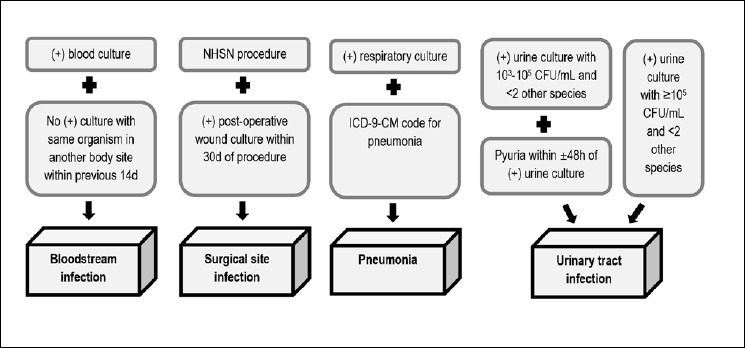
Electronic data were collected retrospectively for all patients discharged from 2006 through 2012. Previously validated computerized algorithms based on National Healthcare Safety Network criteria detected bloodstream infections, pneumonia, surgical site infections, and urinary tract infections with Enterococcus spp., Staphylococcus aureus, Streptococcus pneumoniae, Acinetobacter baumannii, Pseudomonas aeruginosa and Klebsiella pneumoniae. Antimicrobial susceptibilities were obtained from electronic laboratory records. Logistic regression was used to assess changes in odds of acquiring an HAI and odds of antimicrobial resistance over time, controlling for age, gender, severity of illness, previous hospitalizations, and admission source.
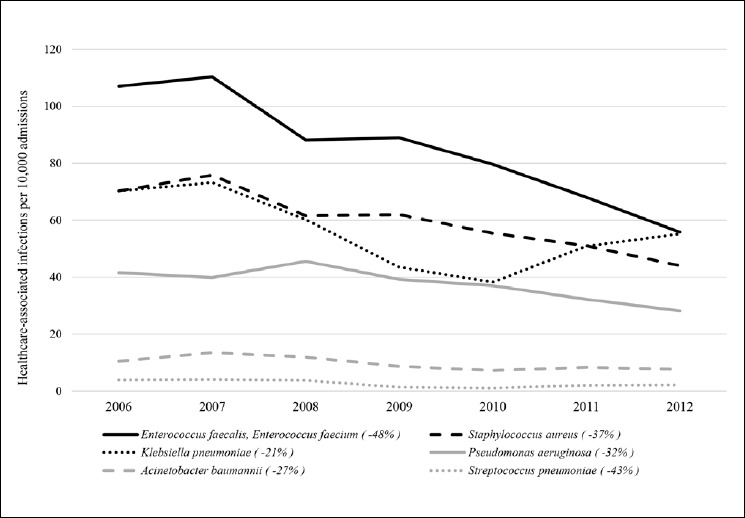
In total, 19,052 HAI were identified among 761,426 discharges. HAI rates fell for all organisms, all infection types, and within all hospitals. Odds of acquiring an HAI decreased significantly over time for all organisms. Resistance levels were stable for Enterococcus spp., S. aureus, A. baumannii, and S. pneumoniae. Multidrug resistance increased for P. aeruginosa and decreased for K. pneumoniae, though imipenem resistance among K. pneumoniae climbed sharply in 2011.
This study suggests that HAI incidence rates are falling, possibly due to increased federal, state and local attention to healthcare quality and patient safety. Though we found no substantial reductions in resistance, recent national attention towards antimicrobial stewardship may precipitate a change in coming years.
近期,各国为减少医疗保健相关感染(HAI)做出了诸多努力,不过关于长期进展的详细数据有限。这项回顾性队列研究旨在描述纽约市四家医院七年间HAI的发病率及抗菌药物敏感性变化。
回顾性收集2006年至2012年所有出院患者的电子数据。基于国家医疗安全网络标准的先前验证过的计算机算法检测到血流感染、肺炎、手术部位感染以及由肠球菌属、金黄色葡萄球菌、肺炎链球菌、鲍曼不动杆菌、铜绿假单胞菌和肺炎克雷伯菌引起的尿路感染。抗菌药物敏感性数据来自电子实验室记录。采用逻辑回归评估随时间推移发生HAI的几率以及抗菌药物耐药几率的变化,并对年龄、性别、疾病严重程度、既往住院史和入院来源进行控制。
在761,426例出院患者中,共识别出19,052例HAI。所有病原体、所有感染类型以及所有医院的HAI发生率均有所下降。所有病原体随时间推移发生HAI的几率显著降低。肠球菌属、金黄色葡萄球菌、鲍曼不动杆菌和肺炎链球菌的耐药水平保持稳定。铜绿假单胞菌的多重耐药性增加,肺炎克雷伯菌的多重耐药性降低,不过2011年肺炎克雷伯菌对亚胺培南的耐药性急剧上升。
本研究表明HAI发病率正在下降,这可能是由于联邦、州和地方对医疗质量和患者安全的关注度提高。尽管我们发现耐药性没有大幅降低,但近期全国对抗菌药物管理的关注可能会在未来几年引发变化。