Venkatasamy Aïna, Veillon Francis, Fleury Aude, Eliezer Michael, Abu Eid Maher, Romain Benoit, Vuong Hella, Rohmer Dominique, Charpiot Anne, Sick Henri, Riehm Sophie
1Service d'imagerie 1, Hôpitaux Universitaires de Strasbourg, 1 avenue Molière, Strasbourg, F-67098 France.
2Service d'ORL, Hôpitaux Universitaires de Strasbourg, Strasbourg, France.
Eur Radiol Exp. 2017;1(1):14. doi: 10.1186/s41747-017-0020-7. Epub 2017 Oct 9.
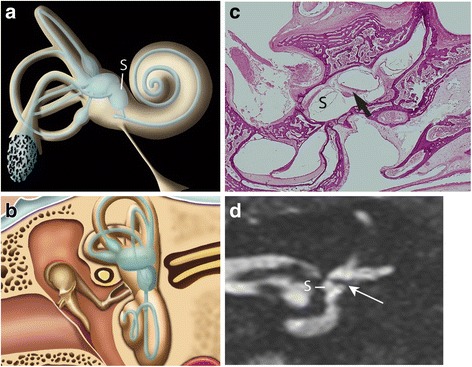
Endolymphatic hydrops can be studied on magnetic resonance imaging (MRI) using images acquired 4 h after intravenous injection of Gd-chelate. Our aim was to compare high-resolution T2-weighted images of the saccule in normal subjects with histological sections from cadavers and to identify its changes in Meniere disease, compared to healthy volunteers.
Sixty-four healthy volunteers without any otologic disease and 64 patients who fulfilled all the criteria for unilateral Meniere disease underwent 3 T MRI using a T2-weighted steady state free precession (SSFP) sequence, without contrast material injection. Images of healthy volunteers were compared with histological sections of normal inner ears from premature foetuses and compared with volunteers.
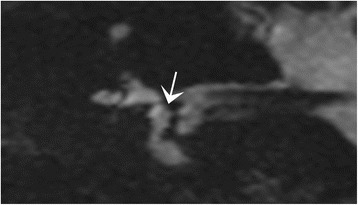
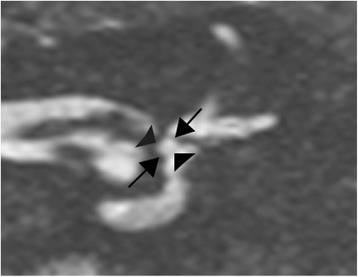
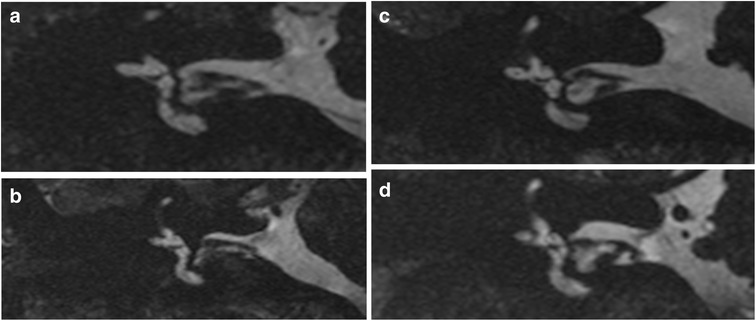
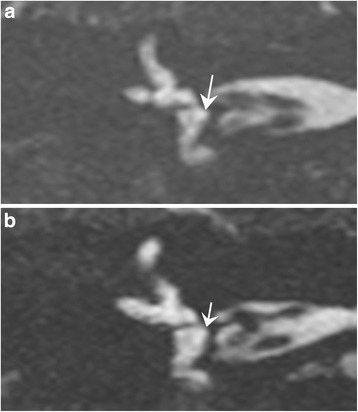
The normal saccule was easily visible on T2-weighted images in volunteers, with a normal maximal height of 1.6 mm (1.4 ± 0.1 mm, mean ± standard deviation) and a good correlation with reference histological sections, while in Meniere disease the saccule was dilated in 52/62 patients (84%), with a saccular height greater than 1.6 mm (1.69 ± 0.24 mm, = 0.001), found in 45/52 patients (86%). An associated increased width (greater than 1.4 mm) was found in 23/52 patients (44%). A round shape or the non-visualisation of the saccule were also found in 2/52 (4%) and in 5/62 patients (8%), respectively.
A T2-weighted sequence is an easy method to diagnose Meniere disease. Saccular abnormalities were found in 84% of the cases: elongation (height > 1.6 mm) in 86%, increased saccular width in 44%, or a missing saccule in 8%.
内淋巴积水可通过静脉注射钆螯合物4小时后采集的磁共振成像(MRI)进行研究。我们的目的是将正常受试者球囊的高分辨率T2加权图像与尸体组织切片进行比较,并确定与健康志愿者相比,梅尼埃病患者球囊的变化。
64名无任何耳科疾病的健康志愿者和64名符合单侧梅尼埃病所有标准的患者接受了3T MRI检查,使用T2加权稳态自由进动(SSFP)序列,未注射造影剂。将健康志愿者的图像与早产胎儿正常内耳的组织切片进行比较,并与志愿者进行比较。
在志愿者的T2加权图像上,正常球囊很容易看到,正常最大高度为1.6毫米(1.4±0.1毫米,平均值±标准差)与参考组织切片有良好的相关性,而在梅尼埃病中,52/62例患者(84%)的球囊扩张,球囊高度大于1.6毫米(1.69±0.24毫米,P=0.001),45/52例患者(86%)出现这种情况;23/52例患者(44%)发现球囊宽度增加(大于1.4毫米);2/52例(4%)和5/62例患者(8%)分别出现球囊呈圆形或未显示的情况。
T2加权序列是诊断梅尼埃病的简便方法。84%的病例发现球囊异常:86%为伸长(高度>1.6毫米),44%为球囊宽度增加,8%为球囊缺失。