Human Genetics Unit, Faculty of Medicine, University of Colombo, Kynsey Road, Colombo, 00800, Sri Lanka.
Faculty of Medicine and Allied Sciences, Rajarata University of Sri Lanka, Anuradhapura, Sri Lanka.
Lipids Health Dis. 2018 May 2;17(1):100. doi: 10.1186/s12944-018-0763-z.
Hypercholesterolemia is a major determinant of cardiovascular disease-associated morbidity and mortality. Mutations in the LDL-receptor (LDLR) gene are implicated in the majority of the cases with familial hypercholesterolemia (FH). However, the spectrum of mutations in the LDLR gene in Sri Lankan patients has not been investigated. The objective of this study was to report the frequency and spectrum of variants in LDLR in a cohort of Sri Lankan patients with FH.
A series of consecutive patients with FH, diagnosed according to Modified Simon Broome criteria or Dutch Lipid Clinic Network criteria at the University Medical Unit, Colombo, were recruited. Clinical data was recorded. DNA was extracted from peripheral blood samples. The LDLR gene was screened for genetic variants by Sanger sequencing.
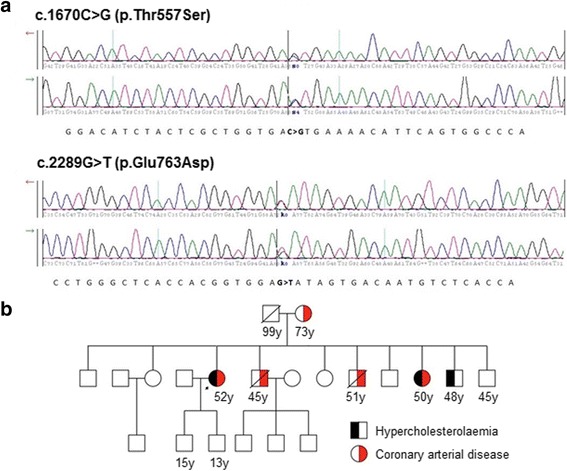
A total of 27 patients [13 (48%) males, 14 (52%) females; age range 24-73 years] were tested. Clinical features found among these 27 patients were: xanthelasma in 5 (18.5%), corneal arcus in 1 (3.7%), coronary artery disease (CAD) in 10 (37%), and a family history of hypercholesterolemia and/or CAD in 24 (88.9%) patients. In the entire cohort, mean total cholesterol was 356.8 mg/dl (±66.4) and mean LDL-cholesterol was 250.3 mg/dl (±67.7). Sanger sequencing of the 27 patients resulted in the identification of known pathogenic missense mutations in 5 (18.5%) patients. Four were heterozygotes for 1 mutation each. They were c.682G > C in 2 patients, c.1720C > A in 1 patient, and c.1855 T > A in 1 patient. One patient with severe FH phenotypes was a compound heterozygote for one known mutation, c.2289G > T, and another missense variant, c.1670C > G (p.Thr557Ser), with unknown functional impact. This latter variant has not been reported in any other population previously.
The frequency of known mutations in the LDLR gene in this cohort of patients was markedly low compared to frequencies reported in other populations. This highlights the likelihood of a complex, polygenic inheritance of FH in Sri Lankan patients, indicating the need for a comprehensive genetic evaluation that includes the screening for mutations in other genes that cause FH, such as APOB, PCSK9, and LDLRAP1.
高胆固醇血症是心血管疾病相关发病率和死亡率的主要决定因素。LDL 受体(LDLR)基因突变与大多数家族性高胆固醇血症(FH)病例有关。然而,斯里兰卡患者 LDLR 基因突变的谱尚未得到研究。本研究的目的是报告 FH 斯里兰卡患者 LDLR 中变异的频率和谱。
连续招募了在科伦坡大学医学系根据改良西蒙布鲁姆标准或荷兰脂质诊所网络标准诊断为 FH 的一系列患者。记录临床数据。从外周血样本中提取 DNA。通过 Sanger 测序筛选 LDLR 基因的遗传变异。
共检测了 27 例患者[13 例(48%)男性,14 例(52%)女性;年龄 24-73 岁]。这些 27 例患者的临床特征为:睑黄瘤 5 例(18.5%),角膜弓 1 例(3.7%),冠心病 10 例(37%),24 例(88.9%)有高胆固醇血症和/或冠心病家族史。在整个队列中,总胆固醇平均为 356.8mg/dl(±66.4),LDL 胆固醇平均为 250.3mg/dl(±67.7)。对 27 名患者进行 Sanger 测序,发现 5 名(18.5%)患者存在已知致病性错义突变。其中 4 例各为 1 种突变的杂合子。2 例为 c.682G>C,1 例为 c.1720C>A,1 例为 c.1855T>A。1 例严重 FH 表型患者为 1 种已知突变 c.2289G>T 和另 1 种错义变异 c.1670C>G(p.Thr557Ser)的复合杂合子,其功能影响未知。这种变异以前在其他任何人群中都没有报道过。
与其他人群报道的频率相比,本研究中患者 LDLR 基因中已知突变的频率明显较低。这突出表明 FH 在斯里兰卡患者中可能存在复杂的多基因遗传,表明需要进行全面的遗传评估,包括筛查引起 FH 的其他基因中的突变,如 APOB、PCSK9 和 LDLRAP1。