Nature Research Centre, Akademijos 2, LT-08412, Vilnius, Lithuania.
Institute of Pathology and Forensic Veterinary Medicine, University of Veterinary Medicine, Vienna, 1210, Vienna, Austria.
Malar J. 2018 May 2;17(1):184. doi: 10.1186/s12936-018-2325-2.
Microscopic research has shown that Plasmodium relictum is the most common agent of avian malaria. Recent molecular studies confirmed this conclusion and identified several mtDNA lineages, suggesting the existence of significant intra-species genetic variation or cryptic speciation. Most identified lineages have a broad range of hosts and geographical distribution. Here, a rare new lineage of P. relictum was reported and information about biological characters of different lineages of this pathogen was reviewed, suggesting issues for future research.
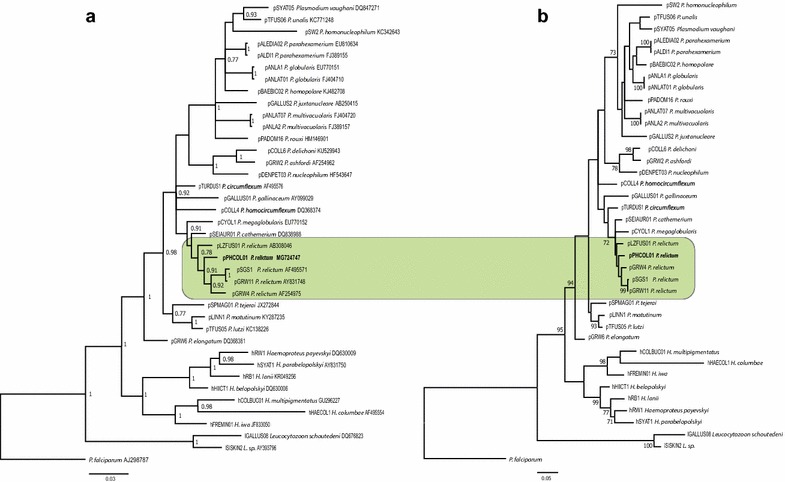
The new lineage pPHCOL01 was detected in Common chiffchaff Phylloscopus collybita, and the parasite was passaged in domestic canaries Serinus canaria. Organs of infected birds were examined using histology and chromogenic in situ hybridization methods. Culex quinquefasciatus mosquitoes, Zebra finch Taeniopygia guttata, Budgerigar Melopsittacus undulatus and European goldfinch Carduelis carduelis were exposed experimentally. Both Bayesian and Maximum Likelihood analyses identified the same phylogenetic relationships among different, closely-related lineages pSGS1, pGRW4, pGRW11, pLZFUS01, pPHCOL01 of P. relictum. Morphology of their blood stages was compared using fixed and stained blood smears, and biological properties of these parasites were reviewed.
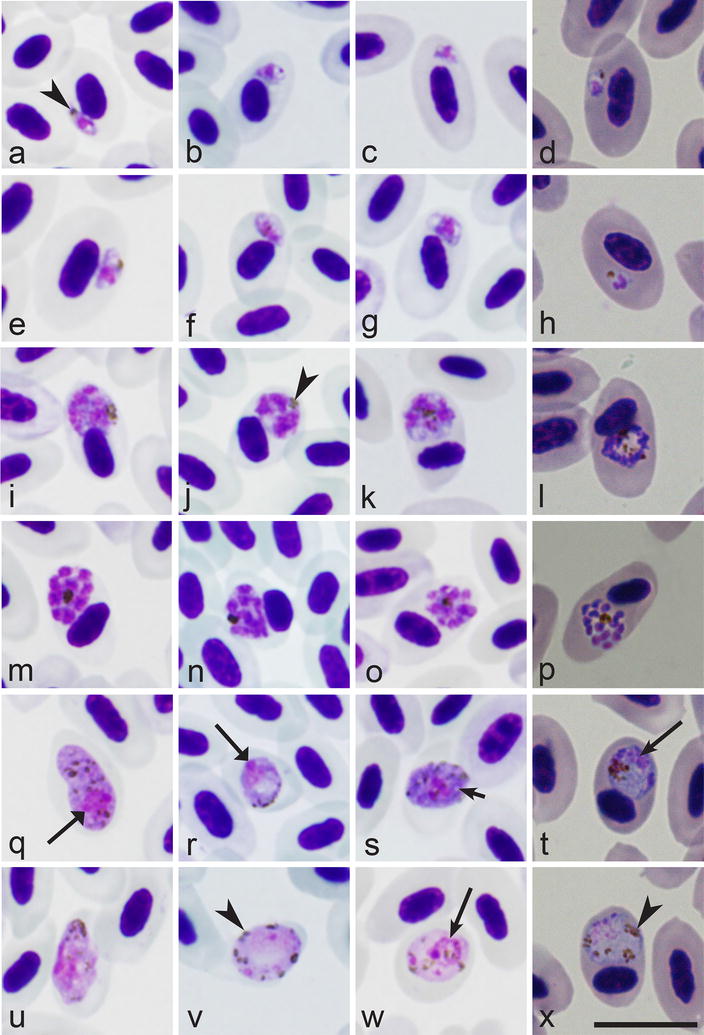
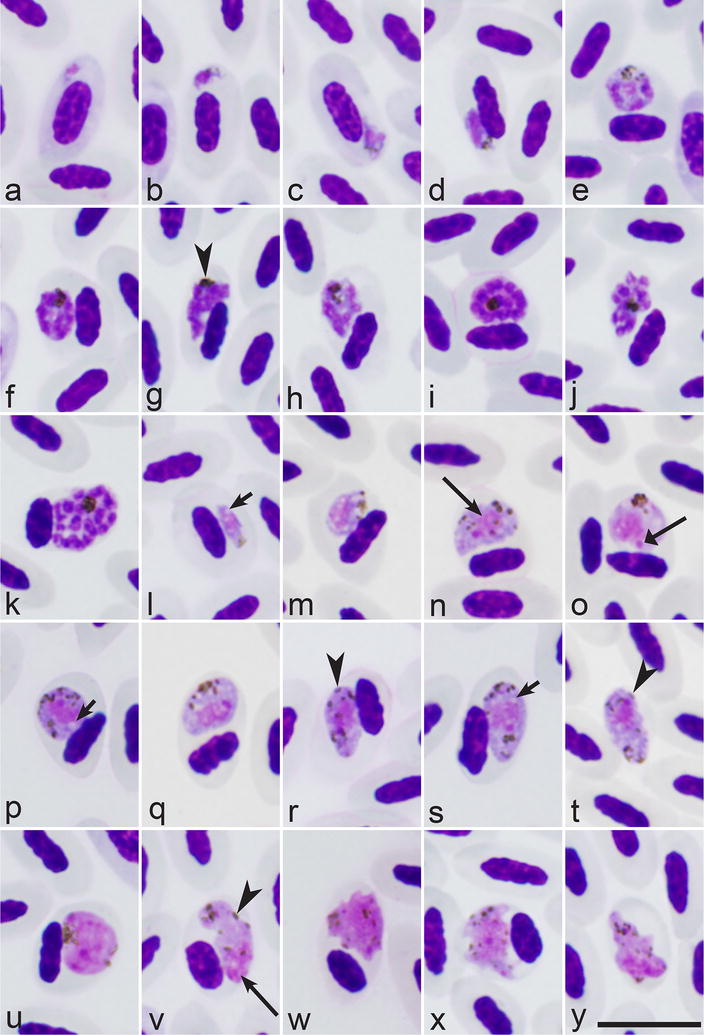
Common canary and European goldfinch were susceptible to the parasite pPHCOL01, and had markedly variable individual prepatent periods and light transient parasitaemia. Exo-erythrocytic and sporogonic stages were not seen. The Zebra finch and Budgerigar were resistant. Neither blood stages nor vector stages of all examined P. relictum lineages can be distinguished morphologically.
Within the huge spectrum of vertebrate hosts, mosquito vectors, and ecological conditions, different lineages of P. relictum exhibit indistinguishable, markedly variable morphological forms. Parasites of same lineages often develop differently in different bird species. Even more, the variation of biological properties (parasitaemia dynamics, blood pathology, prepatent period) in different isolates of the same lineage might be greater than the variation in different lineages during development in the same species of birds, indicating negligible taxonomic value of such features. Available lineage information is excellent for parasite diagnostics, but is limited in predictions about relationships in certain host-parasite associations. A combination of experiments, field observations, microscopic and molecular diagnostics is essential for understanding the role of different P. relictum lineages in bird health.
微观研究表明,疟原虫残留是鸟类疟疾最常见的病原体。最近的分子研究证实了这一结论,并鉴定出了几个 mtDNA 谱系,表明存在显著的种内遗传变异或隐种形成。大多数已鉴定的谱系具有广泛的宿主和地理分布。在这里,报告了一种罕见的疟原虫新谱系,并回顾了该病原体不同谱系的生物学特征信息,这表明了未来研究的问题。
在普通朱雀 Phylloscopus collybita 中检测到新谱系 pPHCOL01,并在家养金丝雀 Serinus canaria 中传代。使用组织学和显色原位杂交方法检查感染鸟类的器官。实验暴露于库蚊 Culex quinquefasciatus、斑胸草雀 Taeniopygia guttata、虎皮鹦鹉 Melopsittacus undulatus 和欧洲金翅雀 Carduelis carduelis。贝叶斯和最大似然分析确定了疟原虫的不同、密切相关谱系 pSGS1、pGRW4、pGRW11、pLZFUS01、pPHCOL01 之间的相同系统发育关系。使用固定和染色的血涂片比较它们的血液阶段形态,并回顾这些寄生虫的生物学特性。
普通金丝雀和欧洲金翅雀易感染寄生虫 pPHCOL01,具有明显可变的个体潜隐期和短暂的轻度寄生虫血症。未观察到外红细胞和孢子形成阶段。斑胸草雀和虎皮鹦鹉具有抗性。所有检查的疟原虫谱系的血期和向量期在形态上都无法区分。
在巨大的脊椎动物宿主、蚊子媒介和生态条件范围内,疟原虫的不同谱系表现出无法区分的、明显可变的形态形式。同一谱系的寄生虫在不同鸟类物种中的发育情况往往不同。甚至,同一谱系不同分离株的生物学特性(寄生虫血症动态、血液病理学、潜隐期)的变化可能大于不同谱系在同一鸟类物种中的发育变化,表明这些特征的分类价值微不足道。现有的谱系信息非常适合寄生虫诊断,但在预测某些宿主-寄生虫关联中的关系方面有限。实验、实地观察、显微镜和分子诊断的结合对于理解不同疟原虫谱系在鸟类健康中的作用至关重要。