Department of Psychology, Education and Child Studies, Erasmus University Rotterdam, PO Box 1738, 3000, DR, Rotterdam, The Netherlands.
BMC Psychol. 2018 May 2;6(1):21. doi: 10.1186/s40359-018-0235-2.
Trypophobia refers to aversion to clusters of holes. We investigated whether trypophobic stimuli evoke augmented early posterior negativity (EPN).
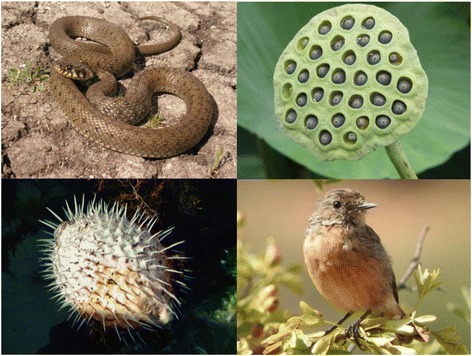
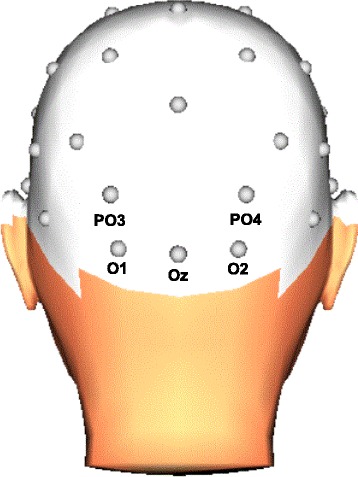
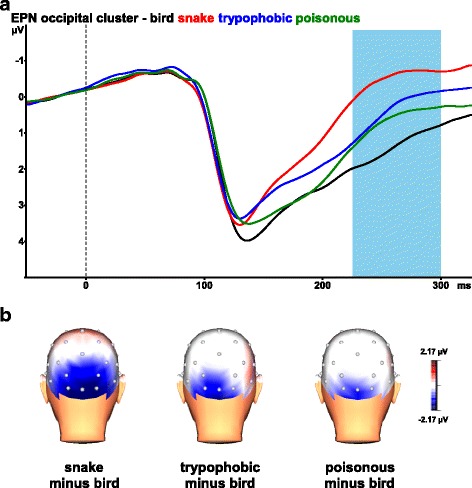
Twenty-four participants filled out a trypophobia questionnaire and watched the random rapid serial presentation of 450 trypophobic pictures, 450 pictures of poisonous animals, 450 pictures of snakes, and 450 pictures of small birds (1800 pictures in total, at a rate of 3 pictures/s). The EPN was scored as the mean activity at occipital electrodes (PO3, O1, Oz, PO4, O2) in the 225-300 ms time window after picture onset.
The EPN was significantly larger for snake pictures than for the other categories, and significantly larger for trypophobic pictures and poisonous animal pictures than for bird pictures. Remarkably, the scores on the trypophobia questionnaire were correlated with the EPN amplitudes for trypophobic pictures at the occipital cluster (r = -.46, p = .025).
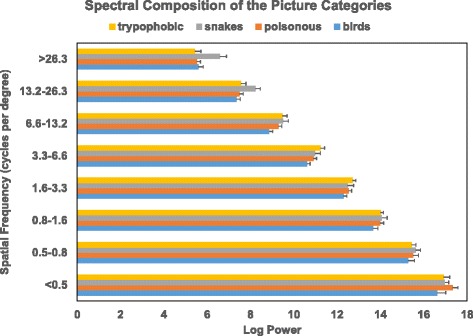
The outcome for the EPN indicates that snakes, and to a somewhat lesser extent trypophobic stimuli and poisonous animals, trigger early automatic visual attention. This supports the notion that the aversion that is induced by trypophobic stimuli reflects ancestral threat and has survival value. The possible influence of the spectral composition of snake and trypophobic stimuli on the EPN is discussed.
密集恐惧症是指对密集小孔的反感。我们研究了密集恐惧症刺激是否会引起增强的早期后向负性(EPN)。
24 名参与者填写了密集恐惧症问卷,并观看了 450 张密集恐惧症图片、450 张有毒动物图片、450 张蛇类图片和 450 张小鸟图片(总共 1800 张图片,以 3 张/秒的速度随机快速序列呈现)的快速连续呈现。EPN 被评分作为图片出现后 225-300 毫秒时间窗口中枕部电极(PO3、O1、Oz、PO4、O2)的平均活动。
蛇类图片的 EPN 明显大于其他类别,而密集恐惧症图片和有毒动物图片的 EPN 明显大于鸟类图片。值得注意的是,密集恐惧症问卷的得分与密集恐惧症图片在枕部簇的 EPN 振幅相关(r=-.46,p=0.025)。
EPN 的结果表明,蛇类,以及在某种程度上密集恐惧症刺激和有毒动物,会引发早期的自动视觉注意。这支持了密集恐惧症刺激引起的厌恶感反映了祖先的威胁,具有生存价值的观点。还讨论了蛇和密集恐惧症刺激的光谱组成对 EPN 的可能影响。