Baattrup-Pedersen Annette, Garssen Annemarie, Göthe Emma, Hoffmann Carl Christian, Oddershede Andrea, Riis Tenna, van Bodegom Peter M, Larsen Søren E, Soons Merel
Department of Bioscience Aarhus University Silkeborg Denmark.
Department of Biology Utrecht University Utrecht The Netherlands.
Ecol Evol. 2018 Mar 26;8(8):4120-4135. doi: 10.1002/ece3.3973. eCollection 2018 Apr.
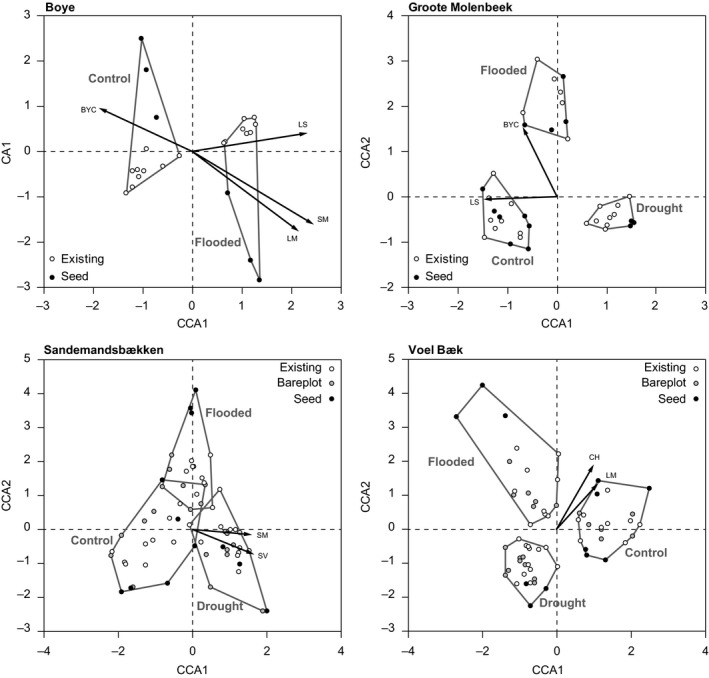
The hydrology of riparian areas changes rapidly these years because of climate change-mediated alterations in precipitation patterns. In this study, we used a large-scale in situ experimental approach to explore effects of drought and flooding on plant taxonomic diversity and functional trait composition in riparian areas in temperate Europe. We found significant effects of flooding and drought in all study areas, the effects being most pronounced under flooded conditions. In near-stream areas, taxonomic diversity initially declined in response to both drought and flooding (although not significantly so in all years) and remained stable under drought conditions, whereas the decline continued under flooded conditions. For most traits, we found clear indications that the functional diversity also declined under flooded conditions, particularly in near-stream areas, indicating that fewer strategies succeeded under flooded conditions. Consistent changes in community mean trait values were also identified, but fewer than expected. This can have several, not mutually exclusive, explanations. First, different adaptive strategies may coexist in a community. Second, intraspecific variability was not considered for any of the traits. For example, many species can elongate shoots and petioles that enable them to survive shallow, prolonged flooding but such abilities will not be captured when applying mean trait values. Third, we only followed the communities for 3 years. Flooding excludes species intolerant of the altered hydrology, whereas the establishment of new species relies on time-dependent processes, for instance the dispersal and establishment of species within the areas. We expect that altered precipitation patterns will have profound consequences for riparian vegetation in temperate Europe. Riparian areas will experience loss of taxonomic and functional diversity and, over time, possibly also alterations in community trait responses that may have cascading effects on ecosystem functioning.
近年来,由于气候变化导致降水模式改变,河岸地区的水文状况迅速变化。在本研究中,我们采用大规模原位实验方法,探究干旱和洪水对欧洲温带河岸地区植物分类多样性和功能性状组成的影响。我们发现,在所有研究区域,洪水和干旱都有显著影响,在洪水条件下影响最为明显。在近溪区域,分类多样性最初因干旱和洪水而下降(尽管并非在所有年份都显著),在干旱条件下保持稳定,而在洪水条件下下降仍在持续。对于大多数性状,我们发现有明确迹象表明,功能多样性在洪水条件下也会下降,尤其是在近溪区域,这表明在洪水条件下成功的策略较少。群落平均性状值也有一致变化,但比预期的少。这可能有几种并非相互排斥的解释。首先,不同的适应策略可能在一个群落中共存。其次,对于任何性状都未考虑种内变异性。例如,许多物种可以伸长茎和叶柄,使其能够在浅层、长期洪水中存活,但在应用平均性状值时,这些能力将无法体现。第三,我们仅对群落进行了3年的跟踪。洪水排除了不耐受水文变化的物种,而新物种的建立依赖于时间相关的过程,例如物种在区域内的扩散和建立。我们预计,降水模式的改变将对欧洲温带的河岸植被产生深远影响。河岸地区将经历分类和功能多样性的丧失,随着时间的推移,群落性状反应可能也会发生变化,这可能对生态系统功能产生连锁反应。