Sarneel Judith M, Hefting Mariet M, Kowalchuk George A, Nilsson Christer, Van der Velden Merit, Visser Eric J W, Voesenek Laurentius A C J, Jansson Roland
Landscape Ecology Group, Department of Ecology and Environmental Sciences, Umeå University, Umeå, Sweden.
Ecology & Biodiversity, Institute of Environmental Biology, Utrecht University, Utrecht, Netherlands.
Glob Chang Biol. 2019 Apr;25(4):1358-1367. doi: 10.1111/gcb.14569. Epub 2019 Jan 30.
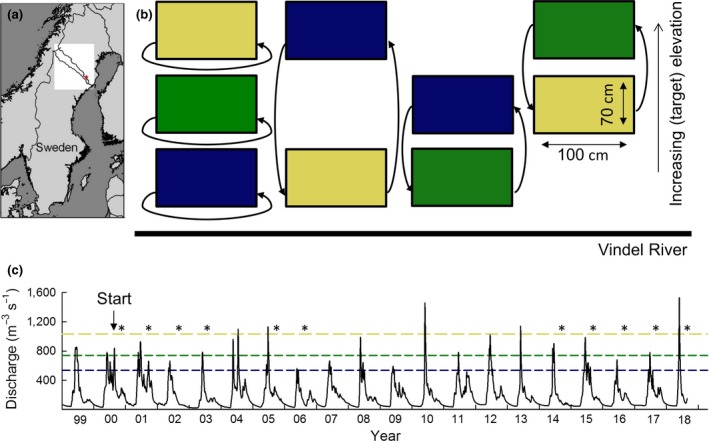
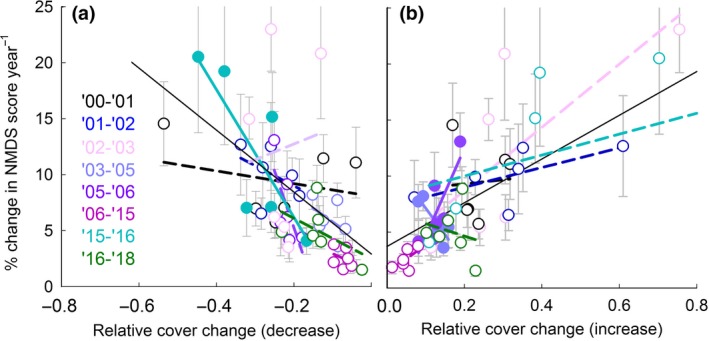
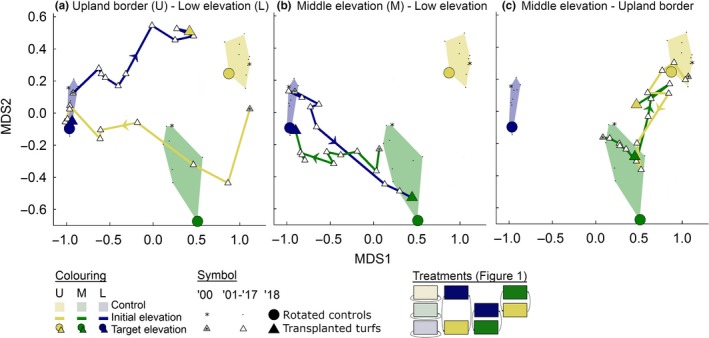
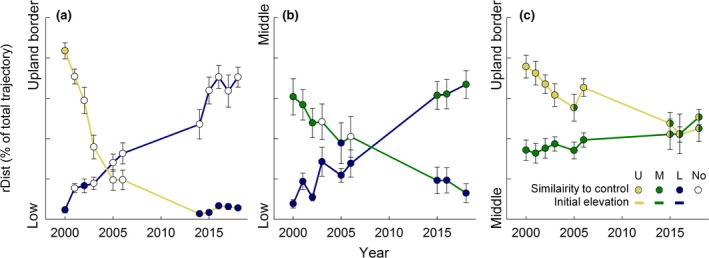
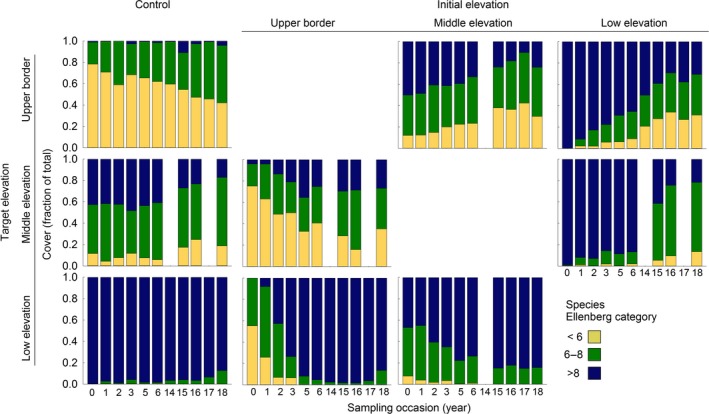
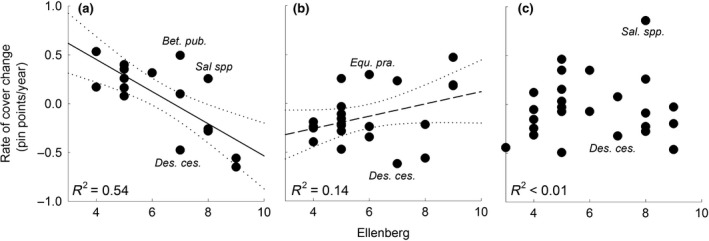
Climate change will have large consequences for flooding frequencies in freshwater systems. In interaction with anthropogenic activities (flow regulation, channel restoration and catchment land-use) this will both increase flooding and drought across the world. Like in many other ecosystems facing changed environmental conditions, it remains difficult to predict the rate and trajectory of vegetation responses to changed conditions. Given that critical ecosystem services (e.g. bank stabilization, carbon subsidies to aquatic communities or water purification) depend on riparian vegetation composition, it is important to understand how and how fast riparian vegetation responds to changing flooding regimes. We studied vegetation changes over 19 growing seasons in turfs that were transplanted in a full-factorial design between three riparian elevations with different flooding frequencies. We found that (a) some transplanted communities may have developed into an alternative stable state and were still different from the target community, and (b) pathways of vegetation change were highly directional but alternative trajectories did occur, (c) changes were rather linear but faster when flooding frequencies increased than when they decreased, and (d) we observed fastest changes in turfs when proxies for mortality and colonization were highest. These results provide rare examples of alternative transient trajectories and stable states under field conditions, which is an important step towards understanding their drivers and their frequency in a changing world.
气候变化将对淡水系统的洪水频率产生重大影响。与人为活动(流量调节、河道修复和集水区土地利用)相互作用,这将增加全球范围内的洪水和干旱。就像许多其他面临环境条件变化的生态系统一样,预测植被对变化条件的响应速度和轨迹仍然很困难。鉴于关键的生态系统服务(如河岸稳定、向水生群落的碳补贴或水净化)取决于河岸植被组成,了解河岸植被如何以及多快对不断变化的洪水状况做出响应非常重要。我们研究了在三个具有不同洪水频率的河岸海拔之间以全因子设计移植的草皮在19个生长季节中的植被变化。我们发现:(a)一些移植群落可能已发展为另一种稳定状态,且仍与目标群落不同;(b)植被变化路径具有高度方向性,但确实出现了替代轨迹;(c)变化相当线性,但洪水频率增加时比减少时变化更快;(d)当死亡率和定殖的代理指标最高时,我们观察到草皮变化最快。这些结果提供了野外条件下替代瞬态轨迹和稳定状态的罕见例子,这是朝着理解其驱动因素及其在变化世界中的频率迈出的重要一步。