Sangaramoorthy Thurka, Kroeger Karen
Department of Anthropology, University of Maryland, 1111 Woods Hall, College Park, MD 20742.
Division of Sexually Transmitted Disease Prevention, Centers for Disease Control and Prevention, 1600 Clifton Road NE, Atlanta, GA 30333.
Hum Organ. 2013 Fall;72(3):263-272. doi: 10.17730/humo.72.3.q1m53143x42p0653.
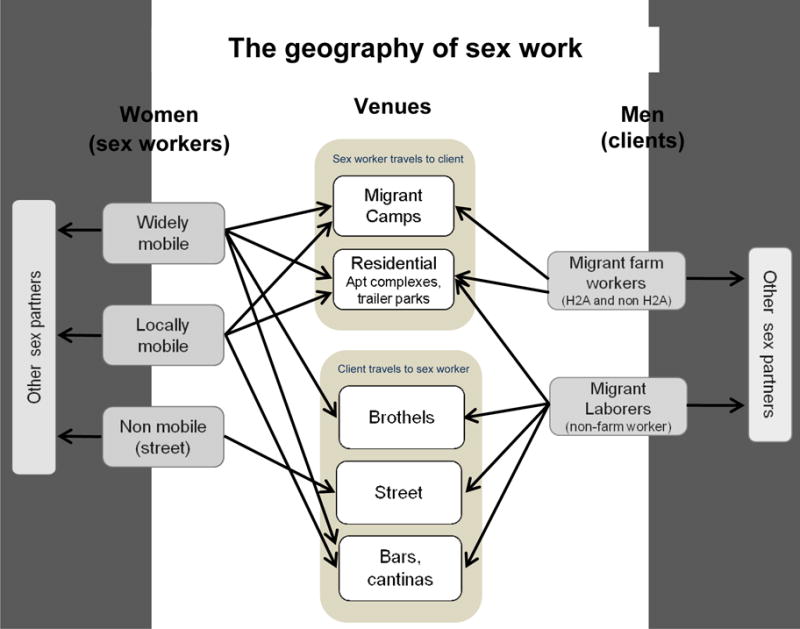
Recent studies have documented frequent use of female sex workers among Latino migrant men in the southeastern United States, yet little is known about the context in which sex work takes place, or the women who provide these services. As anthropologists working in applied public health, we use rapid ethnographic assessment as a technical assistance tool to document local understandings of the organization and typology of sex work and patterns of mobility among sex workers and their Latino migrant clients. By incorporating ethnographic methods in traditional public health needs assessments, we were able to highlight the diversity of migrant experiences and better understand the health needs of mobile populations more broadly. We discuss the findings in terms of their practical implications for HIV/STD prevention and call on public health to incorporate the concept of mobility as an organizing principle for the delivery of health care services.
最近的研究记录了美国东南部拉丁裔移民男性中频繁与女性性工作者发生性接触的情况,但对于性交易发生的背景,以及提供这些服务的女性却知之甚少。作为从事应用公共卫生工作的人类学家,我们使用快速人种志评估作为一种技术援助工具,来记录当地对性工作的组织形式、类型以及性工作者及其拉丁裔移民客户的流动模式的理解。通过将人种志方法纳入传统的公共卫生需求评估中,我们能够突出移民经历的多样性,并更广泛地更好地理解流动人群的健康需求。我们根据这些研究结果对艾滋病毒/性传播感染预防的实际影响进行了讨论,并呼吁公共卫生部门将流动概念纳入提供医疗服务的组织原则中。