Xiao Tingting, Yu Wei, Niu Tianshui, Huang Chen, Xiao Yonghong
State Key Laboratory for Diagnosis and Treatment of Infectious Diseases, Collaborative Innovation Center for Diagnosis and Treatment of Infectious Diseases, the First Affiliated Hospital, College of Medicine, Zhejiang University, Hangzhou, People's Republic of China.
Department of Infectious Diseases, Zhejiang Provincial People's Hospital, Hangzhou, People's Republic of China.
Infect Drug Resist. 2018 Apr 24;11:595-606. doi: 10.2147/IDR.S153246. eCollection 2018.
Carbapenem-nonsusceptible (CnSKP) is rapidly emerging as a life-threatening nosocomial infection. The efficacy of tigecycline in the treatment of bloodstream infections (BSIs) remains controversial.
Data from a total of 428 patients with carbapenem-susceptible (CSKP) and CnSKP BSIs were collected at a single center between January 2013 and December 2015. A three-part analysis was conducted to identify the risk factors associated with CnSKP, explore prognosis, and evaluate treatments.
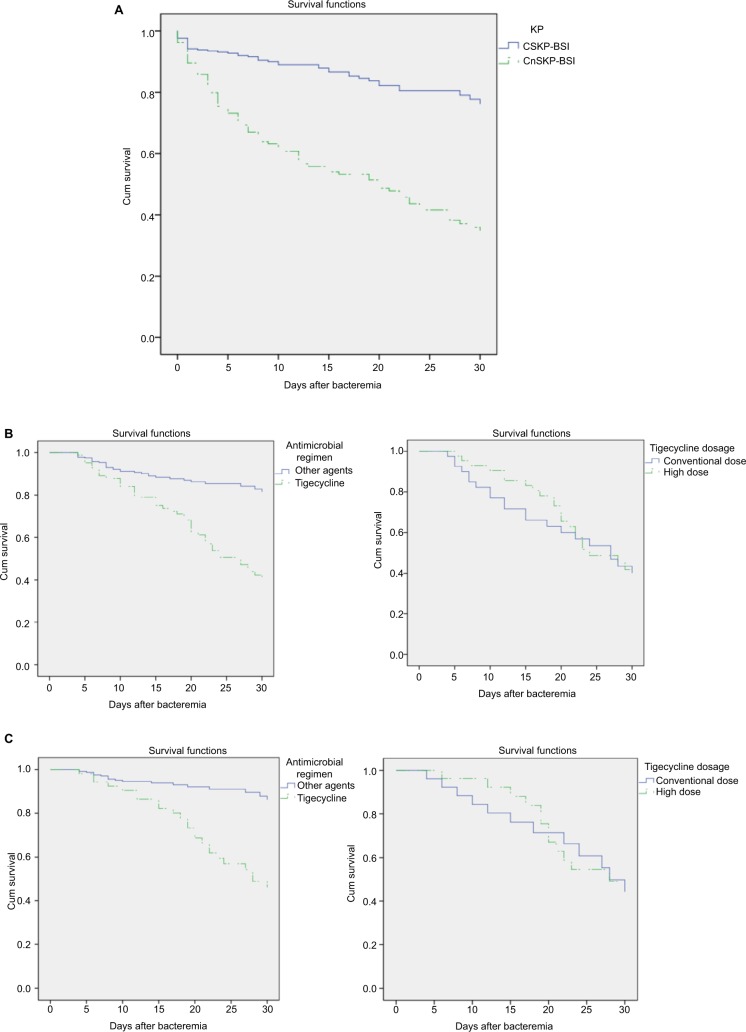
Data from 428 patients with (KP) BSIs were included, 31.5% (n=135) of them with CnSKP. Multivariate analysis showed that prior hospitalization, urinary catheterization, the use of immunosuppressive agents, prior use of antibiotics, pulmonary disease, and high Acute Physiology and Chronic Health Evaluation (APACHE) II scores were independent risk factors for CnSKP-BSIs. The 30-day mortality was higher in patients with CnSKP than in those with CSKP (58.5% vs 15.4%; <0.001). In patients with KP-BSIs, neutropenia, multiple organ dysfunction, respiratory failure, CnSKP infection, high APACHE II score, and tigecycline therapy were independently associated with higher mortality risk. Among patients whose APACHE II score was <15, higher mortality rates were observed in patients treated with tigecycline than in those treated with other antibiotics (45.3% vs 7.7%; <0.001). Central venous catheterization, multiple organ dysfunction, and high APACHE II scores were independent risk factors for death from CnSKP.
A significant increase in the incidence of CnSKP-BSIs was observed during the study period, with a higher mortality rate found in these patients. Exposure to carbapenems and severe illness were independent risk factors for the development of CnSKP-BSIs, and tigecycline therapy resulted in a significant increase in mortality.
碳青霉烯类不敏感肺炎克雷伯菌(CnSKP)正迅速成为一种危及生命的医院感染。替加环素治疗血流感染(BSIs)的疗效仍存在争议。
2013年1月至2015年12月期间,在单一中心收集了总共428例碳青霉烯类敏感肺炎克雷伯菌(CSKP)和CnSKP血流感染患者的数据。进行了三部分分析,以确定与CnSKP相关的危险因素、探索预后并评估治疗方法。
纳入了428例肺炎克雷伯菌血流感染(KP)患者的数据,其中31.5%(n = 135)为CnSKP。多因素分析显示,既往住院史、导尿、使用免疫抑制剂、既往使用抗生素、肺部疾病以及高急性生理与慢性健康状况评分系统(APACHE)II评分是CnSKP血流感染的独立危险因素。CnSKP患者的30天死亡率高于CSKP患者(58.5%对15.4%;P<0.001)。在肺炎克雷伯菌血流感染患者中(KP-BSIs),中性粒细胞减少、多器官功能障碍、呼吸衰竭、CnSKP感染、高APACHE II评分以及替加环素治疗与更高的死亡风险独立相关。在APACHE II评分<15的患者中,接受替加环素治疗的患者死亡率高于接受其他抗生素治疗的患者(45.3%对7.7%;P<0.001)。中心静脉置管、多器官功能障碍以及高APACHE II评分是CnSKP死亡的独立危险因素。
在研究期间,观察到CnSKP血流感染的发生率显著增加,这些患者的死亡率更高。接触碳青霉烯类药物和重症疾病是CnSKP血流感染发生的独立危险因素,替加环素治疗导致死亡率显著增加。