School of Medicine, University of Electronic Science and Technology of China, Chengdu, Sichuan, China.
Department of Laboratory Medicine, Sichuan Provincial People's Hospital, University of Electronic Science and Technology of China, Chengdu, Sichuan, China.
Front Cell Infect Microbiol. 2023 Apr 20;13:1157010. doi: 10.3389/fcimb.2023.1157010. eCollection 2023.
To analyze the mortality rate of patients with bacteremia (KPB) and the impact of extended spectrum beta-lactamase (ESBL) producing or carbapenem-resistance (CR) KP on the mortality rate among patients with bacteremia.
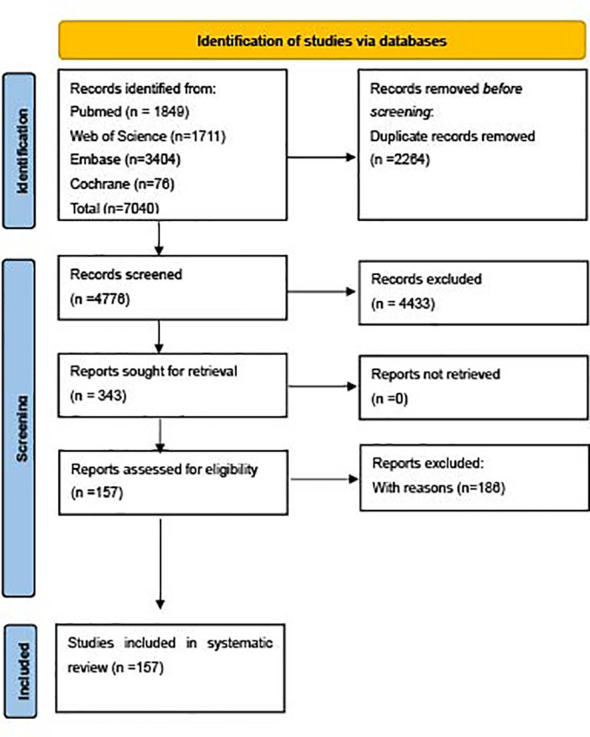
EMbase, Web of Science, PubMed, and The Cochrane Library were searched up to September 18, 2022. Two reviewers independently extracted data and evaluated risk of bias of included studies by ROBINS-I tool. A meta-regression analysis was conducted using a mixed-effects model to explore possible sources of heterogeneity. A random-effects model was used for pooled analysis in case of significant heterogeneity (I>50%). Otherwise, the fixed-effects model was performed.
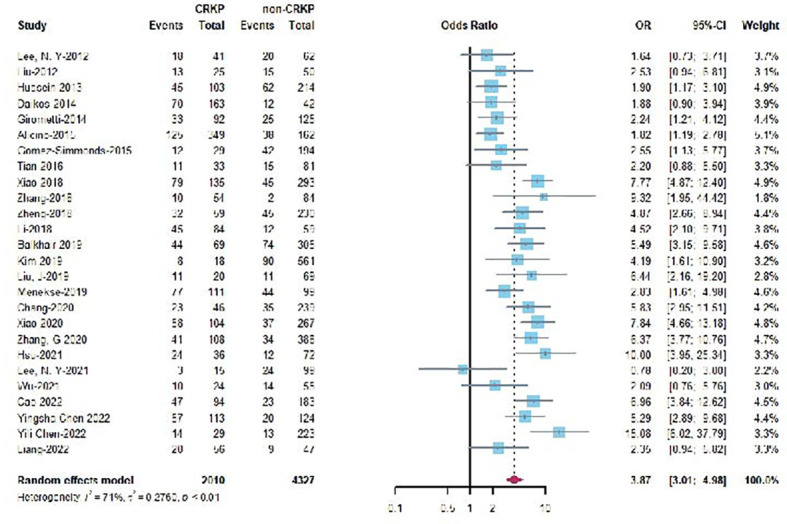
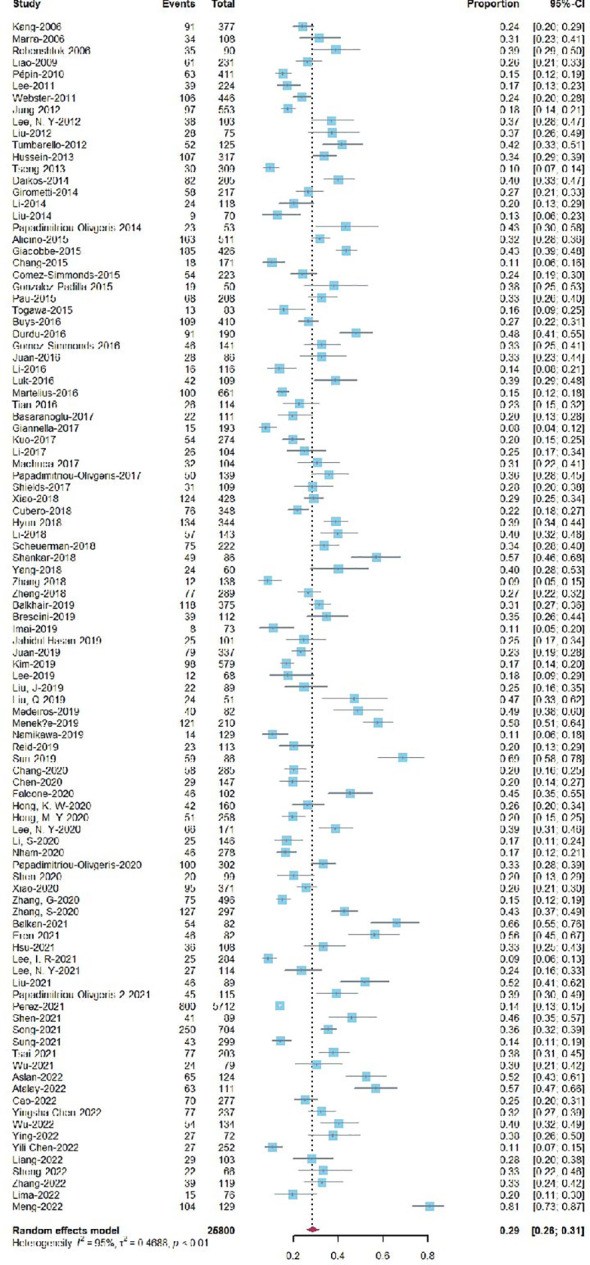
A total of 157 studies (37,915 enrolled patients) were included in the meta-analysis. The pooled death proportions of KPB were 17% (95% CI=0.14-0.20) at 7-day, 24% (95% CI=0.21-0.28) at 14-day, 29% (95% CI=0.26-0.31) at 30-day, 34% (95% CI=0.26-0.42) at 90-day, and 29% (95% CI=0.26-0.33) in hospital, respectively. Heterogeneity was found from the intensive care unit (ICU), hospital-acquired (HA), CRKP, and ESBL-KP in the meta-regression analysis. More than 50% of ICU, HA, CRKP, and ESBL-KP were associated with a significant higher 30-day mortality rates. The pooled mortality odds ratios (ORs) of CRKP . non-CRKP were 3.22 (95% CI 1.18-8.76) at 7-day, 5.66 (95% CI 4.31-7.42) at 14-day, 3.87 (95% CI 3.01-3.49) at 28- or 30-day, and 4.05 (95% CI 3.38-4.85) in hospital, respectively.
This meta-analysis indicated that patients with KPB in ICU, HA-KPB, CRKP, and ESBL-KP bacteremia were associated with a higher mortality rate. The high mortality rate caused by CRKP bacteremia has increased over time, challenging the public health.
分析菌血症(KPB)患者的死亡率,以及产超广谱β-内酰胺酶(ESBL)或碳青霉烯类耐药(CR)KP 对菌血症患者死亡率的影响。
检索 Embase、Web of Science、PubMed 和 The Cochrane Library,截至 2022 年 9 月 18 日。两位审阅者独立提取数据,并使用 ROBINS-I 工具评估纳入研究的偏倚风险。使用混合效应模型进行荟萃回归分析,以探索异质性的可能来源。如果存在显著异质性(I>50%),则使用随机效应模型进行汇总分析。否则,使用固定效应模型。
共有 157 项研究(37915 名纳入患者)纳入荟萃分析。KPB 的 7 天、14 天、30 天、90 天和住院时的死亡比例分别为 17%(95%CI=0.14-0.20)、24%(95%CI=0.21-0.28)、29%(95%CI=0.26-0.31)、34%(95%CI=0.26-0.42)和 29%(95%CI=0.26-0.33)。荟萃回归分析显示,重症监护病房(ICU)、医院获得性(HA)、CRKP 和 ESBL-KP 存在异质性。超过 50%的 ICU、HA、CRKP 和 ESBL-KP 与 30 天死亡率显著升高有关。CRKP 和非 CRKP 的 7 天、14 天、28 天或 30 天和住院时的死亡率比值比(OR)分别为 3.22(95%CI 1.18-8.76)、5.66(95%CI 4.31-7.42)、3.87(95%CI 3.01-3.49)和 4.05(95%CI 3.38-4.85)。
本荟萃分析表明,ICU 中的 KPB 患者、HA-KPB 患者、CRKP 菌血症和 ESBL-KP 菌血症患者的死亡率较高。CRKP 菌血症引起的高死亡率呈上升趋势,对公共卫生构成挑战。