Ebrahimi Chaharom Mohammad Esmaeel, Pournaghi Azar Fatemeh, Mohammadi Narmin, Nasiri Rezvan
Department of Operative Dentistry, Faculty of Dentistry, Tabriz University of Medical Sciences, Tabriz, Iran.
Department of Operative Dentistry, Faculty of Dentistry, Arak University of Medical Sciences, Arak, Iran.
J Dent Res Dent Clin Dent Prospects. 2018 Winter;12(1):12-17. doi: 10.15171/joddd.2018.003. Epub 2018 Mar 14.
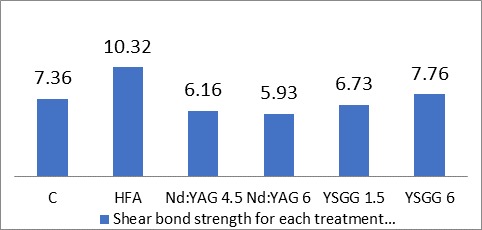
This study was undertaken to evaluate the repair bond strength of lithium disilicate glass ceramic to a silorane-based composite resin after surface preparation with Nd:YAG and Er,Cr:YSGG lasers. A total of 102 lithium disilicate glass ceramic samples (IPS e.max Press), measuring 5 mm in diameter and 4 mm in thickness, were randomly assigned to 6 groups (n=17): group 1, no surface preparation (control); group 2, acid etching with 9.5% hydrofluoric acid (HF); group 3, surface preparation with 4.5-W Nd:YAG laser; group 4, surface preparation with 6-W Nd:YAG laser; group 5, surface preparation with 1.5-W Er,Cr:YSGG laser; and group 6, surface preparation with 6-W Er,Cr:YSGG laser. After preparation of surfaces and application of silane, all the samples were repaired with the use of a silorane-based composite resin, followed by storage in distilled water at a temperature of 37°C for 24 hours and thermocycling. Finally, the samples were subjected to a shearing bond strength test; the fracture modes were determined under a stereomi-croscope. There were significant differences between the HF group and the other groups (P=0.000). Two-by-two comparisons of the other groups revealed no significant differences (P>0.05). Use of HF proved the most effective surface preparation technique to increase the repair bond strength between lithium disilicate glass ceramic and silorane-based composite resin; compared to the control group.
本研究旨在评估用钕钇铝石榴石(Nd:YAG)激光和铬铒钇镓石榴石(Er,Cr:YSGG)激光进行表面处理后,二硅酸锂玻璃陶瓷与硅氧烷基复合树脂之间的修复粘结强度。总共102个二硅酸锂玻璃陶瓷样本(IPS e.max Press),直径5毫米,厚度4毫米,被随机分为6组(n = 17):第1组,未进行表面处理(对照组);第2组,用9.5%氢氟酸(HF)酸蚀;第3组,用4.5瓦Nd:YAG激光进行表面处理;第4组,用6瓦Nd:YAG激光进行表面处理;第5组,用1.5瓦Er,Cr:YSGG激光进行表面处理;第6组,用6瓦Er,Cr:YSGG激光进行表面处理。在表面处理和应用硅烷后,所有样本均使用硅氧烷基复合树脂进行修复,随后在37°C的蒸馏水中储存24小时并进行热循环。最后,对样本进行剪切粘结强度测试;在立体显微镜下确定断裂模式。HF组与其他组之间存在显著差异(P = 0.000)。其他组的两两比较未显示出显著差异(P>0.05)。事实证明,与对照组相比,使用HF是提高二硅酸锂玻璃陶瓷与硅氧烷基复合树脂之间修复粘结强度最有效的表面处理技术。