Goryachev Andrey, Gao Lu, Zhang Yue, Rohling Roderigh Y, Vervuurt René H J, Bol Ageeth A, Hofmann Jan P, Hensen Emiel J M
Laboratory of Inorganic Materials Chemistry, Department of Chemical Engineering and Chemistry Eindhoven University of Technology P.O. Box 513 5600MB Eindhoven The Netherlands.
Laboratory of Plasma and Materials Processing, Department of Applied Physics Eindhoven University of Technology P.O. Box 513 5600MB Eindhoven The Netherlands.
ChemElectroChem. 2018 Apr 11;5(8):1230-1239. doi: 10.1002/celc.201701119. Epub 2018 Feb 22.
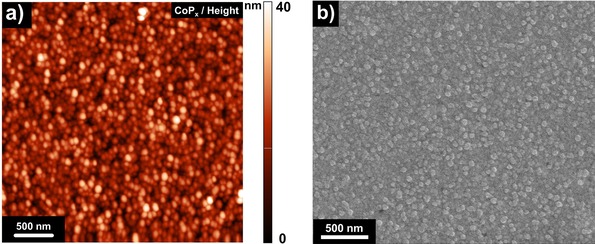
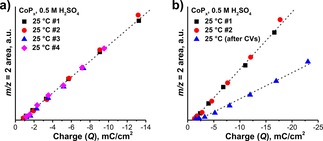
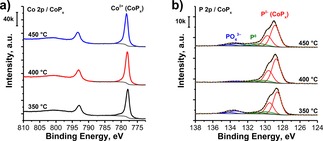
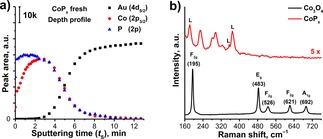
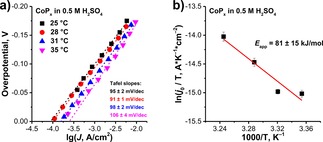
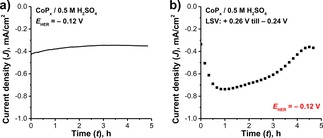
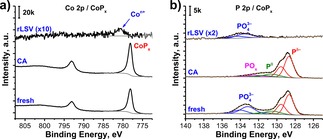
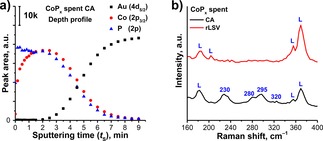
Cobalt phosphides are an emerging earth-abundant alternative to platinum-group-metal-based electrocatalysts for the hydrogen evolution reaction (HER). Yet, their stability is inferior to platinum and compromises the large-scale applicability of CoP in water electrolyzers. In the present study, we employed flat, thin CoP electrodes prepared through the thermal phosphidation (PH) of CoO films made by plasma-enhanced atomic layer deposition to evaluate their stability in acidic water electrolysis by using a multi-technique approach. The films were found to be composed of two phases: CoP in the bulk and a P-rich surface CoP (P/Co>1). Their performance was evaluated in the HER and the exchange current density was determined to be =-8.9 ⋅ 10 A/cm. The apparent activation energy of HER on CoP (=81±15 kJ/mol) was determined for the first time. Dissolution of the material in 0.5 M HSO was observed, regardless of the constantly applied cathodic potential, pointing towards a chemical instead of an electrochemical origin of the observed cathodic instability. The current density and HER faradaic efficiency (FE) were found to be stable during chronoamperometric treatment, as the chemical composition of the HER-active phase remained unchanged. On the contrary, a dynamic potential change performed in a repeated way facilitated dissolution of the film, yielding its complete degradation within 5 h. There, the FE was also found to be changing. An oxidative route of CoP dissolution has also been proposed.
磷化钴是一种新兴的、储量丰富的替代基于铂族金属的析氢反应(HER)电催化剂的材料。然而,它们的稳定性不如铂,这限制了CoP在水电解槽中的大规模应用。在本研究中,我们采用通过等离子体增强原子层沉积制备的CoO薄膜的热磷化(PH)方法制备了扁平、薄的CoP电极,并用多技术方法评估了它们在酸性水电解中的稳定性。发现这些薄膜由两相组成:块状的CoP和富含P的表面CoP(P/Co>1)。在HER中评估了它们的性能,确定交换电流密度为=-8.9⋅10 A/cm。首次确定了HER在CoP上的表观活化能(=81±15 kJ/mol)。观察到材料在0.5 M HSO中溶解,无论持续施加的阴极电位如何,这表明观察到的阴极不稳定性的起源是化学的而非电化学的。在计时电流处理过程中,发现电流密度和HER法拉第效率(FE)是稳定的,因为HER活性相的化学成分保持不变。相反,以重复方式进行的动态电位变化促进了薄膜的溶解,在5 h内使其完全降解。在那里,还发现FE在变化。还提出了CoP溶解的氧化途径。