Zhang Yue, Gao Lu, Hensen Emiel J M, Hofmann Jan P
Laboratory of Inorganic Materials Chemistry, Department of Chemical Engineering and Chemistry, Eindhoven University of Technology, P.O. Box 513, 5600MB Eindhoven, The Netherlands.
ACS Energy Lett. 2018 Jun 8;3(6):1360-1365. doi: 10.1021/acsenergylett.8b00514. Epub 2018 May 16.
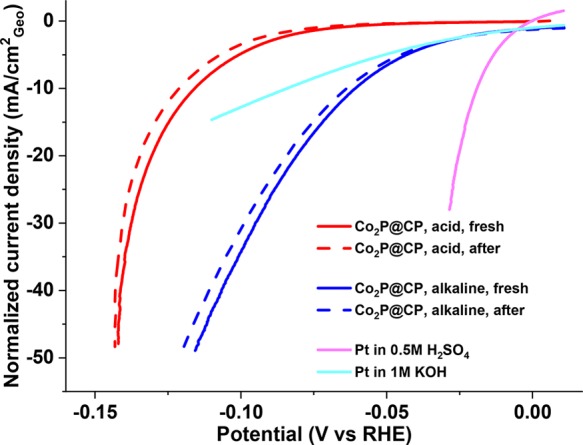
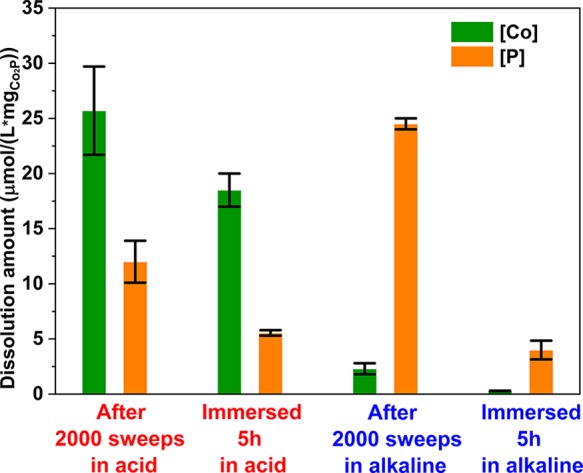
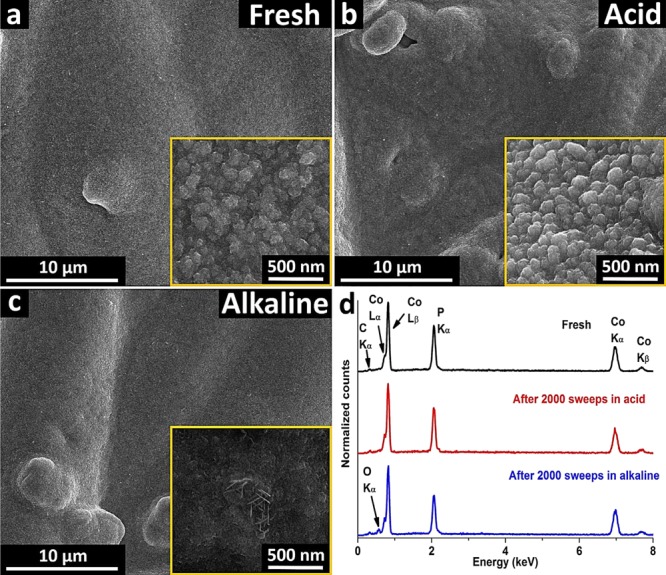
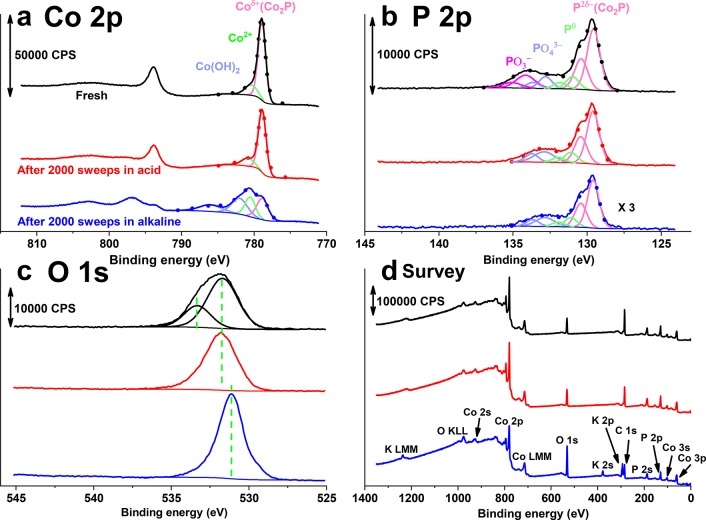
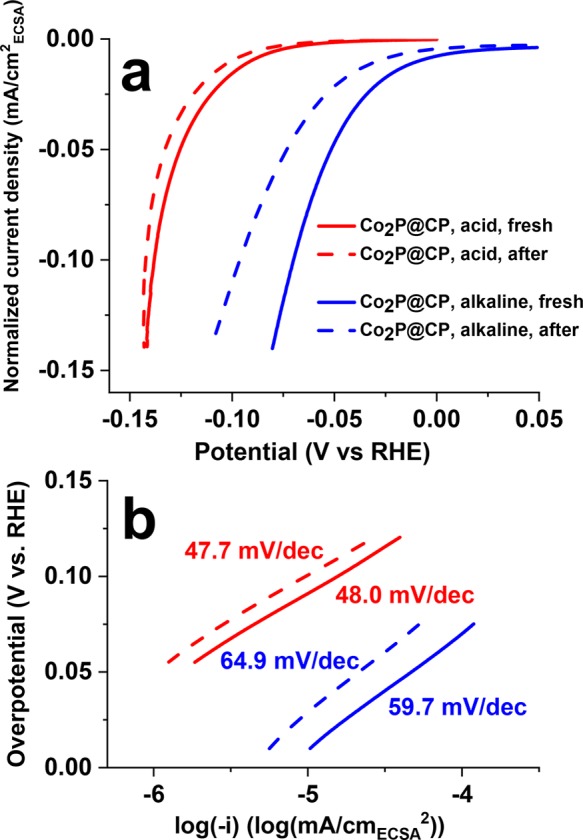
The evaluation of the stability of emerging earth-abundant metal phosphide electrocatalysts by solely electrochemical current-potential sweeps is often not conclusive. In this study, we investigated CoP to evaluate its stability under both acidic (0.5 M HSO) and alkaline (1.0 M KOH) hydrogen evolution (HER) conditions. We found that the electrochemical surface area (ECSA) of CoP only slightly increased in acidic conditions but almost doubled after electrolysis in alkaline electrolyte. The surface composition of the electrode remained almost unchanged in acid but was significantly altered in alkaline during current-potential sweeps. Analysis of the electrolytes after the stability test shows almost stoichiometric composition of Co and P in acid, but a preferential dissolution of P over Co could be observed in alkaline electrolyte. Applying comprehensive postcatalysis analysis of both the electrode and electrolyte, we conclude that CoP, prepared by thermal phosphidization, dissolves stoichiometrically in acid and degrades to hydroxides under alkaline stability testing.
仅通过电化学电流-电位扫描来评估新兴的储量丰富的金属磷化物电催化剂的稳定性往往并不具有决定性。在本研究中,我们研究了CoP,以评估其在酸性(0.5 M HSO)和碱性(1.0 M KOH)析氢(HER)条件下的稳定性。我们发现,CoP的电化学表面积(ECSA)在酸性条件下仅略有增加,但在碱性电解质中电解后几乎增加了一倍。电极的表面组成在酸性条件下几乎保持不变,但在电流-电位扫描过程中在碱性条件下发生了显著变化。稳定性测试后的电解质分析表明,酸性条件下Co和P的组成几乎呈化学计量比,但在碱性电解质中可以观察到P比Co更易溶解。通过对电极和电解质进行全面的催化后分析,我们得出结论,通过热磷化制备的CoP在酸性条件下按化学计量比溶解,并在碱性稳定性测试下降解为氢氧化物。