
布鲁氏菌肽交叉反应性主要组织相容性复合体 I 类呈递激活 SIINFEKL 特异性 T 细胞受体表达 T 细胞。
Brucella Peptide Cross-Reactive Major Histocompatibility Complex Class I Presentation Activates SIINFEKL-Specific T Cell Receptor-Expressing T Cells.
机构信息
Department of Pediatrics, School of Medicine and Public Health, University of Wisconsin-Madison, Madison, Wisconsin, USA.
Department of Pathobiological Sciences, School of Veterinary Medicine, University of Wisconsin-Madison, Madison, Wisconsin, USA.
出版信息
Infect Immun. 2018 Jun 21;86(7). doi: 10.1128/IAI.00281-18. Print 2018 Jul.
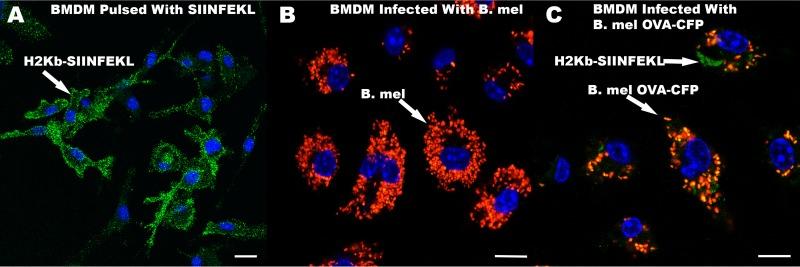
spp. are intracellular pathogenic bacteria remarkable in their ability to escape immune surveillance and therefore inflict a state of chronic disease within the host. To enable further immune response studies, was engineered to express the well-characterized chicken ovalbumin (OVA). Surprisingly, we found that CD8 T cells bearing T cell receptors (TCR) nominally specific for the OVA peptide SIINFEKL (OT-1) reacted to parental -infected targets as well as OVA-expressing variants in cytotoxicity assays. Furthermore, splenocytes from -immunized mice produced gamma interferon (IFN-γ) and exhibited cytotoxicity in response to SIINFEKL-pulsed target cells.To determine if the SIINFEKL-reactive OT-1 TCR could be cross-reacting to peptides, we searched the proteome using an algorithm to generate a list of near-neighbor nonamer peptides that would bind to H2K Selecting five peptide candidates, along with controls, we verified that several of these peptides mimicked SIINFEKL, resulting in T cell activation through the "SIINFEKL-specific" TCR. Activation was dependent on peptide concentration as well as sequence. Our results underscore the complexity and ubiquity of cross-reactivity in T cell recognition. This cross-reactivity may enable microbes such as to escape immune surveillance by presenting peptides similar to those of the host and may also lead to the activation of autoreactive T cells.
spp. 是一种能够逃避免疫监视的细胞内致病性细菌,因此会在宿主中引发慢性疾病状态。为了能够进一步进行免疫反应研究,我们构建了能够表达具有良好特征的鸡卵清蛋白 (OVA) 的 。令人惊讶的是,我们发现,具有针对 OVA 肽 SIINFEKL(OT-1)的名义上特异性的 T 细胞受体 (TCR) 的 CD8 T 细胞在细胞毒性测定中也能反应于亲本感染的靶标以及表达 OVA 的 变体。此外,来自 -免疫的小鼠的脾细胞产生伽马干扰素 (IFN-γ),并对 SIINFEKL 脉冲靶细胞表现出细胞毒性。为了确定 SIINFEKL 反应性的 OT-1 TCR 是否能够与 肽交叉反应,我们使用一种算法搜索了 蛋白质组,以生成一个结合到 H2K 的近邻九肽列表。选择了五个 肽候选物以及对照物,我们验证了其中一些肽模拟了 SIINFEKL,导致通过“SIINFEKL 特异性”TCR 激活 T 细胞。激活依赖于肽浓度和序列。我们的结果强调了 T 细胞识别中的交叉反应的复杂性和普遍性。这种交叉反应可能使像 这样的微生物能够通过呈现与宿主相似的肽来逃避免疫监视,并且也可能导致自身反应性 T 细胞的激活。




 Zotero 插件