Islam Md Rakeb-Ul, Schmidt Daniel J, Crook David A, Hughes Jane M
Australian Rivers Institute, Griffith University, Brisbane, Australia.
Research Institute for Environment and Livelihoods, Charles Darwin University, Darwin, NT, Australia.
PeerJ. 2018 May 3;6:e4654. doi: 10.7717/peerj.4654. eCollection 2018.
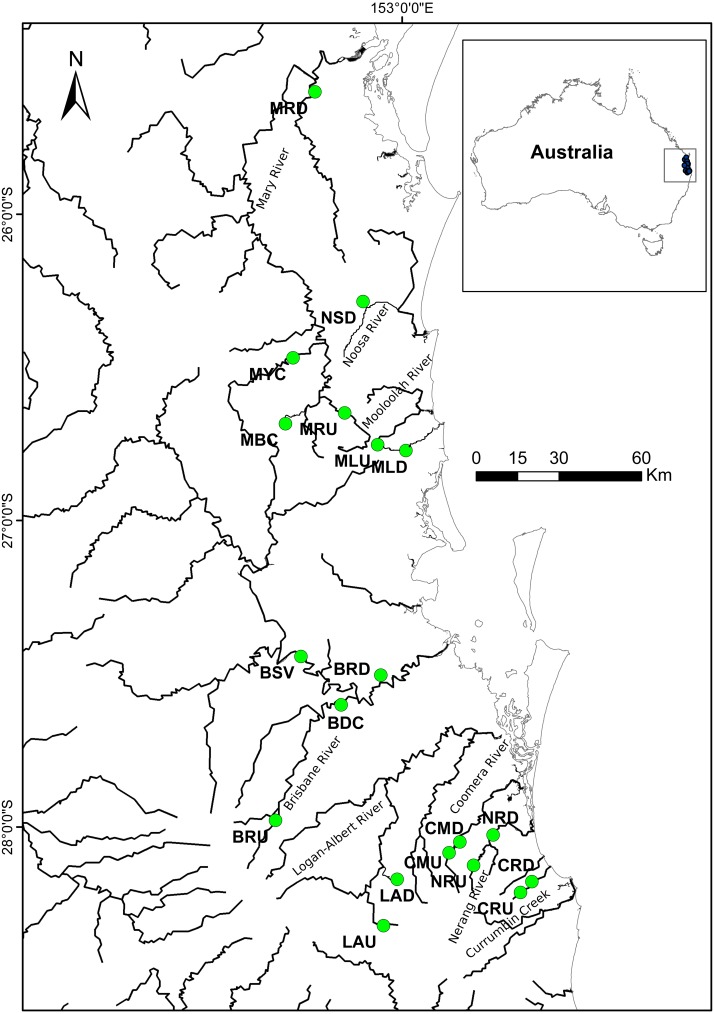
Freshwater fishes often exhibit high genetic population structure due to the prevalence of dispersal barriers (e.g., waterfalls) whereas population structure in diadromous fishes tends to be weaker and driven by natal homing behaviour and/or isolation by distance. The Australian smelt (Retropinnidae: ) is a native fish with a broad distribution spanning inland and coastal drainages of south-eastern Australia. Previous studies have demonstrated variability in population genetic structure and movement behaviour (potamodromy, facultative diadromy, estuarine residence) across the southern part of its geographic range. Some of this variability may be explained by the existence of multiple cryptic species. Here, we examined genetic structure of populations towards the northern extent of the species' distribution, using ten microsatellite loci and sequences of the mitochondrial cyt gene. We tested the hypothesis that genetic connectivity among rivers should be low due to a lack of dispersal via the marine environment, but high within rivers due to dispersal. We investigated populations corresponding with two putative cryptic species, SEQ-North (SEQ-N), and SEQ-South (SEQ-S) lineages occurring in south east Queensland drainages. These two groups formed monophyletic clades in the mtDNA gene tree and among river phylogeographic structure was also evident within each clade. In agreement with our hypothesis, highly significant overall values suggested that both groups exhibit very low dispersal among rivers (SEQ-S = 0.13; SEQ-N = 0.27). Microsatellite data indicated that connectivity among sites within rivers was also limited, suggesting dispersal may not homogenise populations at the within-river scale. Northern groups in the Australian smelt cryptic species complex exhibit comparatively higher among-river population structure and smaller geographic ranges than southern groups. These properties make northern Australian smelt populations potentially susceptible to future conservation threats, and we define eight genetically distinct management units along south east Queensland to guide future conservation management. The present findings at least can assist managers to plan for effective conservation and management of different fish species along coastal drainages of south east Queensland, Australia.
由于扩散障碍(如瀑布)普遍存在,淡水鱼往往呈现出高度的遗传种群结构,而洄游性鱼类的种群结构往往较弱,由出生地归巢行为和/或距离隔离驱动。澳大利亚胡瓜鱼(Retropinnidae: )是一种本土鱼类,广泛分布于澳大利亚东南部的内陆和沿海排水系统。先前的研究表明,在其地理分布范围的南部,种群遗传结构和移动行为(淡水洄游、兼性洄游、河口栖息)存在变异性。这种变异性的部分原因可能是存在多个隐存种。在这里,我们使用10个微卫星位点和线粒体细胞色素基因序列,研究了该物种分布范围北部的种群遗传结构。我们检验了这样一个假设:由于缺乏通过海洋环境的扩散,河流之间的遗传连通性应该较低,但由于扩散,河流内部的遗传连通性应该较高。我们调查了与昆士兰州东南部排水系统中两个假定的隐存种,即SEQ-北(SEQ-N)和SEQ-南(SEQ-S)谱系相对应的种群。这两组在mtDNA基因树中形成了单系类群,并且在每个类群中河流系统发育地理结构也很明显。与我们的假设一致,高度显著的总体 值表明,两组在河流之间的扩散都非常低(SEQ-S = 0.13;SEQ-N = 0.27)。微卫星数据表明,河流内各地点之间的连通性也有限,这表明扩散可能不会在河流尺度上使种群同质化。澳大利亚胡瓜鱼隐存种复合体中的北部种群比南部种群表现出相对较高的河流间种群结构和较小的地理范围。这些特性使澳大利亚北部胡瓜鱼种群未来可能易受保护威胁,我们在昆士兰州东南部定义了8个遗传上不同的管理单元,以指导未来的保护管理。目前的研究结果至少可以帮助管理者规划对澳大利亚昆士兰州东南部沿海排水系统中不同鱼类物种的有效保护和管理。