Digital Manufacturing and Design Center, Singapore University of Technology and Design, Singapore, 487372, Singapore.
College of Engineering and Applied Science, University of Colorado-Denver, Denver, CO, 80204, USA.
Nat Commun. 2018 May 8;9(1):1831. doi: 10.1038/s41467-018-04292-8.
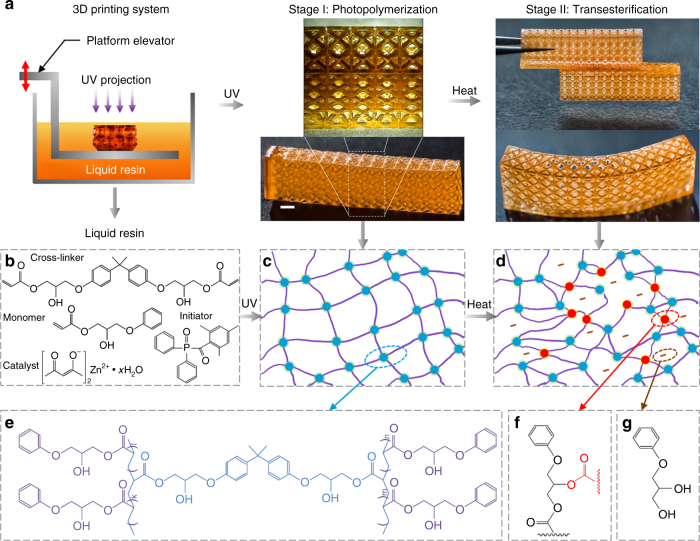
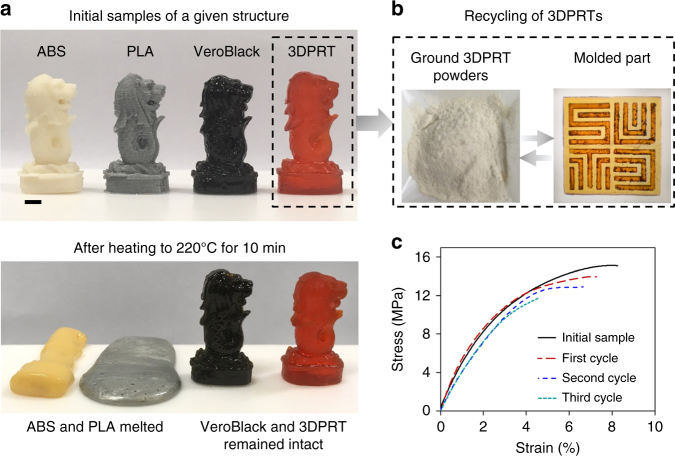
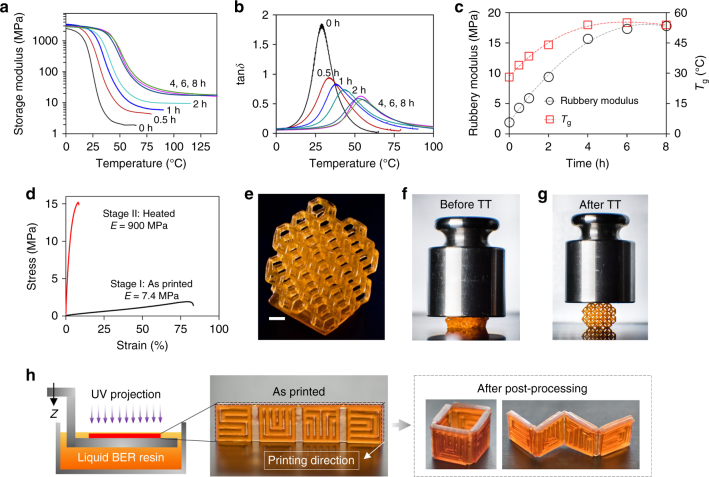
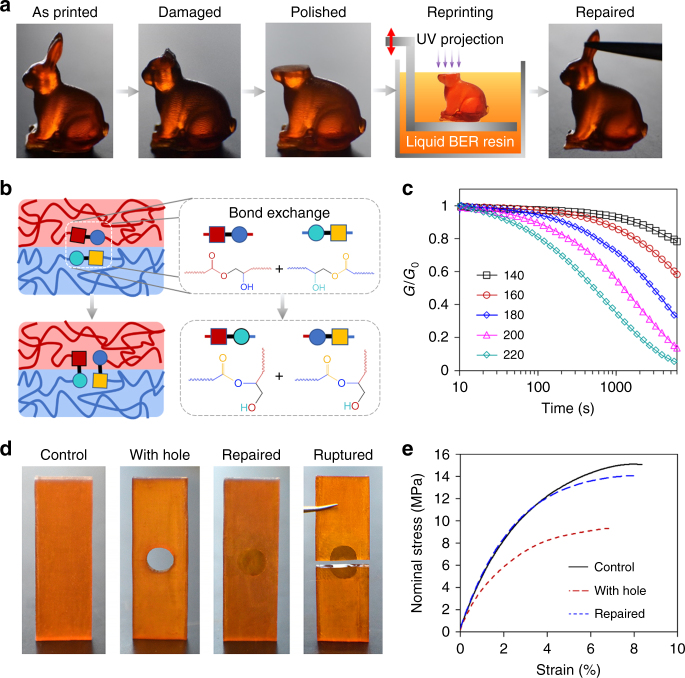
Among all three-dimensional (3D) printing materials, thermosetting photopolymers claim almost half of the market, and have been widely used in various fields owing to their superior mechanical stability at high temperatures, excellent chemical resistance as well as good compatibility with high-resolution 3D printing technologies. However, once these thermosetting photopolymers form 3D parts through photopolymerization, the covalent networks are permanent and cannot be reprocessed, i.e., reshaped, repaired, or recycled. Here, we report a two-step polymerization strategy to develop 3D printing reprocessable thermosets (3DPRTs) that allow users to reform a printed 3D structure into a new arbitrary shape, repair a broken part by simply 3D printing new material on the damaged site, and recycle unwanted printed parts so the material can be reused for other applications. These 3DPRTs provide a practical solution to address environmental challenges associated with the rapid increase in consumption of 3D printing materials.
在所有的三维(3D)打印材料中,热固性光聚合物占据了近一半的市场,由于其在高温下具有优异的机械稳定性、出色的耐化学性以及与高分辨率 3D 打印技术的良好兼容性,因此被广泛应用于各个领域。然而,一旦这些热固性光聚合物通过光聚合形成 3D 零件,其共价网络就是永久性的,无法再进行加工,即无法重塑、修复或回收。在这里,我们报告了一种两步聚合策略,用于开发可进行 3D 打印后处理的热固性材料(3DPRTs),该材料允许用户将打印的 3D 结构改造成新的任意形状,只需在损坏部位上进行 3D 打印新材料即可修复损坏的部件,并回收不需要的打印部件,以便将材料重新用于其他应用。这些 3DPRTs 为解决与 3D 打印材料快速消耗相关的环境挑战提供了一种实用的解决方案。