Filippidi Emmanouela, Cristiani Thomas R, Eisenbach Claus D, Waite J Herbert, Israelachvili Jacob N, Ahn B Kollbe, Valentine Megan T
Materials Research Laboratory, University of California, Santa Barbara, CA 93106, USA.
Department of Mechanical Engineering, University of California, Santa Barbara, CA 93106, USA.
Science. 2017 Oct 27;358(6362):502-505. doi: 10.1126/science.aao0350.
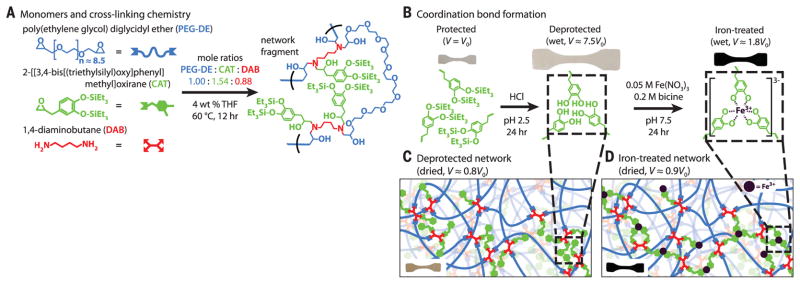
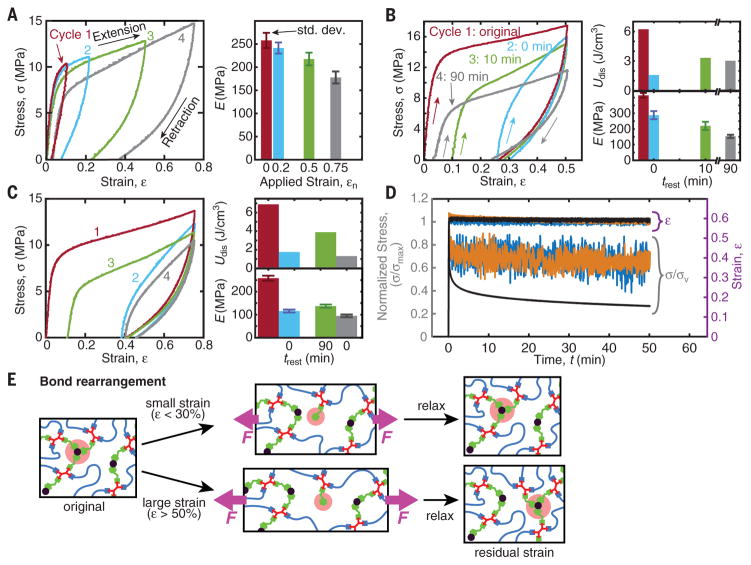
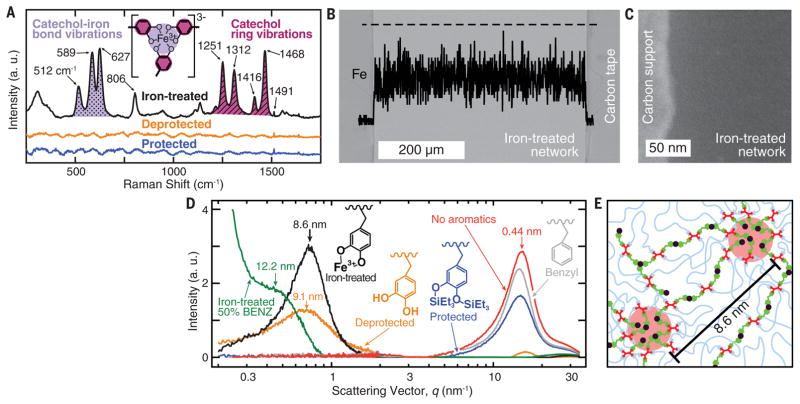
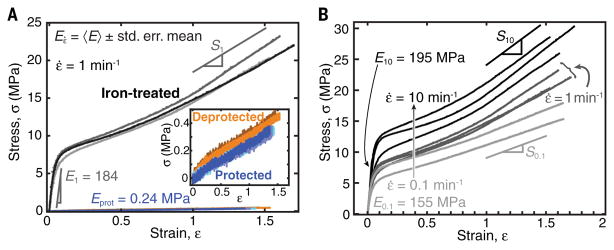
Materials often exhibit a trade-off between stiffness and extensibility; for example, strengthening elastomers by increasing their cross-link density leads to embrittlement and decreased toughness. Inspired by cuticles of marine mussel byssi, we circumvent this inherent trade-off by incorporating sacrificial, reversible iron-catechol cross-links into a dry, loosely cross-linked epoxy network. The iron-containing network exhibits two to three orders of magnitude increases in stiffness, tensile strength, and tensile toughness compared to its iron-free precursor while gaining recoverable hysteretic energy dissipation and maintaining its original extensibility. Compared to previous realizations of this chemistry in hydrogels, the dry nature of the network enables larger property enhancement owing to the cooperative effects of both the increased cross-link density given by the reversible iron-catecholate complexes and the chain-restricting ionomeric nanodomains that they form.
材料通常在刚度和可拉伸性之间存在权衡;例如,通过增加交联密度来增强弹性体会导致脆化和韧性降低。受海洋贻贝足丝角质层的启发,我们通过将牺牲性、可逆的铁-儿茶酚交联引入干燥、交联松散的环氧网络中来规避这种固有的权衡。与不含铁的前驱体相比,含铁网络的刚度、拉伸强度和拉伸韧性提高了两到三个数量级,同时获得了可恢复的滞后能量耗散并保持了其原始可拉伸性。与先前在水凝胶中实现的这种化学方法相比,网络的干燥性质由于可逆铁-儿茶酚配合物提供的交联密度增加以及它们形成的链限制离聚纳米域的协同作用而能够实现更大的性能提升。