Department of Biological Sciences, Clemson University, Clemson, SC, 29631, USA.
Museum of Paleontology, University of Michigan, Ann Arbor, MI, 48109, USA.
Sci Rep. 2018 May 8;8(1):7278. doi: 10.1038/s41598-018-25715-y.
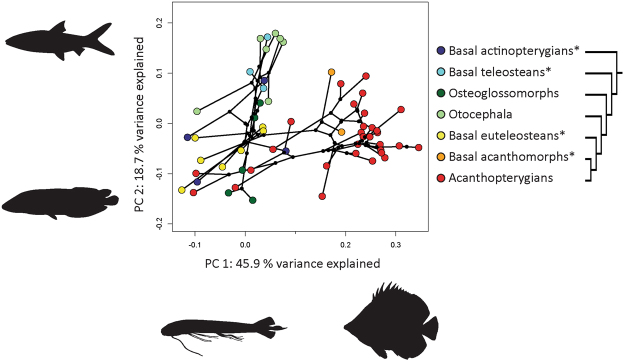
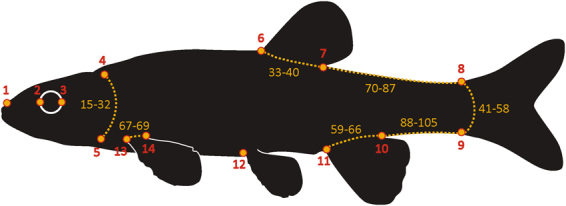
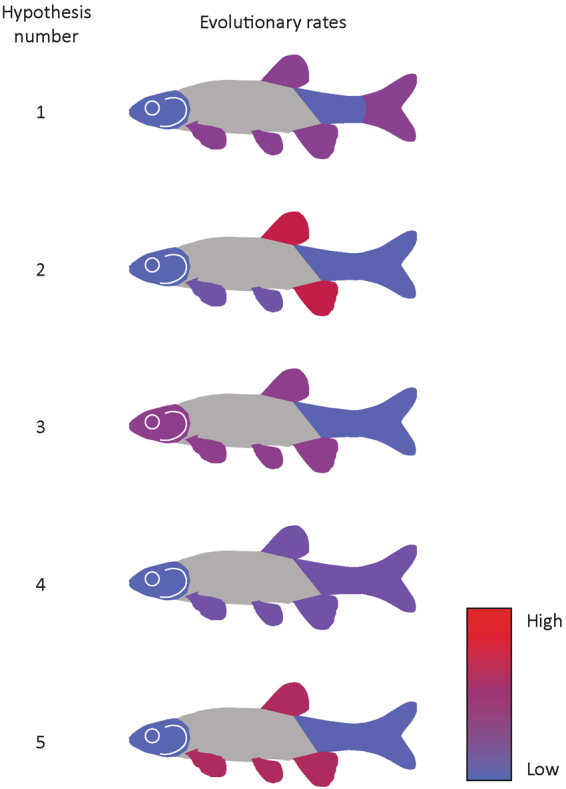
Modularity is considered a prerequisite for the evolvability of biological systems. This is because in theory, individual modules can follow quasi-independent evolutionary trajectories or evolve at different rates compared to other aspects of the organism. This may influence the potential of some modules to diverge, leading to differences in disparity. Here, we investigated this relationship between modularity, rates of morphological evolution and disparity using a phylogenetically diverse sample of ray-finned fishes. We compared the support for multiple hypotheses of evolutionary modularity and asked if the partitions delimited by the best-fitting models were also characterized by the highest evolutionary rate differentials. We found that an evolutionary module incorporating the dorsal, anal and paired fins was well supported by the data, and that this module evolves more rapidly and consequently generates more disparity than other modules. This suggests that modularity may indeed promote morphological disparity through differences in evolutionary rates across modules.
模块化被认为是生物系统进化能力的先决条件。这是因为理论上,单个模块可以遵循准独立的进化轨迹,或者与生物体的其他方面相比以不同的速度进化。这可能会影响某些模块的发散潜力,导致差异度的不同。在这里,我们使用一个多样化的射线鳍鱼类的系统发育样本,研究了模块化、形态进化速度和差异度之间的这种关系。我们比较了对多种进化模块化假说的支持,并询问了最佳拟合模型所限定的分区是否也以最高的进化速率差异为特征。我们发现,一个包含背鳍、臀鳍和偶鳍的进化模块得到了数据的很好支持,并且这个模块比其他模块进化得更快,因此产生了更多的差异。这表明,模块化确实可以通过模块之间的进化速度差异来促进形态差异。