Xi Lei, Zhang Chen, He Yanling
Department of Ophthalmology, Peking University International Hospital, Beijing, China.
Tianjin Medical University Eye hospital, Tianjin Medical University Eye Institute, School of Optometry and Ophthalmology, Tianjin, China.
BMC Ophthalmol. 2018 May 9;18(1):115. doi: 10.1186/s12886-018-0775-5.
To evaluate the refractive and visual outcomes of Transepithelial photorefractive keratectomy (TransPRK) in the treatment of low to moderate myopic astigmatism.
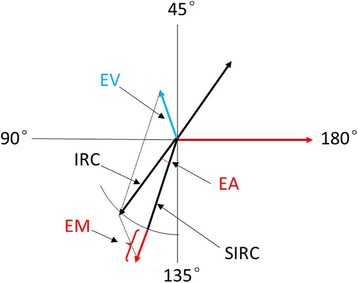
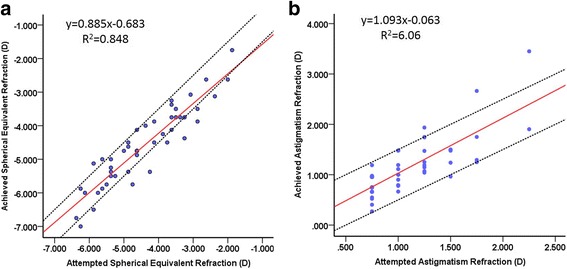
This retrospective study enrolled a total of 47 eyes that had undergone Transepithelial photorefractive keratectomy. Preoperative cylinder diopters ranged from - 0.75D to - 2.25D (mean - 1.11 ± 0.40D), and the sphere was between - 1.50D to - 5.75D. Visual outcomes and vector analysis of astigmatism that included error ratio (ER), correction ratio (CR), error of magnitude (EM) and error of angle (EA) were evaluated.
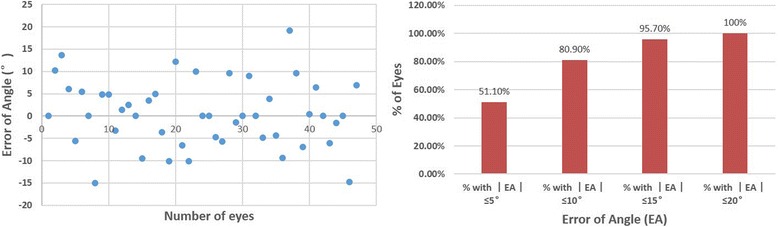
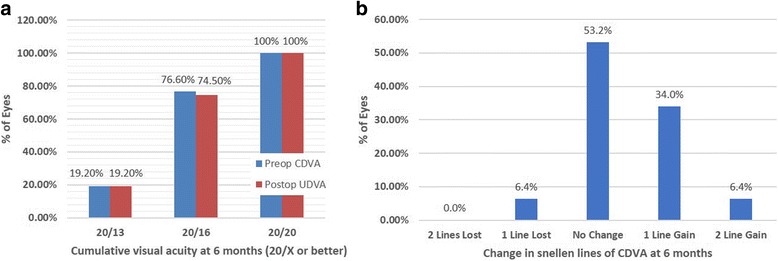
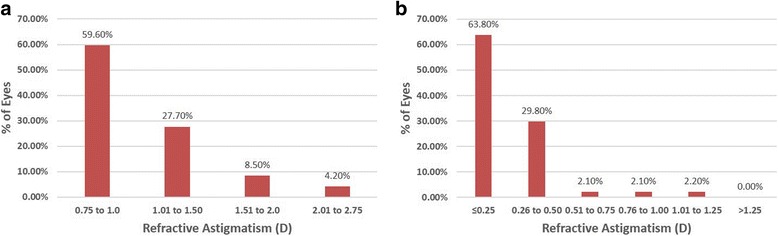
At 6 months after TransPRK, all eyes had an uncorrected distance visual acuity of 20/20 or better, no eyes lost ≥2 lines of corrected distant visual acuity (CDVA), and 93.6% had residual refractive cylinder within ±0.50D of intended correction. On vector analysis, the mean correction ratio for refractive cylinder was 1.03 ± 0.30. The mean error magnitude was - 0.04 ± 0.36. The mean error of angle was 0.44° ± 7.42°and 80.9% of eyes had axis shift within ±10°. The absolute astigmatic error of magnitude was statistically significantly correlated with the intended cylinder correction (r = 0.48, P < 0.01).
TransPRK showed safe, effective and predictable results in the correction of low to moderate astigmatism and myopia.
评估经上皮准分子激光角膜切削术(TransPRK)治疗中低度近视散光的屈光和视觉效果。
这项回顾性研究共纳入47只接受经上皮准分子激光角膜切削术的眼睛。术前柱镜屈光度范围为-0.75D至-2.25D(平均-1.11±0.40D),球镜度数在-1.50D至-5.75D之间。评估视觉效果以及散光的矢量分析,包括误差率(ER)、矫正率(CR)、量值误差(EM)和角度误差(EA)。
TransPRK术后6个月时,所有眼睛的未矫正远视力均达到20/20或更好,没有眼睛的矫正远视力(CDVA)下降≥2行,93.6%的眼睛残余屈光柱镜在预期矫正值的±0.50D范围内。矢量分析显示,屈光柱镜的平均矫正率为1.03±0.30。平均量值误差为-0.04±0.36。平均角度误差为0.44°±7.42°,80.9%的眼睛轴位偏移在±10°以内。量值的绝对散光误差与预期柱镜矫正值在统计学上显著相关(r = 0.48,P < 0.01)。
TransPRK在矫正中低度散光和近视方面显示出安全、有效且可预测的结果。