Department of Radiology, Mayo Clinic and Foundation, Rochester, MN, USA.
Department of Health Sciences Research, Division of Biostatistics, Mayo Clinic and Foundation, Rochester, MN, USA.
Sci Rep. 2018 May 9;8(1):7421. doi: 10.1038/s41598-018-25459-9.
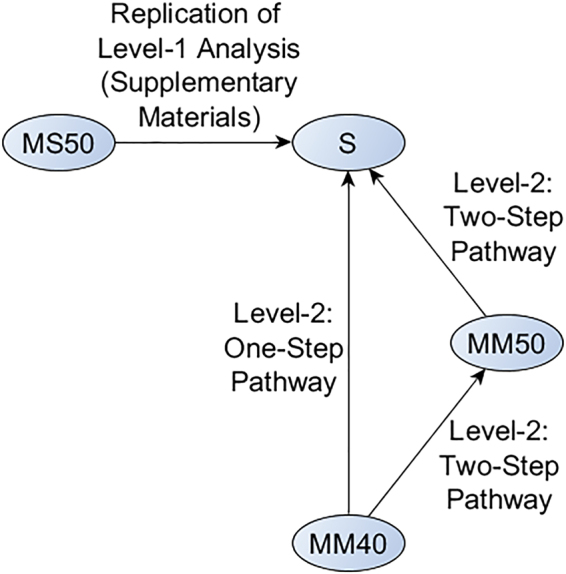
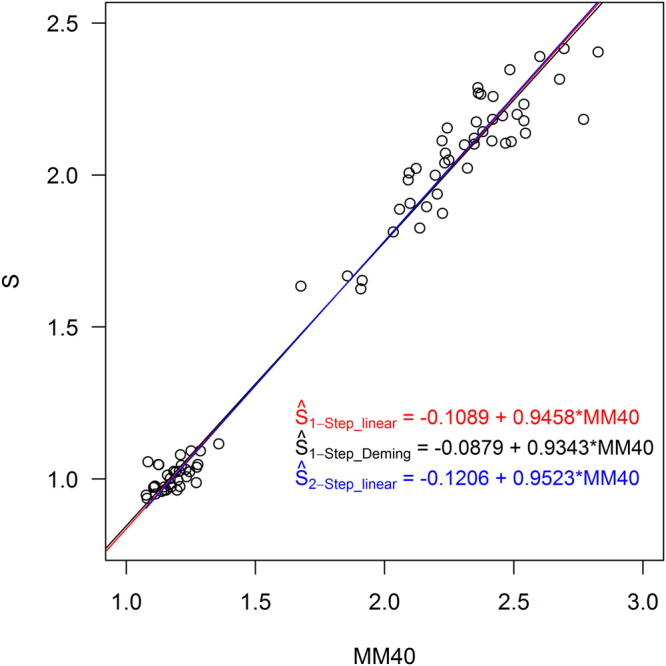
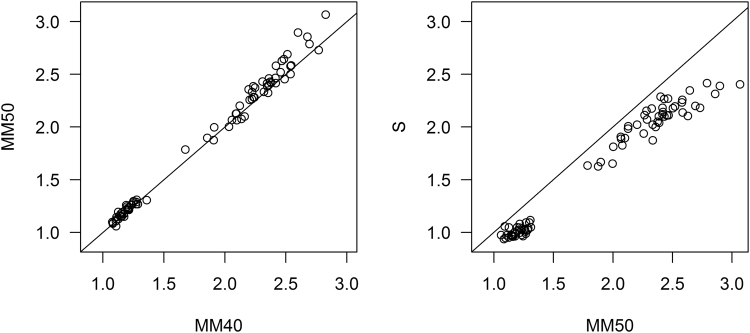
The Centiloid Project describes a post-hoc data transformation to standardize amyloid PET measurements to enable direct data comparisons across sites and studies using differing acquisition/analysis methods. It uses linear regression that transforms values using different measurement scales to match those from a standard Centiloid unit scale. Our group's measurement method differs from the Centiloid's standard method in both acquisition and analysis methods. In this work we examine multiple variations for performing these transformations and compare several approaches. We hypothesized that using Deming regression, which accounts for error on both axes, would produce a more optimal transformation than the recommended standard linear regression. We also examined the effects of performing separate regressions for differences in acquisition and analysis methods, rather than a direct single-regression approach. Our results found that all transformation approaches had very similar performance and were within the recommended tolerance thresholds.
Centiloid 项目描述了一种事后数据转换方法,用于将淀粉样蛋白 PET 测量标准化,以实现使用不同采集/分析方法的跨站点和研究的直接数据比较。它使用线性回归,通过使用不同的测量尺度来转换值,以匹配标准 Centiloid 单位尺度的值。我们小组的测量方法在采集和分析方法上与 Centiloid 的标准方法都不同。在这项工作中,我们研究了执行这些转换的多种变体,并比较了几种方法。我们假设使用同时考虑两个轴上误差的 Deming 回归,会比推荐的标准线性回归产生更优的转换。我们还研究了为采集和分析方法的差异分别进行回归,而不是直接进行单一回归方法的效果。我们的结果发现,所有转换方法的性能都非常相似,并且都在推荐的容差范围内。