Experimental and Observational Rheumatology and Rheumatology Unit, Instituto de Investigación Sanitaria - Hospital Clínico Universitario de Santiago, Travesia Choupana sn, 15706, Santiago de Compostela, Spain.
CESPU, Institute of Research & Advanced Training in Health Sciences & Technologies, Department of Pharmaceutical Sciences, Rua Central de Gandra, 1317, 4585-116, Gandra, PRD, Portugal.
Sci Rep. 2018 May 9;8(1):7342. doi: 10.1038/s41598-018-25634-y.
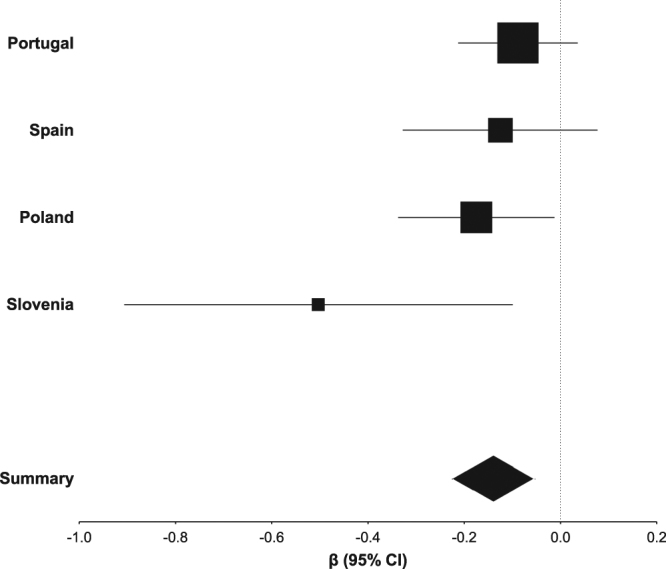
About 70 genetic studies have already addressed the need of biomarkers to predict the response of patients with rheumatoid arthritis (RA) to methotrexate (MTX) treatment. However, no genetic biomarker has yet been sufficiently validated. Here, we aimed to replicate a selection of 25 SNPs in the largest collection of patients up to date, which consisted of 915 patients treated with MTX. The change in disease activity (measured as ΔDAS28) from baseline was considered the primary outcome. In addition, response according to widely used criteria (EULAR) was taken as secondary outcome. We considered consistency between outcomes, P values accounting for the number of SNPs, and independence from potential confounders for interpretation of the results. Only the rs1801394 SNP in MTRR fulfilled the high association standards. Its minor allele was associated with less improvement than the major allele according to ΔDAS28 (p = 0.0016), and EULAR response (p = 0.004), with independence of sex, age, baseline DAS28, smoking, seropositivity, concomitant corticosteroid use or previous treatments. In addition, previous evidence suggests the association of this SNP with response to MTX in another autoimmune disease, juvenile idiopathic arthritis, and with high intracellular folate levels, which could contribute to poor response.
已有约 70 项遗传研究探讨了生物标志物在预测类风湿关节炎(RA)患者对甲氨蝶呤(MTX)治疗反应中的作用。然而,目前尚无遗传生物标志物得到充分验证。本研究旨在对迄今为止最大的患者队列中 25 个 SNP 进行重复验证,该队列共纳入 915 例接受 MTX 治疗的患者。疾病活动度的变化(以 ΔDAS28 衡量)被视为主要结局。此外,还将广泛使用的标准(EULAR)的反应作为次要结局。我们考虑了结局的一致性、考虑 SNP 数量的 P 值以及对潜在混杂因素的独立性,以解释结果。只有 MTRR 中的 rs1801394 SNP 符合高关联标准。与主要等位基因相比,次要等位基因与 ΔDAS28(p=0.0016)和 EULAR 反应(p=0.004)的改善程度较低相关,且不受性别、年龄、基线 DAS28、吸烟、血清阳性、同时使用皮质类固醇或先前治疗的影响。此外,先前的证据表明,该 SNP 与 MTX 在另一种自身免疫性疾病——幼年特发性关节炎中的反应以及与细胞内叶酸水平较高有关,这可能导致反应不佳。