Department of Epidemiology, University of Texas Health Science Center Houston, Texas, United States of America.
Department of Internal Medicine, University of Texas Health Science Center Houston, Texas, United States of America.
PLoS One. 2018 May 10;13(5):e0196395. doi: 10.1371/journal.pone.0196395. eCollection 2018.
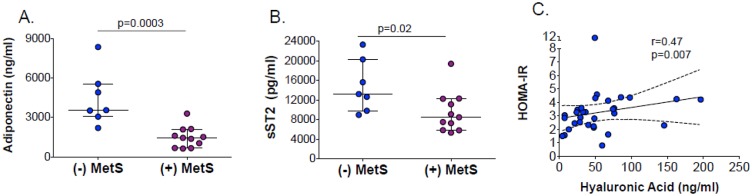
People with HIV are at for metabolic syndrome (MetS) and fatty liver disease, but the role of Antiretroviral therapy (ART) is poorly understood. MetS and fatty liver disease been associated with changes in adiponectin, soluble ST2 (sST2), chitinase 3-like 1 (Chi3L1), hyaluronic acid (HA), tissue inhibitor of metalloproteinase-1 (TIMP-1), lysyl oxidase-like-2 (LOXL2) and transforming growth factor β (TGF-β) concentrations in HIV-uninfected populations. Protease (PI) and non-nucleoside reverse transcriptase inhibitors (NNRTI) may contribute to these comorbidities, but the effects of switching from PI- or NNRTI to raltegravir (RAL) on these biomarkers is unknown.
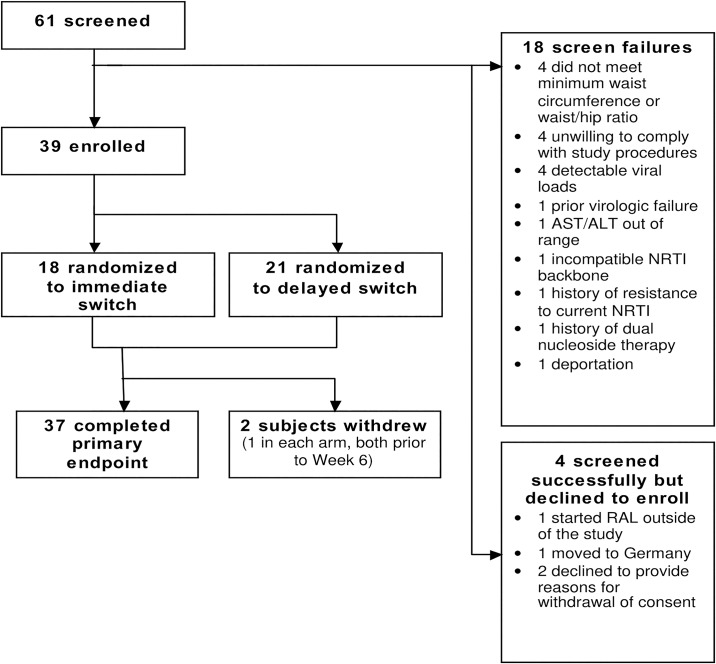
Cryopreserved plasma was obtained from a completed, prospective trial of HIV-infected women with central adiposity on NNRTI- or PI-based ART during which they were randomized to remain on their current ART or switch to a RAL based regimen. Biomarker concentrations were quantified using ELISA and Multiplex assays at baseline and 24 weeks after randomization. Wilcoxon-signed rank test evaluated within-group changes, Spearman and linear regression models evaluated correlations between biomarkers and clinical covariates.
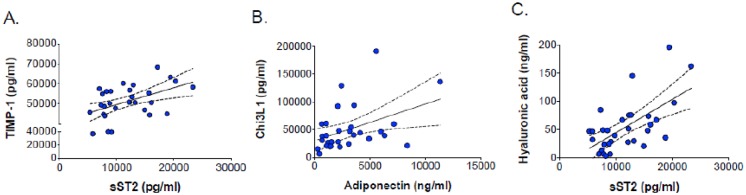
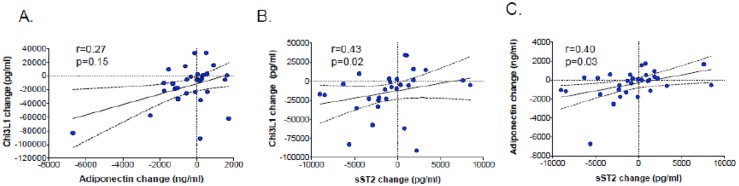
Participants had a median age of 43 years, CD4+ T lymphocyte count 558 cells/mm3 and BMI 32 kg/m2; 35% met criteria for MetS. At baseline, higher adiponectin levels correlated with higher Chi3L1 levels (r = 0.42, p = 0.02), as did declines after 24 weeks (r = 0.40, p = 0.03). Changes in sST2 correlated with changes in Chi3L1 (r = 0.43, p = 0.02) and adiponectin (r = 0.40, p = 0.03). Adiponectin and Chi3L1 levels decreased significantly in women switched to RAL vs continue PI/NNRTI.
In women with HIV and central obesity, the hepatic steatosis/fibrosis marker Chi3L1 and adiponectin decrease in conjunction with sST2 decreases following switch to RAL. Whether switching from NNRTI/PI-based regimens to RAL can improve hepatic steatosis and dysmetabolism requires further study.
Clinicaltrials.gov NCT00656175.
HIV 感染者易患代谢综合征(MetS)和脂肪肝,但抗逆转录病毒治疗(ART)的作用尚不清楚。代谢综合征和脂肪肝与脂联素、可溶性 ST2(sST2)、几丁质酶 3 样蛋白 1(Chi3L1)、透明质酸(HA)、金属蛋白酶组织抑制剂 1(TIMP-1)、赖氨酰氧化酶样 2(LOXL2)和转化生长因子-β(TGF-β)浓度的变化有关在未感染 HIV 的人群中。蛋白酶(PI)和非核苷类逆转录酶抑制剂(NNRTI)可能导致这些合并症,但从 PI 或 NNRTI 转换为雷利度韦(RAL)对这些生物标志物的影响尚不清楚。
从一项已完成的、前瞻性的、针对接受 NNRTI 或 PI 为基础的 ART 治疗且存在中心性肥胖的 HIV 感染女性的试验中获得冷冻保存的血浆,这些女性在研究期间随机分为继续使用当前的 ART 或转换为 RAL 方案。使用 ELISA 和多重检测法在基线和随机分组后 24 周时定量测定生物标志物浓度。Wilcoxon 符号秩检验评估组内变化,Spearman 和线性回归模型评估生物标志物与临床协变量之间的相关性。
参与者的中位年龄为 43 岁,CD4+T 淋巴细胞计数为 558 个细胞/mm3,BMI 为 32 kg/m2;35%符合代谢综合征标准。基线时,较高的脂联素水平与较高的 Chi3L1 水平相关(r = 0.42,p = 0.02),24 周后下降也呈正相关(r = 0.40,p = 0.03)。sST2 的变化与 Chi3L1 的变化相关(r = 0.43,p = 0.02)和脂联素(r = 0.40,p = 0.03)。与继续使用 PI/NNRTI 相比,转换为 RAL 的女性的 sST2、脂联素和 Chi3L1 水平显著下降。
在 HIV 感染且存在中心性肥胖的女性中,雷利度韦转换后,肝脂肪变性/纤维化标志物 Chi3L1 和脂联素与 sST2 下降同时发生。从 NNRTI/PI 为基础的方案转换为 RAL 是否能改善肝脂肪变性和代谢紊乱,还需要进一步研究。
Clinicaltrials.gov NCT00656175。