Department of Internal Medicine, University of Alabama at Birmingham, Birmingham, Alabama, United States of America.
Department of Biostatistics, University of Texas Medical Branch, Galveston, TX, United States of America.
PLoS One. 2018 May 10;13(5):e0197117. doi: 10.1371/journal.pone.0197117. eCollection 2018.
Advanced liver fibrosis is an important predictor of liver disease progression and mortality, and current guidelines recommend screening for complications of cirrhosis once patients develop F3 fibrosis. Our study compared liver disease progression and survival in patients with stage 3 (F3) and stage 4 (F4) fibrosis on liver biopsy.
Retrospective study of patients with F3 or F4 on liver biopsy followed for development of liver disease complications (variceal bleeding, ascites, and hepatic encephalopathy); hepatocellular carcinoma, and survival (overall and transplant free survival).
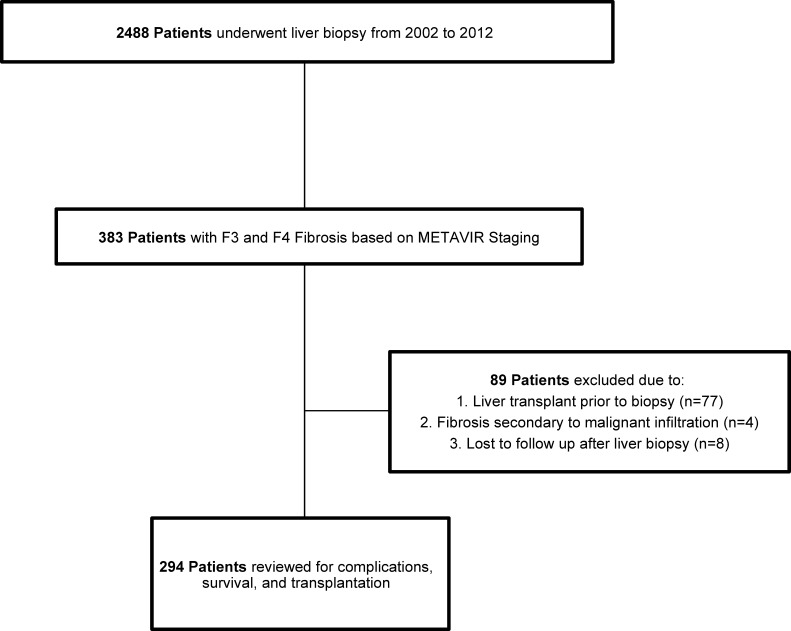
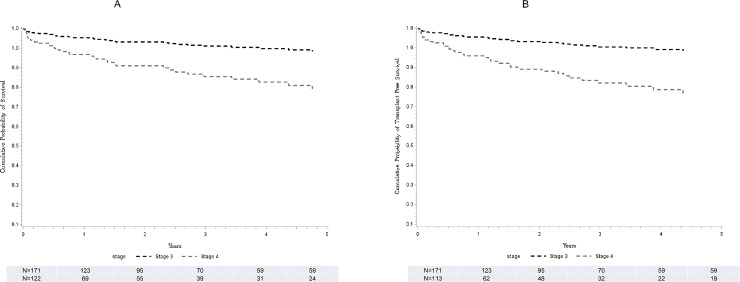
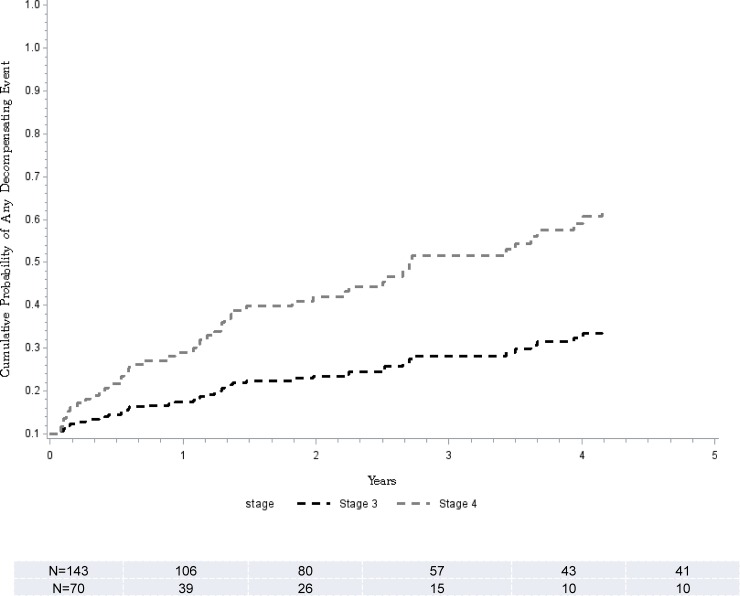
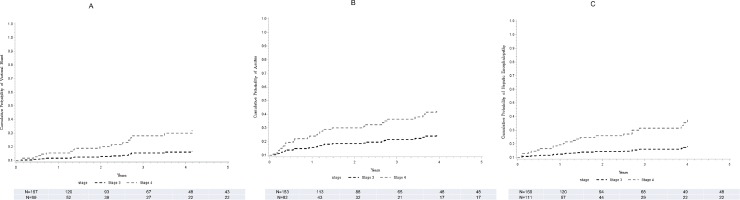
Of 2488 patients receiving liver biopsy between 01/02 and 12/12, a total of 294 (171 F3) were analyzed. Over a median follow up period of 3 years, patients with F4 (mean age 53 years, 63% male) compared to F3 (mean age 49 years, 43% male) had higher five year cumulative probability of any decompensation (38% vs. 14%, p<0.0001), including variceal bleed (10% vs. 4%, p = 0.014), ascites (21% vs. 9%, p = 0.0014), and hepatic encephalopathy (14% vs. 5%, p = 0.003). F4 patients also had lower overall 5-year survival (80% vs. 93%, p = 0.003) and transplant free survival (80% vs. 93%, p = 0.002). Probability of hepatocellular carcinoma in 5 years after biopsy was similar between F3 and F4 (1.2% vs. 2%, p = 0.54).
Compared to F4 stage, patients with F3 fibrosis have decreased risk for development of liver disease complications and better survival. Prospective well designed studies are suggested with large sample size and overcoming the limitations identified in this study, to confirm and validate these findings, as basis for modifying guidelines and recommendations on follow up of patients with advanced fibrosis and stage 3 liver fibrosis.
晚期肝纤维化是肝病进展和死亡的重要预测指标,目前的指南建议一旦患者出现 F3 纤维化,就应筛查肝硬化并发症。本研究比较了肝活检中 3 期(F3)和 4 期(F4)纤维化患者的肝病进展和生存率。
回顾性研究了肝活检中 F3 或 F4 的患者,观察其是否发生了肝病并发症(静脉曲张出血、腹水和肝性脑病)、肝细胞癌以及生存情况(总生存率和无移植生存率)。
在 2002 年 1 月至 2012 年 12 月期间进行肝活检的 2488 例患者中,共分析了 294 例(171 例 F3)。中位随访 3 年后,与 F3 患者(平均年龄 49 岁,43%为男性)相比,F4 患者(平均年龄 53 岁,63%为男性)五年内任何失代偿的累积概率更高(38%比 14%,p<0.0001),包括静脉曲张出血(10%比 4%,p = 0.014)、腹水(21%比 9%,p = 0.0014)和肝性脑病(14%比 5%,p = 0.003)。F4 患者的五年总生存率(80%比 93%,p = 0.003)和无移植生存率(80%比 93%,p = 0.002)也较低。活检后 5 年内肝细胞癌的发生率在 F3 和 F4 之间相似(1.2%比 2%,p = 0.54)。
与 F4 期相比,F3 期纤维化患者发生肝病并发症的风险较低,生存率较高。建议进行设计良好的前瞻性研究,样本量较大,克服本研究中发现的局限性,以证实和验证这些发现,为修改先进纤维化和 3 期肝纤维化患者的随访指南和建议提供依据。