Graduate Institute of Biomedical Sciences, Chang Gung University, No.259, Wenhua 1st Rd., Guishan Dist., Taoyuan City, 333, Taiwan.
Department of Microbiology and Immunology, Chang Gung University, No.259, Wenhua 1st Rd., Guishan Dist., Taoyuan City, 333, Taiwan.
J Exp Clin Cancer Res. 2018 May 10;37(1):102. doi: 10.1186/s13046-018-0754-y.
Aberrant hypermethylation of cellular genes is a common phenomenon to inactivate genes and promote tumorigenesis in nasopharyngeal carcinoma (NPC).
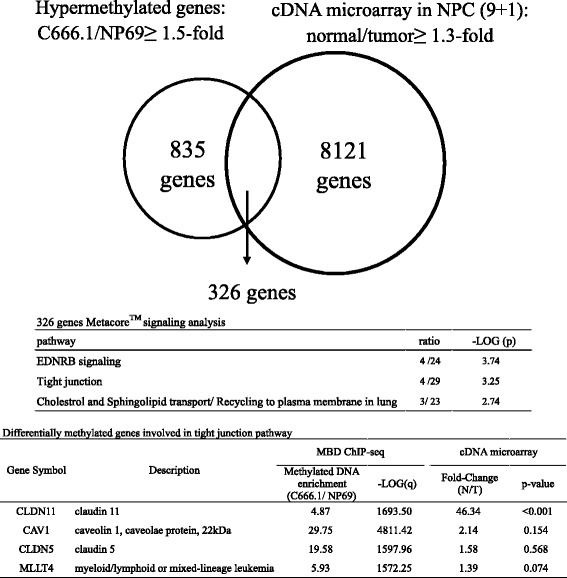
Methyl binding domain (MBD)-ChIP sequencing of NPC cells, microarray data of NPC biopsies and gene ontology analysis were conducted to identify a potential tumor suppressor gene CLDN11 that was both hypermethylated and downregulated in NPC. Bisulfite sequencing, qRT-PCR, immunohistochemistry staining of the NPC clinical samples and addition of methylation inhibitor, 5'azacytidine, in NPC cells were performed to verify the correlation between DNA hypermethylation and expression of CLDN11. Promoter reporter and EMSA assays were used to dissect the DNA region responsible for transcription activator binding and to confirm whether DNA methylation could affect activator's binding, respectively. CLDN11 was transiently overexpressed in NPC cells followed by cell proliferation, migration, invasion assays to characterize its biological roles. Co-immunoprecipitation experiments and proteomic approach were carried out to identify novel interacting protein(s) and the binding domain of CLDN11. Anti-tumor activity of the CLDN11 was elucidated by in vitro functional assay.
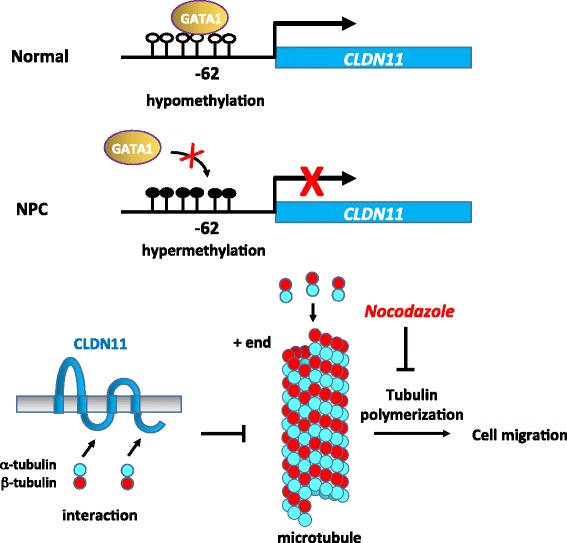
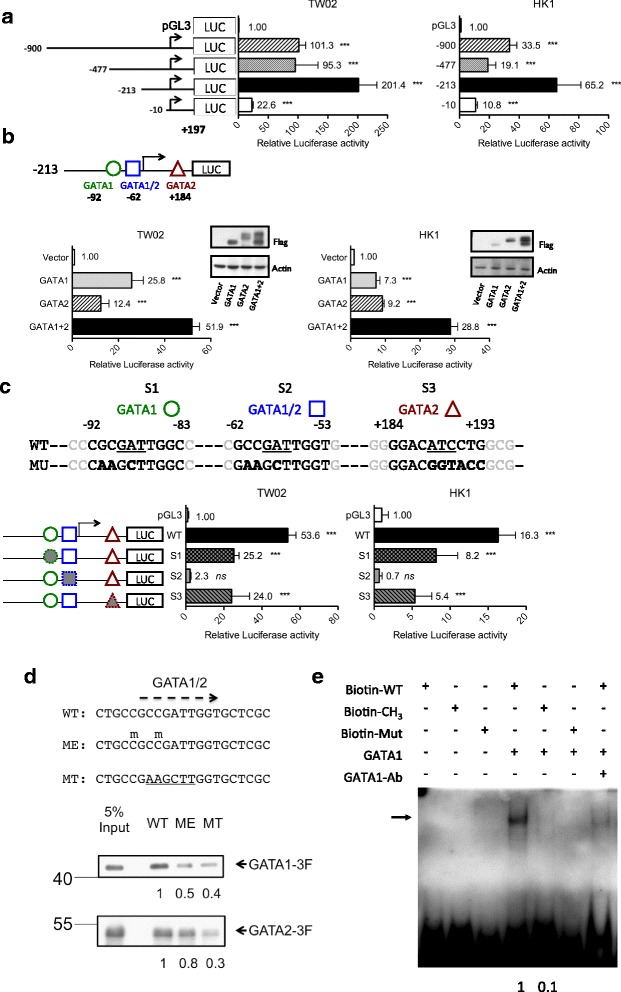
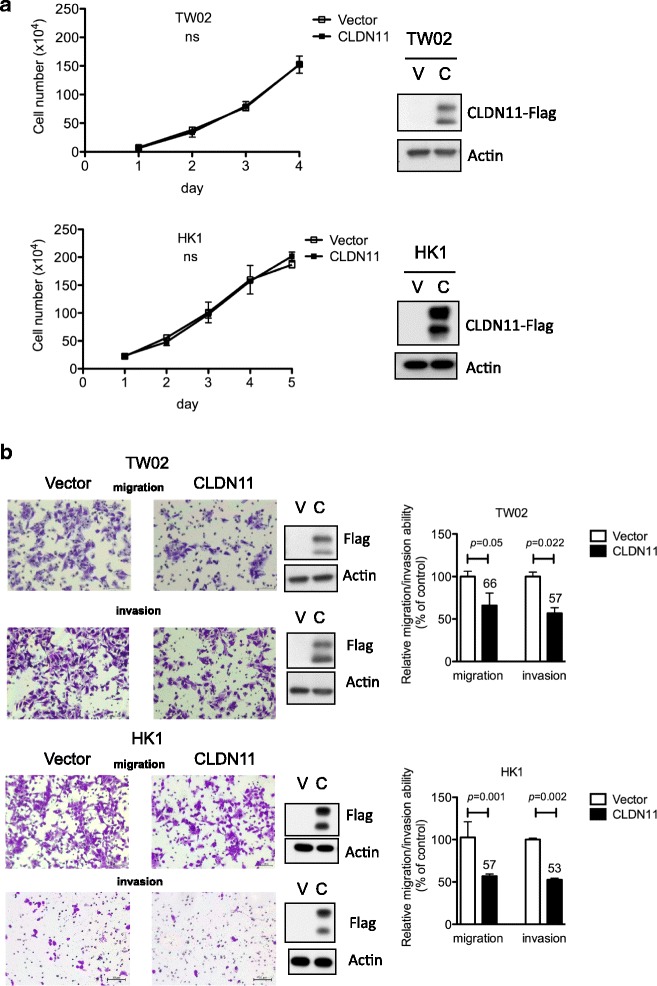
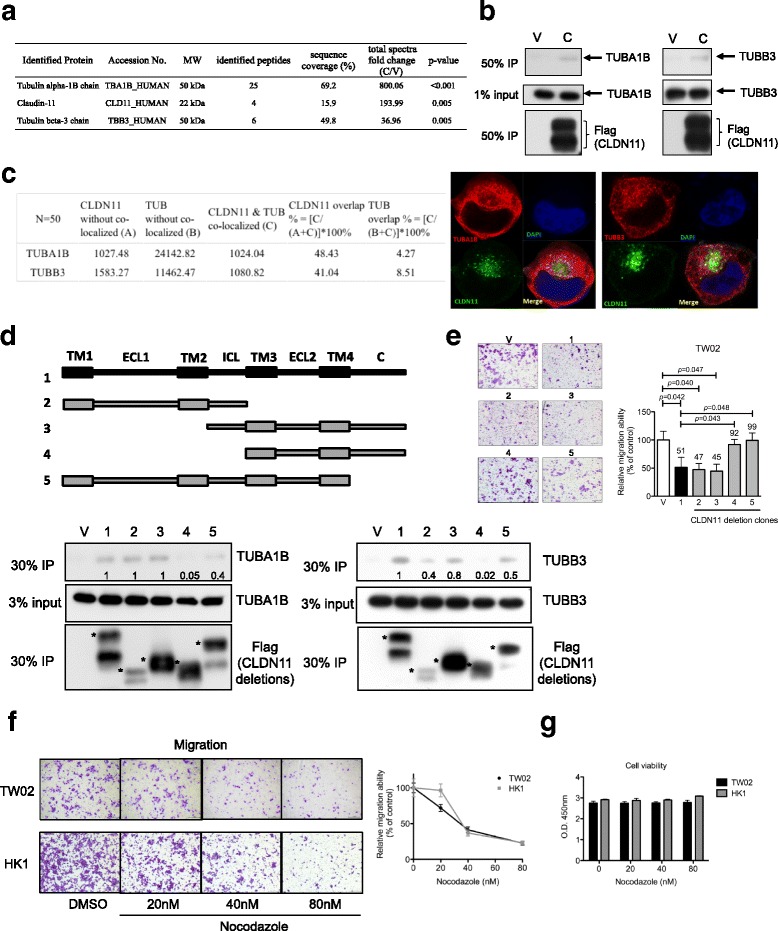
A tight junction gene, CLDN11, was identified as differentially hypermethylated gene in NPC. High methylation percentage of CLDN11 promoter in paired NPC clinical samples was correlated with low mRNA expression level. Immunohistochemistry staining of NPC paired samples tissue array demonstrated that CLDN11 protein expression was relatively low in NPC tumors. Transcription activator GATA1 bound to CLDN11 promoter region - 62 to - 53 and its DNA binding activity was inhibited by DNA methylation. Re-expression of CLDN11 reduced cell migration and invasion abilities in NPC cells. By co-immunoprecipitation and liquid chromatography-tandem mass spectrometry LC-MS/MS, tubulin alpha-1b (TUBA1B) and beta-3 (TUBB3), were identified as the novel CLDN11-interacting proteins. CLDN11 interacted with these two tubulins through its intracellular loop and C-terminus. Furthermore, these domains were required for CLDN11-mediated cell migration inhibition. Treatment with a tubulin polymerization inhibitor, nocodazole, blocked NPC cell migration.
CLDN11 is a hypermethylated and downregulated gene in NPC. Through interacting with microtubules TUBA1B and TUBB3, CLDN11 blocks the polymerization of tubulins and cell migration activity. Thus, CLDN11 functions as a potential tumor suppressor gene and silencing of CLDN11 by DNA hypermethylation promotes NPC progression.
细胞基因的异常高甲基化是导致鼻咽癌(NPC)中基因失活和促进肿瘤发生的常见现象。
对 NPC 细胞进行甲基结合域(MBD)-ChIP 测序、NPC 活检的微阵列数据和基因本体论分析,以鉴定一个潜在的肿瘤抑制基因 CLDN11,该基因在 NPC 中既发生高甲基化,又表达下调。对 NPC 临床样本进行亚硫酸氢盐测序、qRT-PCR、免疫组织化学染色以及在 NPC 细胞中添加甲基化抑制剂 5'-氮杂胞苷,以验证 CLDN11 的 DNA 高甲基化与表达之间的相关性。启动子报告基因和电泳迁移率变动分析(EMSA)实验分别用于剖析负责转录激活剂结合的 DNA 区域,并确认 DNA 甲基化是否会影响激活剂的结合。在 NPC 细胞中转瞬过表达 CLDN11,随后进行细胞增殖、迁移和侵袭实验,以鉴定其生物学功能。通过免疫共沉淀实验和蛋白质组学方法鉴定 CLDN11 的新相互作用蛋白及其结合域。通过体外功能测定法阐明 CLDN11 的抗肿瘤活性。
紧密连接基因 CLDN11 被鉴定为 NPC 中差异高甲基化的基因。配对 NPC 临床样本中 CLDN11 启动子的高甲基化百分比与低 mRNA 表达水平相关。NPC 配对样本组织阵列的免疫组织化学染色显示,CLDN11 蛋白在 NPC 肿瘤中表达相对较低。转录激活因子 GATA1 结合于 CLDN11 启动子区域-62 至-53,其 DNA 结合活性受到 DNA 甲基化的抑制。CLDN11 的重新表达降低了 NPC 细胞的迁移和侵袭能力。通过免疫共沉淀和液相色谱-串联质谱联用(LC-MS/MS),鉴定出微管蛋白 alpha-1b(TUBA1B)和 beta-3(TUBB3)为 CLDN11 的新相互作用蛋白。CLDN11 通过其细胞内环和 C 末端与这两个微管蛋白相互作用。此外,这些结构域对于 CLDN11 介导的细胞迁移抑制是必需的。用微管蛋白聚合抑制剂长春花碱处理阻断了 NPC 细胞的迁移。
CLDN11 是 NPC 中高甲基化和下调的基因。通过与微管蛋白 TUBA1B 和 TUBB3 相互作用,CLDN11 阻止微管蛋白的聚合和细胞迁移活性。因此,CLDN11 作为一种潜在的肿瘤抑制基因发挥作用,DNA 高甲基化导致 CLDN11 失活,促进 NPC 的进展。