Bertin François-René, Ruffin-Taylor Debra, Stewart Allison Jean
School of Veterinary Science, The University of Queensland, Gatton, Queensland, Australia.
Department of Clinical Sciences, College of Veterinary Medicine, Auburn University, Auburn, Alabama.
J Vet Intern Med. 2018 Jul;32(4):1420-1427. doi: 10.1111/jvim.15138. Epub 2018 May 10.
Systemic inflammation is a cause of insulin dysregulation in many species, but the insulin and glucose dynamics in adult horses diagnosed with systemic inflammatory response syndrome (SIRS) are poorly documented.
HYPOTHESIS/OBJECTIVES: In SIRS in horses, insulin and glucose dynamics will be altered and associated with survival.
Adult horses diagnosed with SIRS admitted to a referral hospital.
Prospective study enrolling horses diagnosed with SIRS in which serum insulin and glucose concentrations were measured. Horses were grouped by outcome (survival, hyperinsulinemia, and hyperglycemia) and compared with P < .05 considered significant.
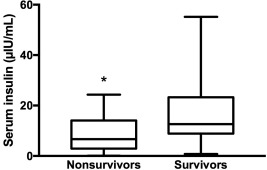
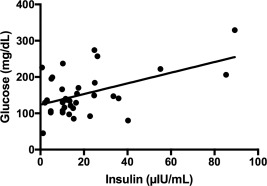
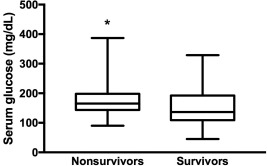
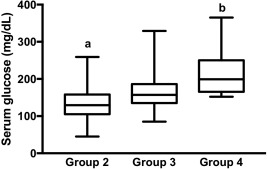
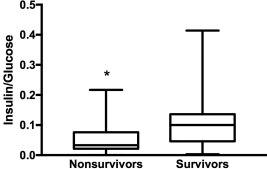
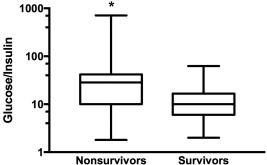
Fifty-eight horses were included in the study and 36 (62%) survived. At admission, 21 horses (36%) were hyperinsulinemic and 44 horses (88%) were hyperglycemic, with survivors having significantly higher serum insulin and a significantly lower serum glucose concentration. Horses diagnosed with hyperinsulinemia at any time during hospitalization were 4 times more likely to survive whereas horses that were hyperglycemic at any time during hospitalization were 5 times less likely to survive. Serum glucose concentration and presence of hyperglycemia both were associated with severity of disease. Insulin/glucose ratio, reflecting insulin secretion, was significantly higher in survivors whereas glucose/insulin ratio, reflecting peripheral tissue insulin resistance, was significantly lower in nonsurvivors. Only in survivors was there a significant correlation between serum insulin and glucose concentrations.
Hyperinsulinemia and hyperglycemia are common features of SIRS in horses, but those presenting with relative hypoinsulinemia and corresponding hyperglycemia suggestive of endocrine pancreatic dysfunction have a worse prognosis.
全身炎症是许多物种胰岛素调节异常的一个原因,但关于诊断为全身炎症反应综合征(SIRS)的成年马匹的胰岛素和葡萄糖动态变化的记录较少。
假设/目的:在马匹的SIRS中,胰岛素和葡萄糖动态变化将发生改变,并与生存相关。
转诊医院收治的诊断为SIRS的成年马匹。
对诊断为SIRS的马匹进行前瞻性研究,测定血清胰岛素和葡萄糖浓度。根据结局(存活、高胰岛素血症和高血糖)对马匹进行分组,并以P < 0.05为有显著差异进行比较。
58匹马纳入本研究,36匹(62%)存活。入院时,21匹马(36%)存在高胰岛素血症,44匹马(88%)存在高血糖,存活马匹的血清胰岛素显著更高,血清葡萄糖浓度显著更低。住院期间任何时候诊断为高胰岛素血症的马匹存活可能性高4倍,而住院期间任何时候存在高血糖的马匹存活可能性低5倍。血清葡萄糖浓度和高血糖的存在均与疾病严重程度相关。反映胰岛素分泌的胰岛素/葡萄糖比值在存活马匹中显著更高,而反映外周组织胰岛素抵抗的葡萄糖/胰岛素比值在非存活马匹中显著更低。仅在存活马匹中血清胰岛素和葡萄糖浓度之间存在显著相关性。
高胰岛素血症和高血糖是马匹SIRS的常见特征,但那些表现为相对低胰岛素血症和相应高血糖提示内分泌胰腺功能障碍的马匹预后较差。