MRC Integrative Epidemiology Unit at the University of Bristol, Oakfield House, Oakfield Grove, Bristol, BS82BN, UK; Population Health Sciences, Bristol Medical School, Oakfield House, Oakfield Grove, Bristol, BS82BN, UK.
MRC Integrative Epidemiology Unit at the University of Bristol, Oakfield House, Oakfield Grove, Bristol, BS82BN, UK; Population Health Sciences, Bristol Medical School, Oakfield House, Oakfield Grove, Bristol, BS82BN, UK.
Atherosclerosis. 2018 Jul;274:94-103. doi: 10.1016/j.atherosclerosis.2018.04.027. Epub 2018 Apr 25.
Males have greater cardiometabolic risk than females, though the reasons for this are poorly understood. The aim of this study was to examine the association between common Y chromosomal haplogroups and cardiometabolic risk during early life.
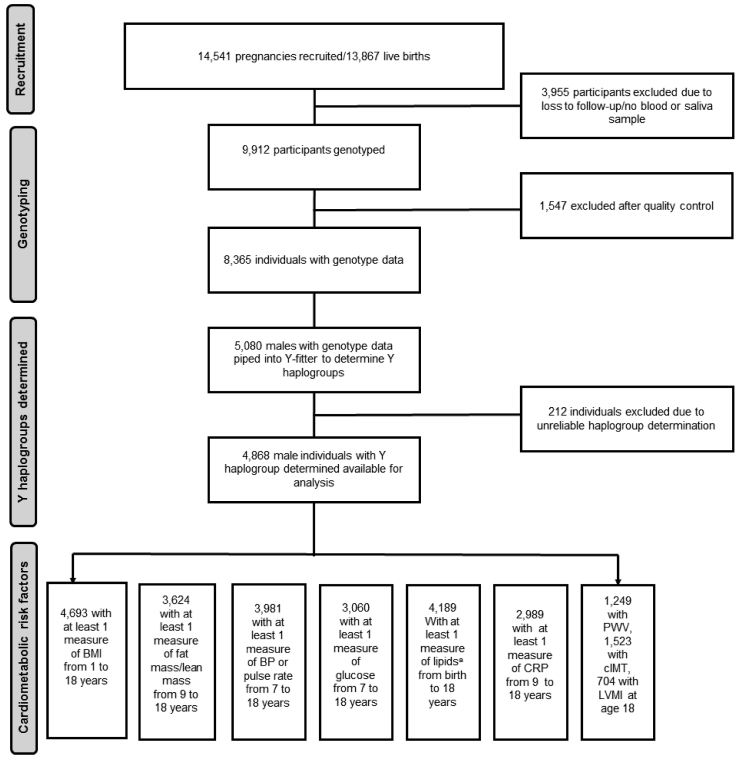
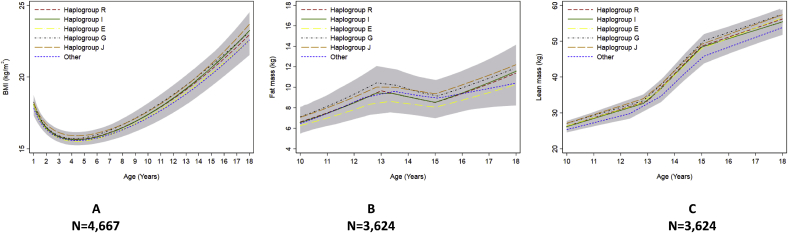
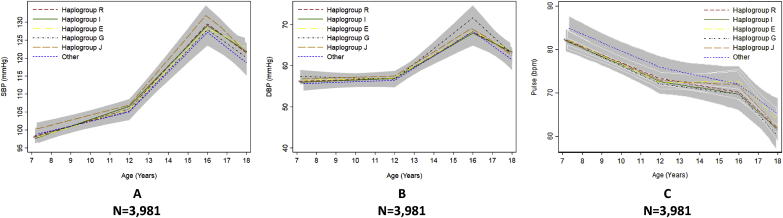
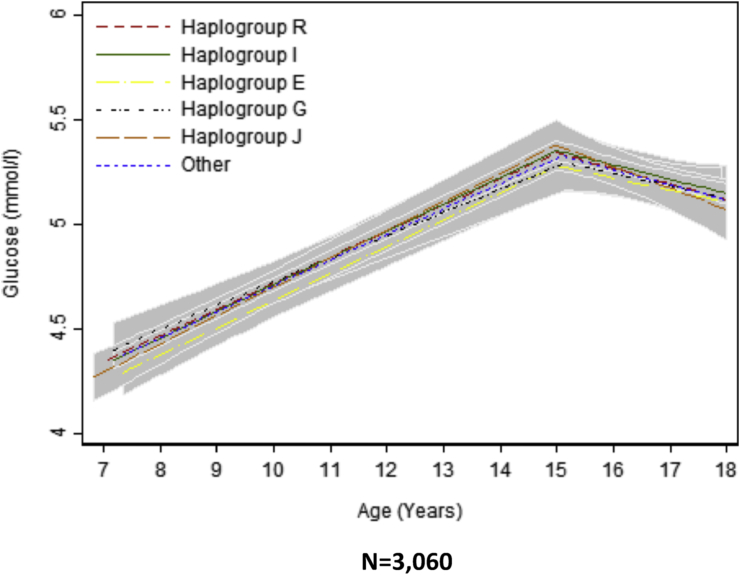
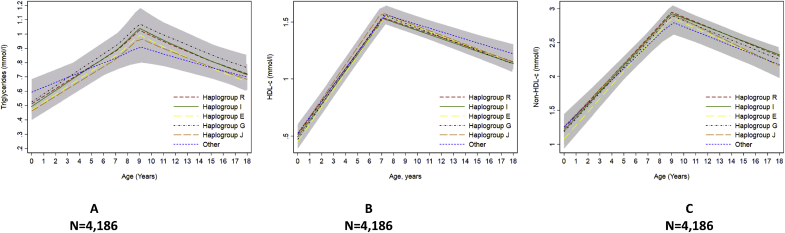
In a British birth cohort, we examined the association of Y chromosomal haplogroups with trajectories of cardiometabolic risk factors from birth to 18 years and with carotid-femoral pulse wave velocity, carotid intima media thickness and left ventricular mass index at age 18. Haplogroups were grouped according to their phylogenetic relatedness into categories of R, I, E, J, G and all other haplogroups combined (T, Q, H, L, C, N and O). Risk factors included BMI, fat and lean mass, systolic blood pressure (SBP), diastolic blood pressure, pulse rate, triglycerides, high density lipoprotein cholesterol (HDL-c), non-HDL-c and c-reactive protein. Analyses were performed using multilevel models and linear regression, as appropriate.
Y chromosomal haplogroups were not associated with any cardiometabolic risk factors from birth to 18 years. For example, at age 18, the difference in SBP comparing each haplogroup with haplogroup R was -0.39 mmHg (95% Confidence Interval (CI): -0.75, 1.54) for haplogroup I, 2.56 mmHg (95% CI: -0.76, 5.89) for haplogroup E, -0.02 mmHg (95% CI: -2.87, 2.83) for haplogroup J, 1.28 mmHg (95% CI: -4.70, 2.13) for haplogroup G and -2.75 mmHg (95% CI: -6.38, 0.88) for all other haplogroups combined.
Common Y chromosomal haplogroups are not associated with cardiometabolic risk factors during childhood and adolescence or with subclinical cardiovascular measures at age 18.
男性的心脏代谢风险高于女性,但原因尚不清楚。本研究旨在探讨常见 Y 染色体单倍群与生命早期心脏代谢危险因素之间的关系。
在英国出生队列中,我们研究了 Y 染色体单倍群与从出生到 18 岁期间心脏代谢危险因素轨迹的关系,以及与 18 岁时颈动脉-股动脉脉搏波速度、颈动脉内中膜厚度和左心室质量指数的关系。单倍群根据其系统发育关系分为 R、I、E、J、G 和其他所有单倍群(T、Q、H、L、C、N 和 O)。危险因素包括 BMI、脂肪和瘦体重、收缩压(SBP)、舒张压、脉搏率、甘油三酯、高密度脂蛋白胆固醇(HDL-c)、非高密度脂蛋白胆固醇和 C 反应蛋白。分析使用多级模型和线性回归进行。
Y 染色体单倍群与从出生到 18 岁期间的任何心脏代谢危险因素均无关。例如,在 18 岁时,与单倍群 R 相比,单倍群 I 的 SBP 差异为-0.39mmHg(95%置信区间:-0.75,1.54),单倍群 E 为 2.56mmHg(95%置信区间:-0.76,5.89),单倍群 J 为-0.02mmHg(95%置信区间:-2.87,2.83),单倍群 G 为 1.28mmHg(95%置信区间:-4.70,2.13),其他所有单倍群组合为-2.75mmHg(95%置信区间:-6.38,0.88)。
常见的 Y 染色体单倍群与儿童和青少年时期的心脏代谢危险因素或 18 岁时的亚临床心血管指标无关。