Chair for Medical Information Technology, Helmholtz Institute for Biomedical Engineering, RWTH Aachen University, Pauwelsstr. 20, D-52074 Aachen, Germany.
Department of Anesthesiology, University Hospital RWTH Aachen, Pauwelsstr. 30, D-52074 Aachen, Germany.
Sensors (Basel). 2018 May 13;18(5):1541. doi: 10.3390/s18051541.
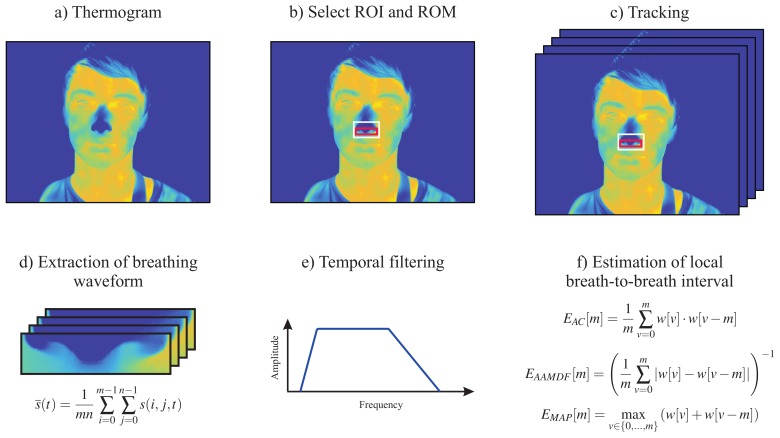
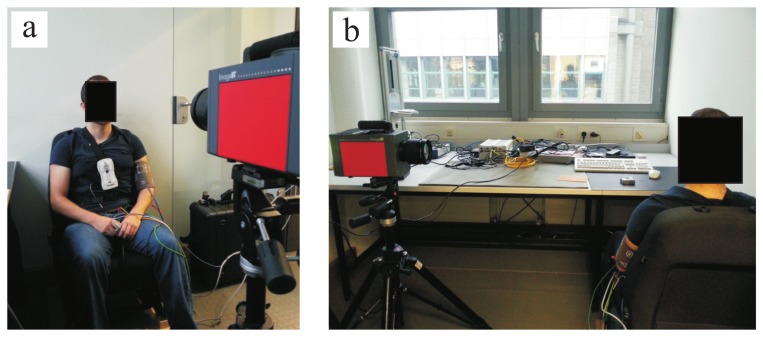
Heart rate (HR) and respiratory rate (RR) are important parameters for patient assessment. However, current measurement techniques require attachment of sensors to the patient’s body, often leading to discomfort, stress and even pain. A new algorithm is presented for monitoring both HR and RR using thermal imaging. The cyclical ejection of blood flow from the heart to the head (through carotid arteries and thoracic aorta) leads to periodic movements of the head; these vertical movements are used to assess HR. Respiratory rate is estimated by using temperature fluctuations under the nose during the respiratory cycle. To test the viability and feasibility of this approach, a pilot study was conducted with 20 healthy subjects (aged 18⁻36 and 1 aged 50 years). The study consisted of two phases: phase A (frontal view acquisitions) and phase B (side view acquisitions). To validate the results, photoplethysmography and thoracic effort (piezoplethysmography) were simultaneously recorded. High agreement between infrared thermography and ground truth/gold standard was achieved. For HR, the root-mean-square errors (RMSE) for phases A and B were 3.53 ± 1.53 and 3.43 ± 1.61 beats per minute, respectively. For RR, the RMSE between thermal imaging and piezoplethysmography stayed around 0.71 ± 0.30 breaths per minute (phase A). This study demonstrates that infrared thermography may be a promising, clinically relevant alternative for the assessment of HR and RR.
心率 (HR) 和呼吸率 (RR) 是患者评估的重要参数。然而,目前的测量技术需要将传感器附着在患者的身体上,这往往会导致不适、压力甚至疼痛。本文提出了一种使用热成像监测 HR 和 RR 的新算法。心脏向头部(通过颈动脉和胸主动脉)周期性地喷射血流会导致头部周期性运动;这些垂直运动用于评估 HR。RR 是通过呼吸周期中鼻子下的温度波动来估计的。为了测试这种方法的可行性和实用性,对 20 名健康受试者(年龄 18-36 岁,1 名 50 岁)进行了一项试点研究。该研究分为两个阶段:A 阶段(正面视图采集)和 B 阶段(侧面视图采集)。为了验证结果,同时记录了光体积描记法和胸廓努力(压体积描记法)。红外热成像与真实值/金标准之间达成了高度一致。对于 HR,A 期和 B 期的均方根误差 (RMSE) 分别为 3.53 ± 1.53 和 3.43 ± 1.61 次/分钟。对于 RR,热成像与压体积描记法之间的 RMSE 保持在 0.71 ± 0.30 次/分钟(A 期)左右。这项研究表明,红外热成像可能是评估 HR 和 RR 的一种有前途的、有临床相关性的替代方法。