Department of Biochemistry and Molecular Biology, University of Florida College of Medicine, Gainesville, FL.
Department of Hematology and Oncology, The Affiliated Zhongda Hospital, Southeast University Medical School, Nanjing, China.
Blood. 2018 Aug 23;132(8):837-848. doi: 10.1182/blood-2017-11-814319. Epub 2018 May 14.
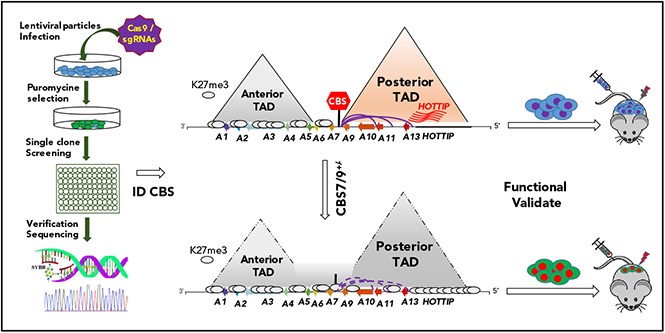
gene dysregulation is a common feature of acute myeloid leukemia (AML). The molecular mechanisms underlying aberrant gene expression and associated AML pathogenesis remain unclear. The nuclear protein CCCTC-binding factor (CTCF), when bound to insulator sequences, constrains temporal gene-expression patterns within confined chromatin domains for normal development. Here, we used targeted pooled CRISPR-Cas9-knockout library screening to interrogate the function of CTCF boundaries in the gene loci. We discovered that the CTCF binding site located between and genes (CBS7/9) is critical for establishing and maintaining aberrant gene expression in AML. Disruption of the CBS7/9 boundary resulted in spreading of repressive H3K27me3 into the posterior active chromatin domain that subsequently impaired enhancer/promoter chromatin accessibility and disrupted ectopic long-range interactions among the posterior genes. Consistent with the role of the CBS7/9 boundary in locus chromatin organization, attenuation of the CBS7/9 boundary function reduced posterior gene expression and altered myeloid-specific transcriptome profiles important for pathogenesis of myeloid malignancies. Furthermore, heterozygous deletion of the CBS7/9 chromatin boundary in the locus reduced human leukemic blast burden and enhanced survival of transplanted AML cell xenograft and patient-derived xenograft mouse models. Thus, the CTCF boundary constrains the normal gene-expression program, as well as plays a role in maintaining the oncogenic transcription program for leukemic transformation. The CTCF boundaries may serve as novel therapeutic targets for the treatment of myeloid malignancies.
基因失调是急性髓系白血病 (AML) 的一个常见特征。导致异常基因表达和相关 AML 发病机制的分子机制尚不清楚。核蛋白 CCCTC 结合因子 (CTCF) 与绝缘子序列结合时,可在正常发育过程中约束局限染色质域内的基因表达模式。在这里,我们使用靶向 pooled CRISPR-Cas9-knockout 文库筛选来研究 CTCF 边界在基因座中的功能。我们发现,位于 和 基因之间的 CTCF 结合位点 (CBS7/9) 对于在 AML 中建立和维持异常基因表达至关重要。破坏 CBS7/9 边界会导致抑制性 H3K27me3 扩散到后活跃染色质域,从而损害增强子/启动子染色质可及性,并破坏后 基因之间的异位长程相互作用。与 CBS7/9 边界在基因座染色质组织中的作用一致,减弱 CBS7/9 边界功能会降低后 基因表达并改变髓系恶性肿瘤发病机制中重要的髓系特异性转录组谱。此外,在 基因座中的 CBS7/9 染色质边界的杂合缺失会减少人类白血病母细胞负担,并增强移植 AML 细胞异种移植和患者来源异种移植小鼠模型的存活率。因此,CTCF 边界限制了正常的基因表达程序,并在维持白血病转化的致癌转录程序中发挥作用。CTCF 边界可能成为治疗髓系恶性肿瘤的新的治疗靶点。