Verrecchia Franck, Rédini Françoise
UMR1238 INSERM, Université de Nantes, PHY-OS, "Bone Sarcomas and Remodeling of Calcified Tissues", Medical School, Nantes, France.
Front Oncol. 2018 Apr 30;8:133. doi: 10.3389/fonc.2018.00133. eCollection 2018.
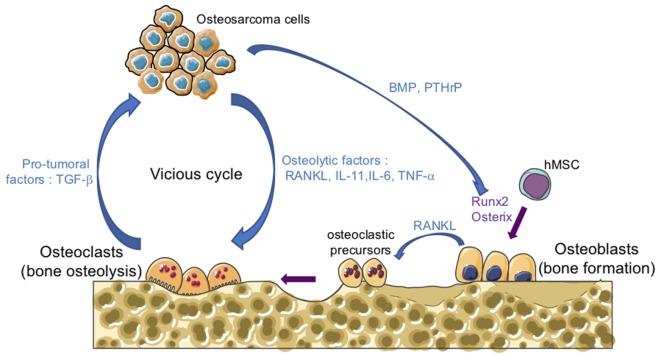
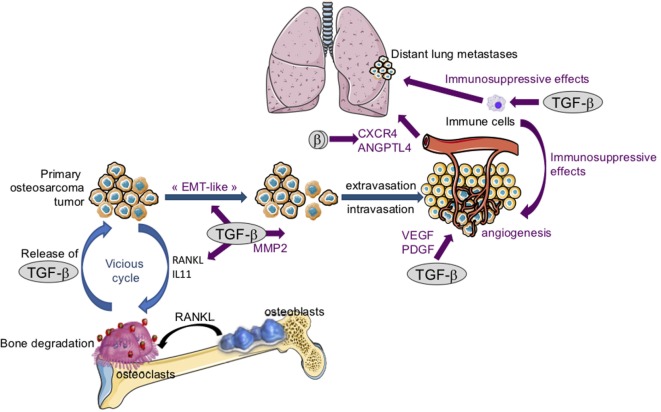
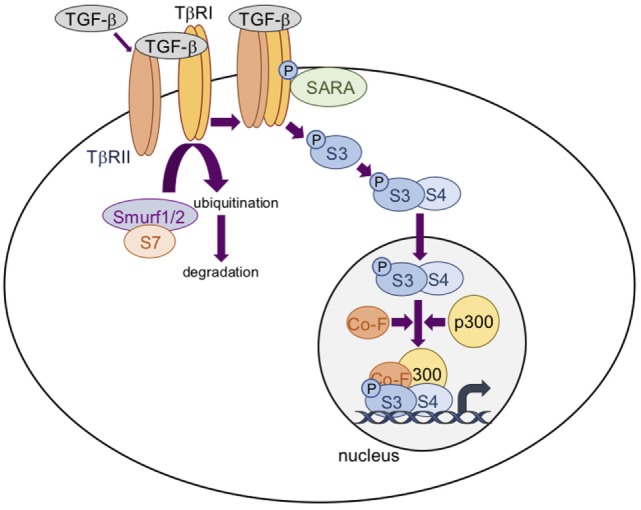
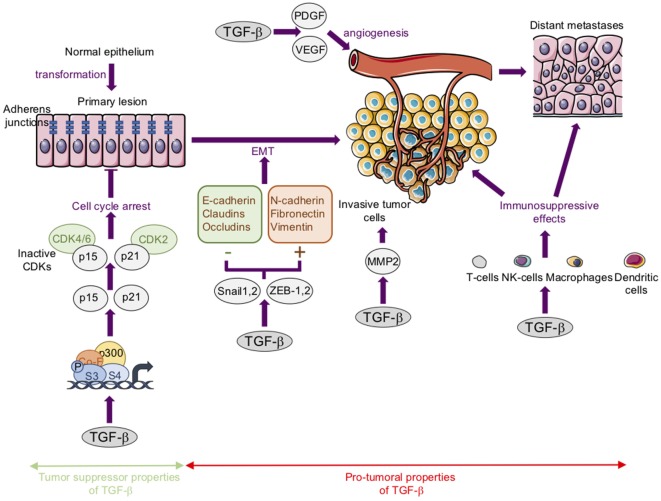
Osteosarcomas are the most frequent form of primary bone tumors and mainly affect children, adolescents, and young adults. Despite encouraging progress in therapeutic management, including the advent of multidrug chemotherapy, the survival rates have remained unchanged for more than four decades: 75% at 5 years for localized disease, but two groups of patients are still at high risk: metastatic at diagnosis (overall survival around 40% at 5 years) and/or poor responders to chemotherapy (20% at 5 years). Because these tumors are classified as "complex genomic," it is extremely difficult to determine the signaling pathways that might be targeted by specific therapies. A hypothesis has thus emerged, stating that the particular microenvironment of these tumors may interfere with the tumor cells that promote chemoresistance and the dissemination of metastases. The stroma is composed of a large number of cell types (immune cells, endothelial cells, mesenchymal stromal cells, etc.) which secrete growth factors, such as transforming growth factor-β (TGF-β), which favors the development of primary tumors and dissemination of metastases by constituting a permissive niche at primary and distant sites. Rather than targeting the tumor cells themselves, which are very heterogeneous in osteosarcoma, the hypothesis is instead to target the key actors secreted in the microenvironment, such as TGF-βs, which play a part in tumor progression. In the last decade, numerous studies have shown that overexpression of TGF-β is a hallmark of many cancers, including primary bone tumors. In this context, TGF-β signaling has emerged as a crucial factor in the cross talk between tumor cells and stroma cells in poor-prognosis cancers. Secretion of TGF-β by tumor cells or stroma cells can effectively act in a paracrine manner to regulate the phenotype and functions of the microenvironment to stimulate protumorigenic microenvironmental changes. TGF-β can thus exert its protumorigenic function in primary bone tumors by promoting angiogenesis, bone remodeling and cell migration, and by inhibiting immunosurveillance. This review focuses on the involvement of TGF-β signaling in primary bone tumor development, and the related therapeutic options that may be possible for these tumors.
骨肉瘤是原发性骨肿瘤最常见的形式,主要影响儿童、青少年和年轻成年人。尽管在治疗管理方面取得了令人鼓舞的进展,包括多药化疗的出现,但四十多年来生存率一直没有变化:局限性疾病患者5年生存率为75%,但仍有两组患者处于高风险状态:诊断时已发生转移(5年总生存率约为40%)和/或对化疗反应不佳(5年生存率为20%)。由于这些肿瘤被归类为“复杂基因组”肿瘤,因此极难确定可能被特定疗法靶向的信号通路。因此出现了一种假说,认为这些肿瘤的特殊微环境可能会干扰促进化疗耐药性和转移扩散的肿瘤细胞。基质由大量细胞类型(免疫细胞、内皮细胞、间充质基质细胞等)组成,这些细胞分泌生长因子,如转化生长因子-β(TGF-β),通过在原发部位和远处部位形成一个允许性微环境,促进原发性肿瘤的发展和转移扩散。该假说不是针对骨肉瘤中非常异质性的肿瘤细胞本身,而是针对微环境中分泌的关键因子,如在肿瘤进展中起作用的TGF-β。在过去十年中,大量研究表明TGF-β的过表达是许多癌症的一个标志,包括原发性骨肿瘤。在这种情况下,TGF-β信号传导已成为预后不良癌症中肿瘤细胞与基质细胞之间相互作用的关键因素。肿瘤细胞或基质细胞分泌的TGF-β可以以旁分泌方式有效发挥作用,调节微环境的表型和功能,以刺激促肿瘤的微环境变化。因此,TGF-β可以通过促进血管生成、骨重塑和细胞迁移以及抑制免疫监视,在原发性骨肿瘤中发挥其促肿瘤功能。本综述重点关注TGF-β信号传导在原发性骨肿瘤发展中的作用,以及针对这些肿瘤可能的相关治疗选择。