Gadoth Avi, Zekeridou Anastasia, Klein Christopher J, Thoreson Colton J, Majed Masoud, Dubey Divyanshu, Flanagan Eoin P, McKeon Andrew, Jenkins Sarah M, Lennon Vanda A, Pittock Sean J
Department of Neurology Mayo Clinic Rochester Minnesota.
Laboratory Medicine and Pathology Mayo Clinic Rochester Minnesota.
Ann Clin Transl Neurol. 2018 Apr 2;5(5):646-650. doi: 10.1002/acn3.561. eCollection 2018 May.
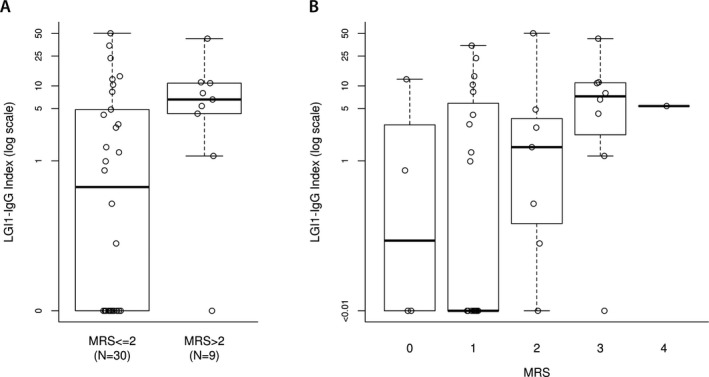
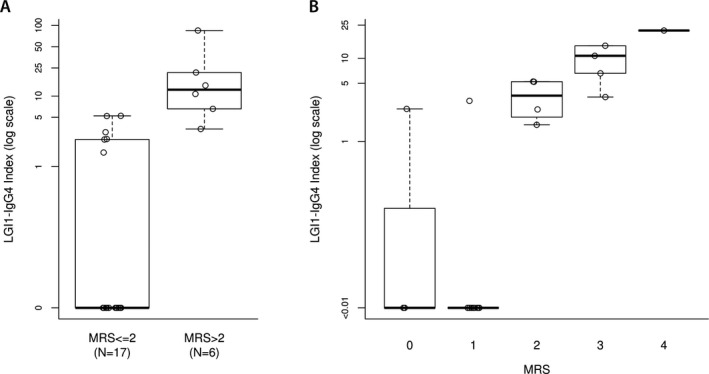
To determine whether CSF leucine-rich glioma-inactivated 1(LGI1)-IgG titer, index or IgG subclass has prognostic significance, we tested serum and CSF specimens collected concomitantly from 39 seropositive patients. LGI1-IgG index was elevated (>1) in 21 patients (54%), suggesting intrathecal synthesis. Patients with worse outcome at last follow-up (modified Rankin Scale >2) had significantly higher index (median 6.57 vs. 0.5, = 0.048) compared to those with better outcome. Higher CSF LGI1-IgG4 subclass-specific titer and index correlated with worse outcome ( < 0.005 for both). These data suggest that evidence of intrathecal LGI1-IgG synthesis may correlate with neuronal injury and warrant consideration of aggressive immunotherapy.
为了确定脑脊液富含亮氨酸胶质瘤失活蛋白1(LGI1)-IgG滴度、指数或IgG亚类是否具有预后意义,我们检测了39例血清学阳性患者同时采集的血清和脑脊液标本。21例患者(54%)的LGI1-IgG指数升高(>1),提示鞘内合成。与预后较好的患者相比,末次随访时预后较差(改良Rankin量表>2)的患者指数显著更高(中位数6.57对0.5,P=0.048)。脑脊液中较高的LGI1-IgG4亚类特异性滴度和指数与较差的预后相关(两者P均<0.005)。这些数据表明,鞘内LGI1-IgG合成的证据可能与神经元损伤相关,值得考虑积极的免疫治疗。