From the French Reference Center on Paraneoplastic Neurological Syndromes and Autoimmune Encephalitis (S.M.-C., L.T., A.V., A.-L.P., G.P., C.B., L.-D.D., B.J., V.R., J. Honnorat), Hospices Civils de Lyon, Hôpital Neurologique, Bron, France; SynatAc Team (S.M.-C., L.T., A.V., A.-L.P., G.P., C.B., L.-D.D., B.J., V.R., J. Honnorat), Institut NeuroMyoGène, INSERM U1217/CNRS UMR 5310, Université de Lyon, Université Claude Bernard Lyon 1, France; Clinic Research and Epidemiology Department (J. Haesebaert), Hospices Civils de Lyon, Lyon, France, HESPER Team, EA 7425, Medicine School, Université Claude Bernard Lyon 1, France; Neurology Department 2-Mazarin (G.B., D.P., A. Alentorn), Hôpitaux Universitaires La Pitié Salpêtrière-Charles Foix, APHP; Brain and Spinal Cord Institute (G.B., D.P., A. Alentorn), INSERM U1127/CNRS UMR 7255, Université Pierre-et-Marie-Curie, Universités Sorbonnes, Paris, France; HLA Laboratory (V.D.), French Blood Service, EFS Auvergne-Rhône-Alpes, Lyon, France; Stanford University Center for Sleep Sciences and Medicine (A. Ambati, E.M.), Palo Alto, CA; and Department of Psychiatry (R.T.), Hôpitaux Universitaires Henri Mondor, Créteil, France, Mondor Institute for Biomedical Research, INSERM U955, Université de Paris-Est-Créteil, France.
Neurol Neuroimmunol Neuroinflamm. 2021 Mar 5;8(3). doi: 10.1212/NXI.0000000000000974. Print 2021 May.
Antibodies against leucine-rich glioma-inactivated 1 (LGI1-Abs) characterize a limbic encephalitis (LE) strongly associated with HLA-DRB1*07:01, although some patients lack LGI1-Abs in CSF or do not carry this allele. Whether they represent a different subtype of disease or have different prognoses is unclear.
Retrospective analysis of clinical features, IgG isotypes, and outcome according to LGI1-Ab CSF positivity and DRB1*07:01 in a cohort of anti-LGI1 LE patients.
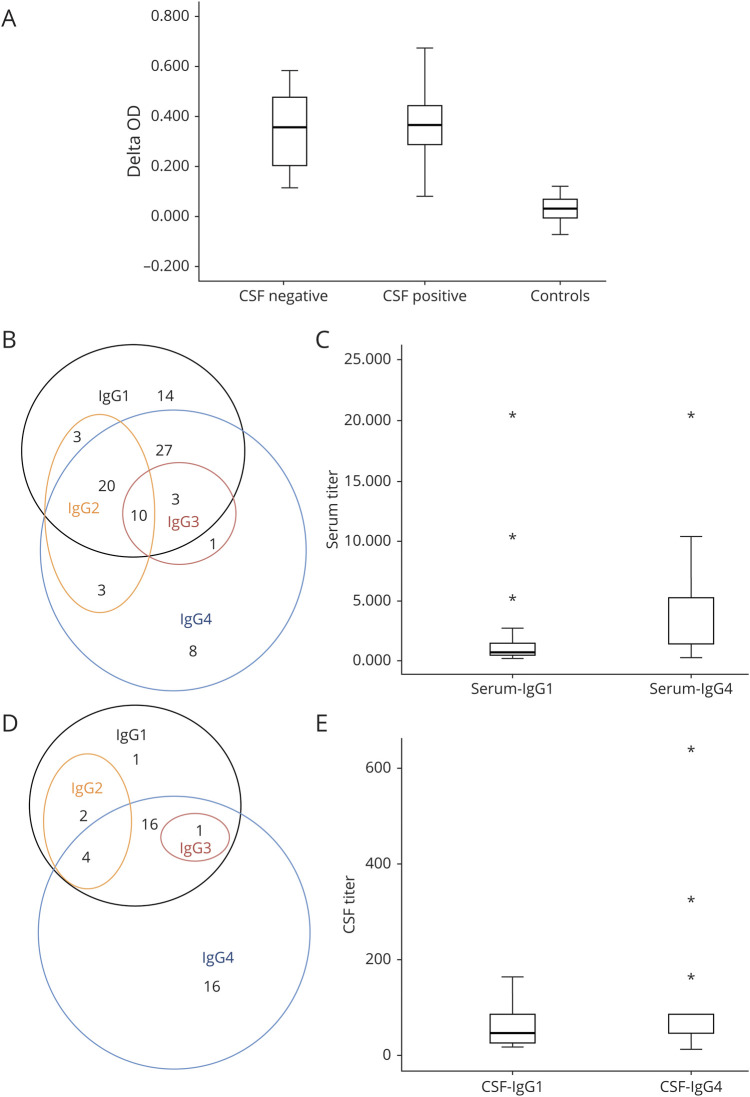
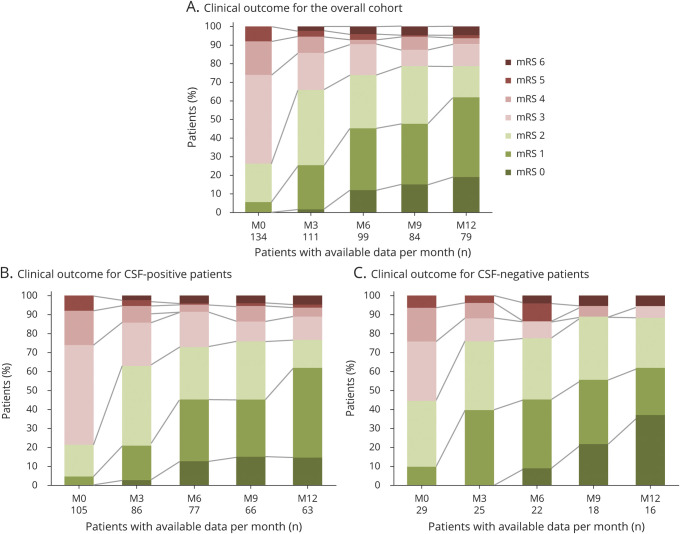
Patients with LGI1-Abs detected in both CSF and serum (105/134, 78%) were compared with those who were CSF negative (29/134, 22%). Both groups had similar clinical features and serum levels, but CSF-positive patients had shorter diagnostic delay, more frequently hyponatremia, inflammatory CSF, and abnormal MRI ( < 0.05). Human leukocyte antigen (HLA) genotyping was performed in 72/134 (54%) patients and 63/72 (88%) carried DRB1*07:01. Noncarriers (9/72, 12%) were younger, more commonly women, and had less frequently psychiatric and frontal symptoms ( < 0.05). No difference in IgG isotypes according to CSF positivity or HLA was found ( > 0.05). HLA and IgG isotypes were not associated with poor outcome (mRS >2 at last follow-up) in univariate analyses; CSF positivity was only identified as a poor outcome predictor in the multivariate analysis including the complete follow-up, whereas age and female sex also remained when just the first year was considered.
LE without CSF LGI1-Abs is clinically indistinguishable and likely reflects just a lesser LGI1-Ab production. HLA association is sex and age biased and presents clinical particularities, suggesting subtle differences in the immune response. Long-term outcome depends mostly on demographic characteristics and the intensity of the intrathecal synthesis.
抗亮氨酸丰富的胶质瘤失活 1 抗体(LGI1-Abs)是一种强烈与 HLA-DRB1*07:01 相关的边缘性脑炎(LE),尽管一些患者的脑脊液中缺乏 LGI1-Abs 或不携带该等位基因。它们是否代表一种不同的疾病亚型或具有不同的预后尚不清楚。
对一组抗 LGI1 LE 患者的临床特征、IgG 同种型以及根据 LGI1-Ab 脑脊液阳性和 DRB1*07:01 的结果进行回顾性分析。
将 LGI1-Abs 同时在脑脊液和血清中检测到的患者(105/134,78%)与脑脊液阴性的患者(29/134,22%)进行比较。两组患者的临床特征和血清水平相似,但脑脊液阳性患者的诊断延迟更短,更常出现低钠血症、炎症性脑脊液和异常 MRI(<0.05)。对 72/134(54%)名患者进行人类白细胞抗原(HLA)基因分型,63/72(88%)名患者携带 DRB1*07:01。非携带者(9/72,12%)更年轻,更常见于女性,更常出现精神和额叶症状(<0.05)。根据脑脊液阳性或 HLA,未发现 IgG 同种型的差异(>0.05)。在单变量分析中,HLA 和 IgG 同种型与不良预后(末次随访时 mRS >2)无关;在包括完整随访的多变量分析中,只有脑脊液阳性被确定为不良预后的预测因素,而在仅考虑第一年时,年龄和女性性别也仍然存在。
无脑脊液 LGI1-Abs 的 LE 在临床上无法区分,可能仅反映 LGI1-Ab 产生较少。HLA 相关性存在性别和年龄偏倚,并表现出临床特殊性,提示免疫反应存在细微差异。长期预后主要取决于人口统计学特征和鞘内合成的强度。