Department of Mechanical Engineering, Koc University, Rumeli Feneri Kampüsü, Sarıyer, Istanbul, Turkey.
Department of Mechanical Engineering, University of Texas at San Antonio, San Antonio, TX, USA.
Ann Biomed Eng. 2018 Sep;46(9):1292-1308. doi: 10.1007/s10439-018-2043-5. Epub 2018 May 14.
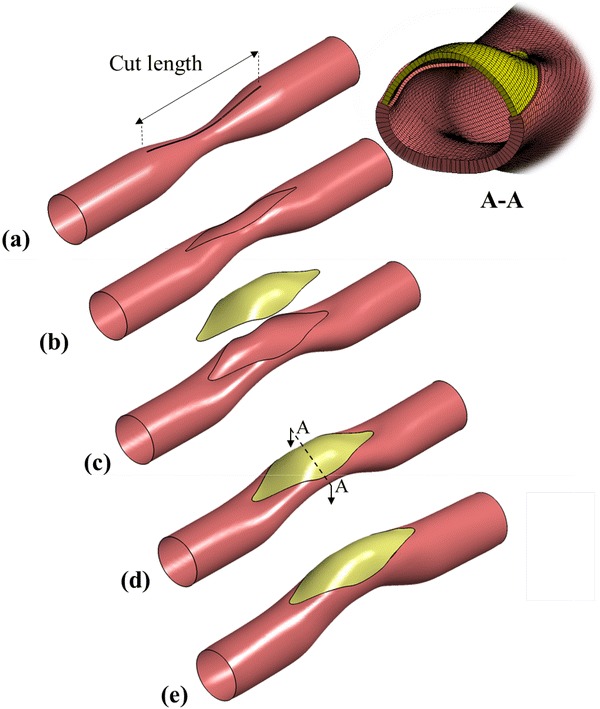
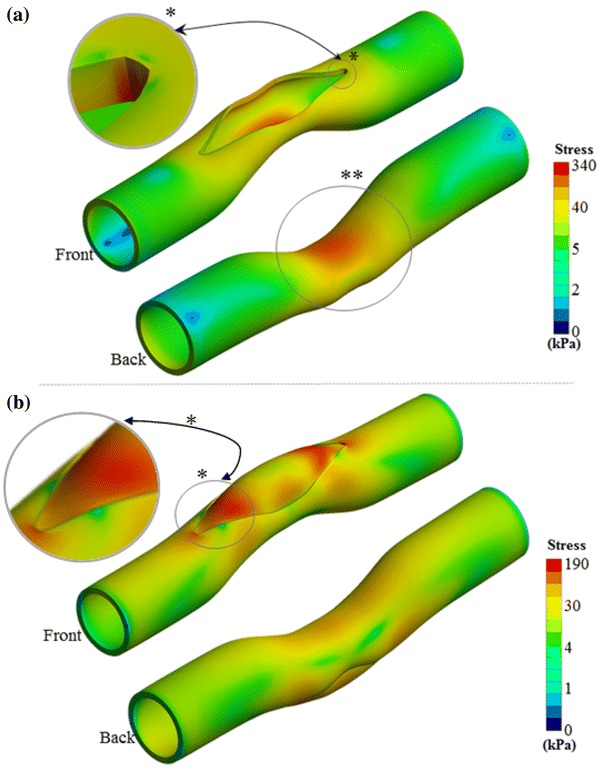
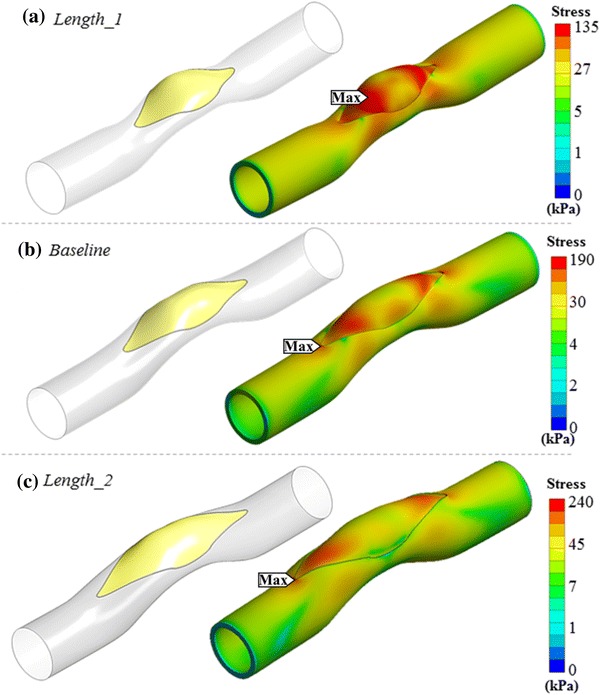
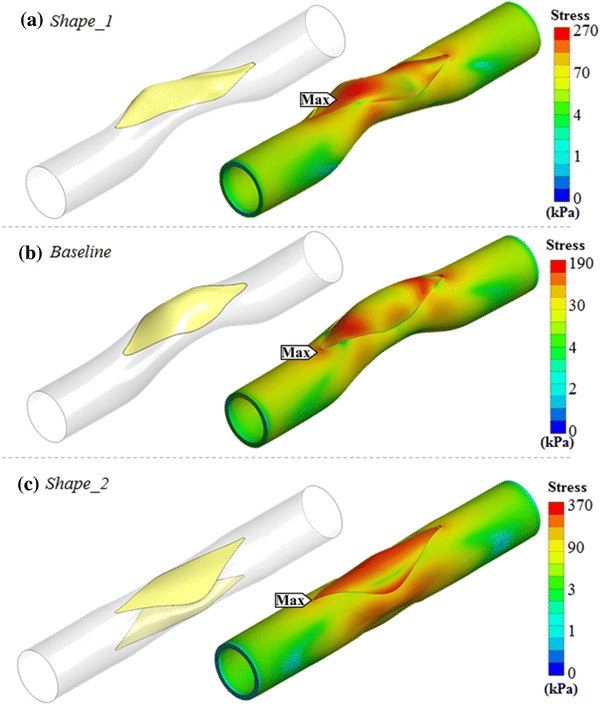
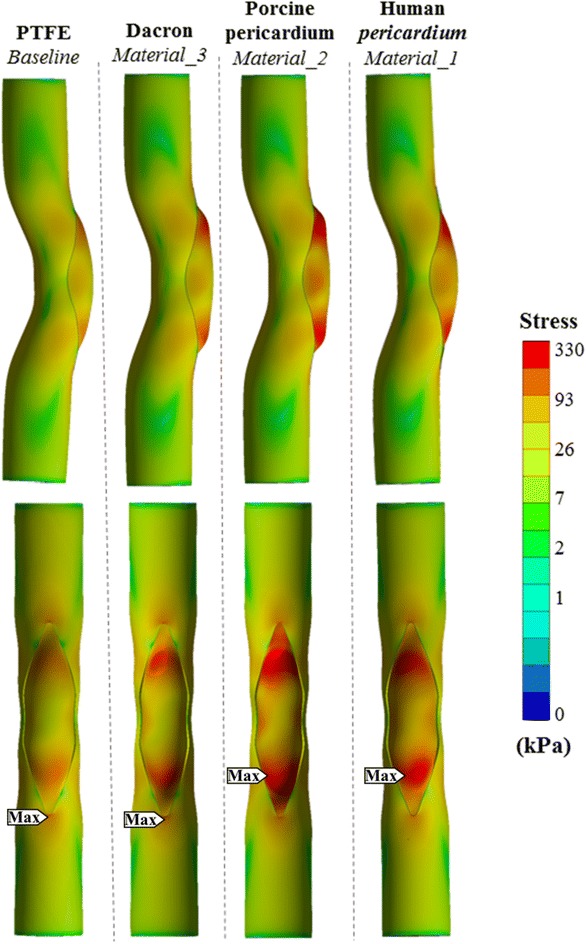
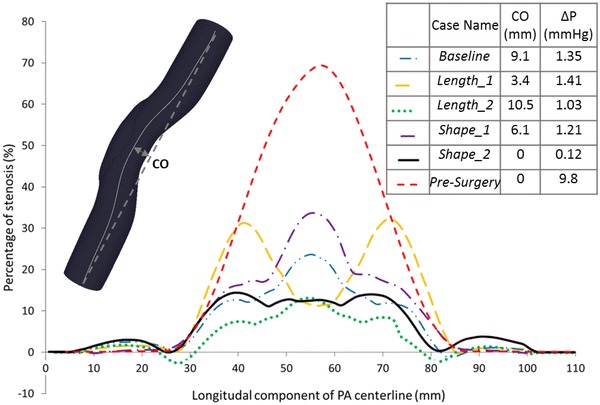
Surgical treatment of congenital heart disease (CHD) involves complex vascular reconstructions utilizing artificial and native surgical materials. A successful surgical reconstruction achieves an optimal hemodynamic profile through the graft in spite of the complex post-operative vessel growth pattern and the altered pressure loading. This paper proposes a new in silico patient-specific pre-surgical planning framework for patch reconstruction and investigates its computational feasibility. The proposed protocol is applied to the patch repair of main pulmonary artery (MPA) stenosis in the Tetralogy of Fallot CHD template. The effects of stenosis grade, the three-dimensional (3D) shape of the surgical incision and material properties of the artificial patch are investigated. The release of residual stresses due to the surgical incision and the extra opening of the incision gap for patch implantation are simulated through a quasi-static finite-element vascular model with shell elements. Implantation of different unloaded patch shapes is simulated. The patched PA configuration is pressurized to the physiological post-operative blood pressure levels of 25 and 45 mmHg and the consequent post-operative stress distributions and patched artery shapes are computed. Stress-strain data obtained in-house, through the biaxial tensile tests for the mechanical properties of common surgical patch materials, Dacron, Polytetrafluoroethylene, human pericardium and porcine xenopericardium, are employed to represent the mechanical behavior of the patch material. Finite-element model is experimentally validated through the actual patch surgery reconstructions performed on the 3D printed anatomical stenosis replicas. The post-operative recovery of the initially narrowed lumen area and post-op tortuosity are quantified for all modeled cases. A computational fluid dynamics solver is used to evaluate post-operative pressure drop through the patch-reconstructed outflow tract. According to our findings, the shorter incisions made at the throat result in relatively low local peak stress values compared to other patch design alternatives. Longer cut and double patch cases are the most effective in repairing the initial stenosis level. After the patch insertion, the pressure drop in the artery due to blood flow decreases from 9.8 to 1.35 mmHg in the conventional surgical configuration. These results are in line with the clinical experience where a pressure gradient at or above 50 mmHg through the MPA can be an indication to intervene. The main strength of the proposed pre-surgical planning framework is its capability to predict the intra-operative and post-operative 3D vascular shape changes due to intramural pressure, cut length and configuration, for both artificial and native patch materials.
先天性心脏病(CHD)的外科治疗涉及利用人工和天然外科材料进行复杂的血管重建。尽管存在复杂的术后血管生长模式和压力负荷改变,但成功的外科重建可通过移植物实现最佳血流动力学状态。本文提出了一种新的基于个体患者的补片重建术前规划框架,并研究了其计算可行性。该方案应用于法洛四联症 CHD 模型的主肺动脉(MPA)狭窄的补片修复。研究了狭窄程度、手术切口的三维(3D)形状和人工补片材料的性能对其的影响。通过壳单元的准静态有限元血管模型模拟了由于手术切口引起的残余应力释放以及为补片植入而额外打开的切口间隙。模拟了不同卸载补片形状的植入。将补片后的 PA 构型加压至 25 和 45mmHg 的生理术后血压水平,并计算相应的术后应力分布和补片动脉形状。通过对常见外科补片材料(Dacron、聚四氟乙烯、人心包和猪异种心包)的双轴拉伸试验获得的本构数据,代表补片材料的力学性能。通过在 3D 打印解剖学狭窄复制品上进行的实际补片手术重建对有限元模型进行了实验验证。对所有建模病例的初始狭窄管腔面积的术后恢复和术后迂曲进行了量化。使用计算流体动力学求解器通过补片重建的流出道评估术后压力降。根据我们的发现,与其他补片设计方案相比,在喉咙处进行较短的切口可导致相对较低的局部峰值应力值。较长的切口和双补片病例在修复初始狭窄程度方面最为有效。补片插入后,由于血流,动脉内的压力降从常规手术构型中的 9.8 降至 1.35mmHg。这些结果与临床经验一致,即 MPA 内的压力梯度为 50mmHg 或以上可能是需要干预的指征。所提出的术前规划框架的主要优势在于能够预测人工和天然补片材料由于腔内压力、切口长度和构型引起的术中及术后的 3D 血管形状变化。