Department of Biological Systems Engineering, Washington State University, PO Box 646120, Pullman, WA 99164, USA.
Center for Precision and Automated Agricultural Systems, Washington State University, 24106 North Bunn Road, Prosser, WA 99350, USA.
Sensors (Basel). 2018 May 15;18(5):1561. doi: 10.3390/s18051561.
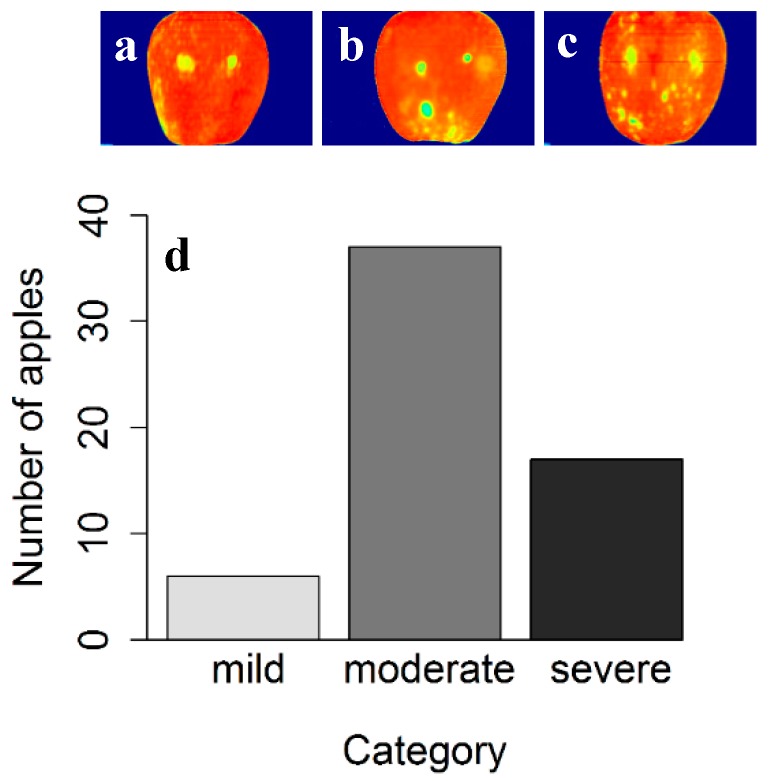
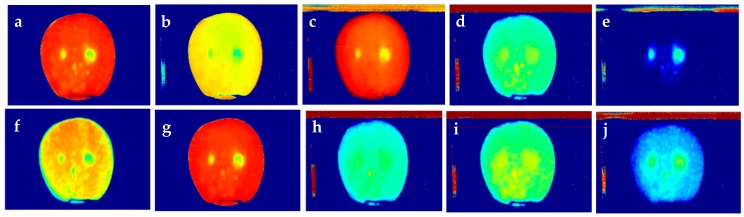
Bitter pit is one of the most important disorders in apples. Some of the fresh market apple varieties are susceptible to bitter pit disorder. In this study, visible⁻near-infrared spectrometry-based reflectance spectral data (350⁻2500 nm) were acquired from 2014, 2015 and 2016 harvest produce after 63 days of storage at 5 °C. Selected spectral features from 2014 season were used to classify the healthy and bitter pit samples from three years. In addition, these spectral features were also validated using hyperspectral imagery data collected on 2016 harvest produce after storage in a commercial storage facility for 5 months. The hyperspectral images were captured from either sides of apples in the range of 550⁻1700 nm. These images were analyzed to extract additional set of spectral features that were effective in bitter pit detection. Based on these features, an automated spatial data analysis algorithm was developed to detect bitter pit points. The pit area was extracted, and logistic regression was used to define the categorizing threshold. This method was able to classify the healthy and bitter pit apples with an accuracy of 85%. Finally, hyperspectral imagery derived spectral features were re-evaluated on the visible⁻near-infrared reflectance data acquired with spectrometer. The pertinent partial least square regression classification accuracies were in the range of 90⁻100%. Overall, the study identified salient spectral features based on both hyperspectral spectrometry and imaging techniques that can be used to develop a sensing solution to sort the fruit on the packaging lines.
苦痘病是苹果最重要的病害之一。一些新鲜市场的苹果品种容易感染苦痘病。在这项研究中,从 2014 年、2015 年和 2016 年收获的果实中采集了可见-近红外光谱反射光谱数据(350-2500nm),这些果实经过 63 天在 5°C 下储存。从 2014 年的季节中选择的光谱特征用于对三年的健康和苦痘样本进行分类。此外,这些光谱特征也使用在商业储存设施中储存 5 个月后收集的 2016 年收获果实的高光谱图像数据进行了验证。高光谱图像是在 550-1700nm 范围内从苹果的两侧采集的。对这些图像进行了分析,以提取在苦痘检测中有效的额外光谱特征集。基于这些特征,开发了一种自动空间数据分析算法来检测苦痘点。提取了坑面积,并使用逻辑回归定义了分类阈值。该方法能够以 85%的准确率对健康和苦痘苹果进行分类。最后,使用光谱仪获取的可见-近红外反射数据重新评估了高光谱图像衍生的光谱特征。偏最小二乘回归分类的相关准确率在 90-100%的范围内。总的来说,该研究基于高光谱光谱和成像技术确定了显著的光谱特征,可用于开发一种传感解决方案,以便在包装线上对水果进行分类。